Michael McNeil (@michaelemcneil) 's Twitter Profile
Michael McNeil

@michaelemcneil

A ‘Like’ or retweet in reply to Twitter tweet, Facebook post, etc., typically means ‘I appreciate this post. Thank you! It's informative or thought provoking.’

ID: 1595973950231617536

calendar_today25-11-2022 03:01:18

10,10K Tweet

1,1K Followers

970 Following

Michael McNeil (@michaelemcneil) 's Twitter Profile Photo

Today, 2025-10-18 A.D. Gregorian, is the (medieval Roman Empire's official) “Year of the Cosmos”—_Étos Kosmoú_—date 7534-02-05, or October 5 of the year 7534 ε.κ. This is the dating system employed by the medieval (so-called “Byzantine” or “East”) Roman Empire for over a

Michael McNeil (@michaelemcneil) 's Twitter Profile Photo

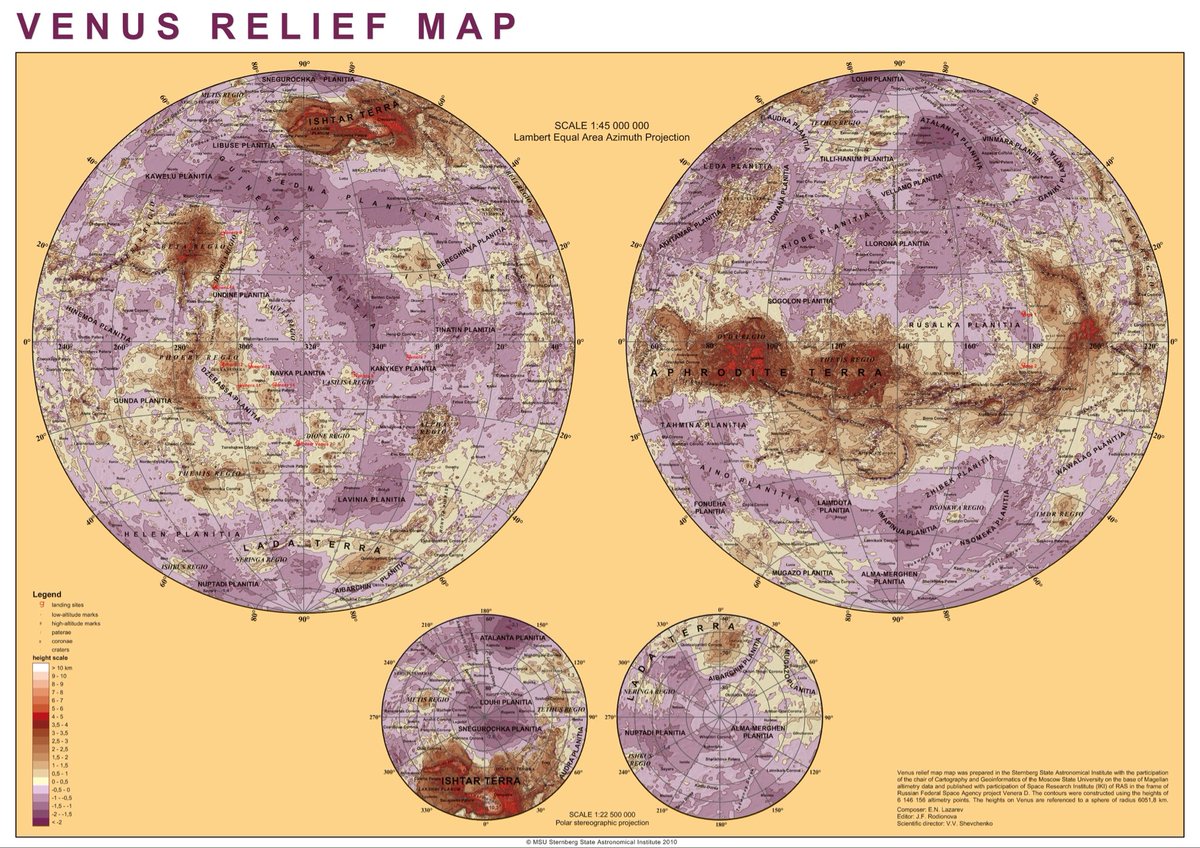
No, Venus is what happens when you're a world lacking in plate tectonics, which therefore is subject to so-called _lid tectonics_. In Venus' case, this transformed what could have been a semi-habitable world into the hellhole we see there today—not by means of any kind of a

No, Venus is what happens when you're a world lacking in plate tectonics, which therefore is subject to so-called _lid tectonics_.

In Venus' case, this transformed what could have been a semi-habitable world into the hellhole we see there today—not by means of any kind of a
Michael McNeil (@michaelemcneil) 's Twitter Profile Photo

Then there's (4) Vesta. The great asteroid Vesta's mere existence as an intact, surviving “protoplanet” from the early solar system shows which of the traditional two theories of how the asteroid belt came to be is correct. Vesta is also a giant, matched only by Ceres—the latter

Michael McNeil (@michaelemcneil) 's Twitter Profile Photo

Let's see just how (angularly) “big” 3I/ATLAS is from the perspective of Mars. y = diameter = 3 km (comet nucleus) x = distance = 30 • 10^6 km θ = arctan( y/x ) θ = arctan( 3 km / 30 • 10^6 km ) θ = arctan( 10^-7 ) θ = 5.729578… • 10^-6 ° θ = 0° 0' 0.02062648…" θ = ~0.02"

Michael McNeil (@michaelemcneil) 's Twitter Profile Photo

There are obviously _no_ pics (pics worth a damn, that is) of 3I/ATLAS's nucleus. The fact is that _no_ telescope in space or on earth possesses an angular resolution great enough so as to be capable of obtaining more than a _single pixel_ out of 3I/ATLAS's _3-kilometer (2-mile)

Michael McNeil (@michaelemcneil) 's Twitter Profile Photo

“The surface gravity of the moon is only one-sixth that of the Earth.” That's supposed to make it easy? Rather, the lesser lunar gravity is almost irrelevant if one is trying to balance while maneuvering around enveloped by an encumberance as unwieldy as those lunar spacesuits.

Michael McNeil (@michaelemcneil) 's Twitter Profile Photo

I see that I can't easily find information about (e.g.) the U.S. Supreme Court "Heller" decision at Grokipedia by just searching for "Heller case" or even "Heller case Supreme Court". I can, of course, do so at Wikipedia. What's up with that, Grokipedia?


Brian Cox (@profbriancox) 's Twitter Profile Photo

Here is a great summary of what is known and what is unusual / usual about comet 3I/ATLAS from Jason Wright at Penn State - I don’t think he’s on X. The headline is ‘It’s Obviously a Comet’. sites.psu.edu/astrowright/20…

Michael McNeil (@michaelemcneil) 's Twitter Profile Photo

Just completed a whole-globe rotation animation covering the same two days bracketing the southern summer solstice that I'd previously encompassed in a cropped-down excerpt only showing Antarctica and the Southern Ocean. Flat-earthers deny that a 24-hr sun in Antarctica exists.

🚀conspiracy_slayer🌕 (@conspiracyslyr) 's Twitter Profile Photo

New Crater on the Moon The crater is 22 m wide, lies north of Römer crater (at 26.1941° N, 36.1212° E) and formed between 2009 and 2012. lroc.im-ldi.com/images/1464