
Environment China (@envirochina) 's Twitter Profile
Environment China

@envirochina

A bi-weekly podcast featuring fresh voices in China’s environmental field. Free stream and download: bit.ly/2oDZegU

ID: 838294536942055424

linkhttp://beijingenergynetwork.com/environment-china-podcast calendar_today05-03-2017 07:46:07

251 Tweet

525 Followers

100 Following

Anders Hove (@derznovich) 's Twitter Profile Photo

Environment China is back for its first episode of 2022! In this episode, I host experts and researchers looking at data center power consumption and flexibility for integrating renewables, the topic of a Energy Transition in China report. (We get a bit technical!)

Environment China (@envirochina) 's Twitter Profile Photo

Some rare good news, we need more RE companies/investors to realize the value in buying up legacy fossil fuel companies, using their assets for good, and shutting off their toxic lobbying campaigns.

@pfairley.bsky.social (@pfairley) 's Twitter Profile Photo

This ain't about renewables folks. "We see strong elements of ‘artificial tightness’ in European gas markets, which appears to be due to the behaviour of Russia’s state-controlled gas supplier.“

Anders Hove (@derznovich) 's Twitter Profile Photo

Environment China continues to dive deep, this time into the solar supply chain with Andy Klump! Podcast here: environmentchinapodcast.com/podcast/episod…

China Environment Forum 中国环境论坛 (@wilsoncef) 's Twitter Profile Photo

Will China be able to dethrone old king coal? Check out the latest blog by our own, @elijpatton on this week's New Security Beat China's "New Energy Cloud" READ: newsecuritybeat.org/2022/01/chinas…
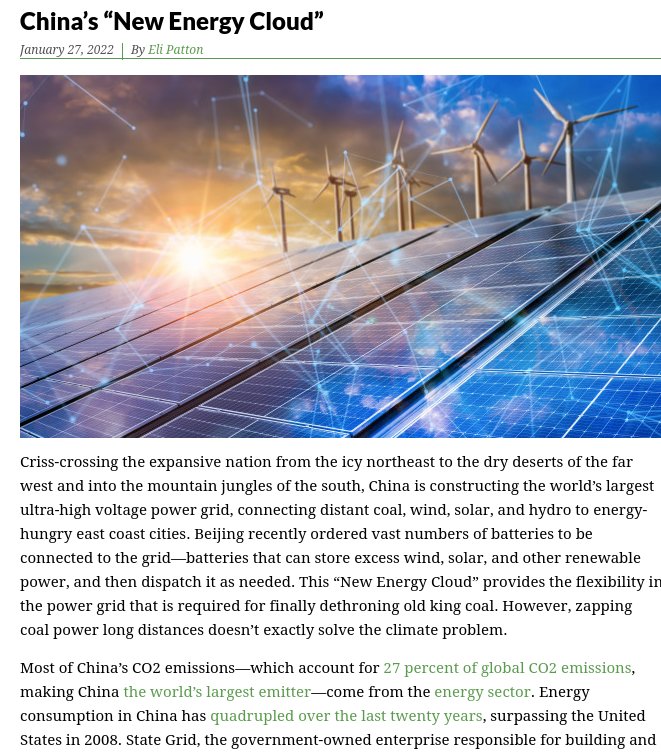

Will China be able to dethrone old king coal?

Check out the latest blog by our own, @elijpatton on this week's <a href="/NewSecurityBeat/">New Security Beat</a> 

China's "New Energy Cloud"

READ: 
newsecuritybeat.org/2022/01/chinas…
Tristan Edis (@tristanedis) 's Twitter Profile Photo

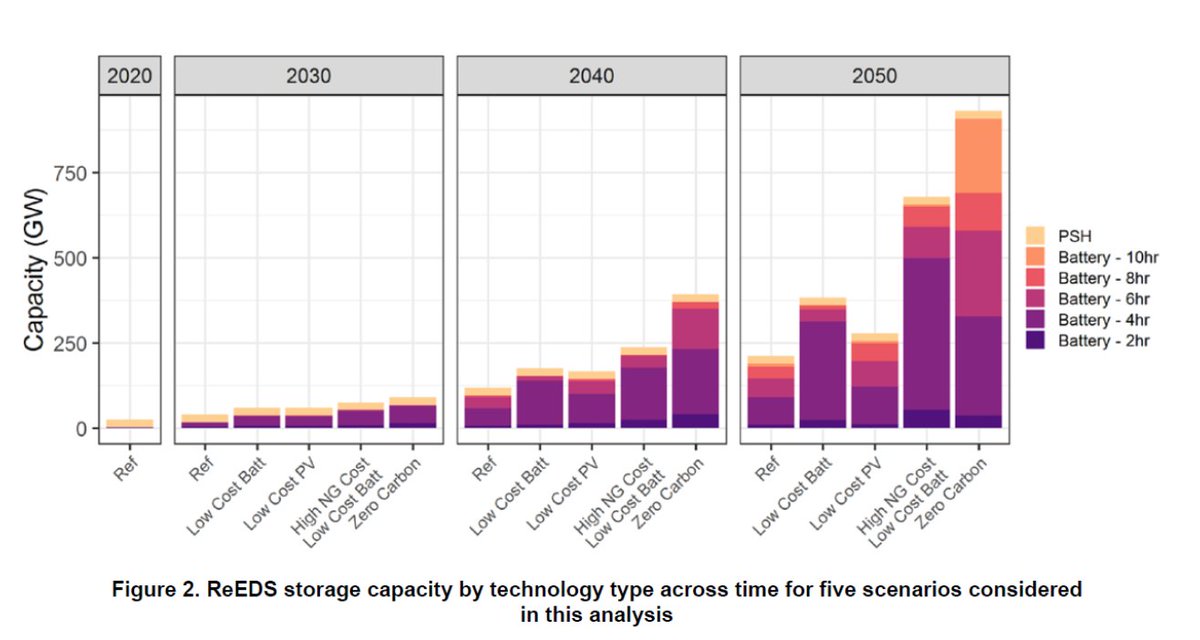
NREL has released report looking at future energy storage needs for US electricity system. It finds little need for energy storage beyond 6 hours of duration until 2040's when grid reaches 90%+ renewables. Similar AEMO's ISP modelling for Australian east coast grid.

NREL has released report looking at future energy storage needs for US electricity system. It finds little need for energy storage beyond 6 hours of duration until 2040's when grid reaches 90%+ renewables. 
Similar AEMO's ISP modelling for Australian east coast grid.
EVsmart (@evsmartnet) 's Twitter Profile Photo

Overview: China’s new energy heavy-duty truck market in 2021 | EVsmart Blog bit.ly/3GQJVoF China saw 199% rise in NEV tucks sales in 2021, and there are more and more electric trucks with battery swapping technology on the road. Lei Xing discusses the latest situation.

Michael Pettis (@michaelxpettis) 's Twitter Profile Photo

8/8 That's the problem. It is easy to talk about what these countries might want to do if we assume that there is an infinite ability for the world to absorb their savings imbalances, but there isn't.

Unearthed (@ue) 's Twitter Profile Photo

WATCH | Here's one of ExxonMobil's (now former) top lobbyists explaining to an undercover reporter how he lobbied Congress to protect Exxon's huge investments in Russian oil and gas from US sanctions, following Putin's annexation of Ukraine in 2014.

Daniel M Kammen (@dan_kammen) 's Twitter Profile Photo

Given the regular routes of U.S. Postal Service it is crazy not to electrify the full fleet. Just ask Secretary Jennifer Granholm & Secretary Pete Buttigieg !! Oh, and ask @OMBPress, too. It is also a #RussianAggression response strategy, too.

Lauri Myllyvirta (@laurimyllyvirta) 's Twitter Profile Photo

Energy intensity target will be "assessed flexibly" over the 2021-25 period, meaning no firm target is set or at least published for 2022. Push for higher GDP means more construction, more heavy industry output, more energy intensive econ structure, undermining intensity gains.

Tim Latimer (@timmlatimer) 's Twitter Profile Photo

Advocating for smart energy policy is hard. Pre-crisis, it’s “too expensive” and not a priority. During a crisis, it’s “too slow” and not a priority. We need to learn better from history and not keep repeating the same mistakes, especially now when we have more tools than ever.