London Wealthiest (@eniobanke_gcfr) 's Twitter Profile
London Wealthiest

@eniobanke_gcfr

Certified CloudDigital Leader|| Fintech Strategist|| Project Manager

ID: 1901884382

calendar_today24-09-2013 21:45:47

1,1K Tweet

277 Followers

649 Following

Defense News Nigeria (@defensenigeria) 's Twitter Profile Photo

We have an advanced training system that produces top tier pilots. What we now need is a sizable fleet of hard hitting assets to provide real strategic depth...enough to turn the Lake Chad islands, where ISWAP terrorists retreat to rest, regroup and plan attacks, into nothing but

London Wealthiest (@eniobanke_gcfr) 's Twitter Profile Photo

I changed a key phrase in KinCart: “contribution visible” → “shared intent visible.” Why: “contribution” invites scorekeeping. “Shared intent” keeps coordination visible without judging people. Invariant protected: emotional safety > optimisation. Next: every UI label +

London Wealthiest (@eniobanke_gcfr) 's Twitter Profile Photo

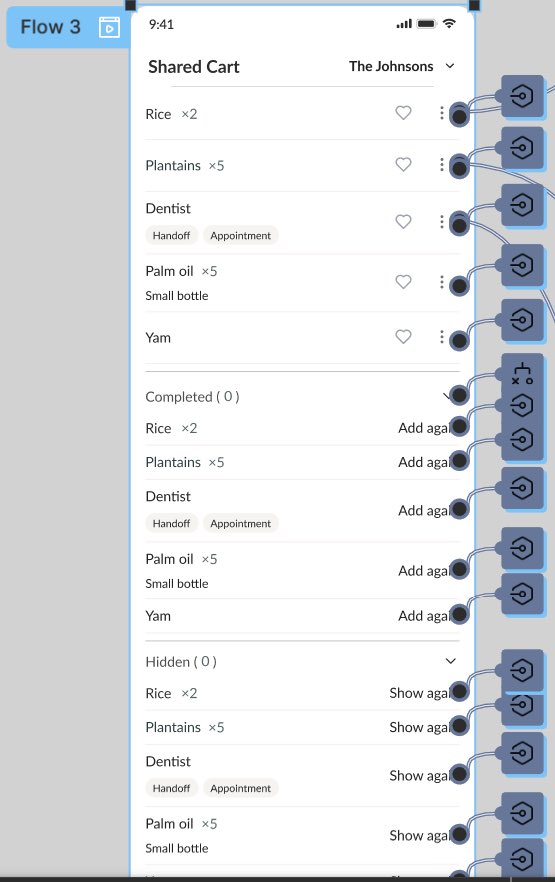
“Complete item” is reversible by default. In KinCart, Complete item hides an Item from the Shared Cart without making it feel final. If it comes back, you tap Add again. Shared intent stays visible. No pressure language. #HCI #CSCW #ProductDesign

London Wealthiest (@eniobanke_gcfr) 's Twitter Profile Photo

Decision log #3 Identity is system-owned, not social proof. In KinCart, Activity isn’t a performance feed. It’s a readable record of shared intent. So identity is handled carefully: • “Member” or “Former member” (system-owned) • no public attribution by default •

London Wealthiest (@eniobanke_gcfr) 's Twitter Profile Photo

Decision log: Gratitude is item-scoped, not a feed mechanic In KinCart, “Hearts” are deliberately not a social currency. • Hearts live on the Item, not the person. • No counts by default. No leaderboard energy. • Visibility goal: “someone appreciated this” without

London Wealthiest (@eniobanke_gcfr) 's Twitter Profile Photo

Most coordination tools drift from visibility into pressure. In my HCI/CSCW research (KinCart), I’m treating refusal as a design variable: • no reminders • no scoring • no blame-attributing logs So we can study how people interpret coordination cues during breakdown &

London Wealthiest (@eniobanke_gcfr) 's Twitter Profile Photo

Today’s KinCart win: ‘Complete item’ does not mean gone. It means hidden from the active list, reversible, and system-owned. Small wording, big safety effect.

London Wealthiest (@eniobanke_gcfr) 's Twitter Profile Photo

I spent today removing logic, not adding it. In KinCart, completion isn’t “done forever.” It’s “out of view,” with a clear way back. I’m testing whether reversibility changes how mistakes are interpreted.

London Wealthiest (@eniobanke_gcfr) 's Twitter Profile Photo

Self-taught Figma to build KinCart research materials (probe, not product). Not findings. Studying visibility-to-enforcement drift in household coordination: how shared visibility cues get read as pressure. Constraints: no reminders, nudges, scoring, urgency. Activity stays a

Self-taught Figma to build KinCart research materials (probe, not product). Not findings.

Studying visibility-to-enforcement drift in household coordination: how shared visibility cues get read as pressure.

Constraints: no reminders, nudges, scoring, urgency. Activity stays a
London Wealthiest (@eniobanke_gcfr) 's Twitter Profile Photo

The tension: visibility can help, but certain cues get read as accountability pressure, surveillance, or judgement, especially when breakdown happens and people try to repair.