Christian Bokhove (@cbokhove) 's Twitter Profile
Christian Bokhove

@cbokhove

Professor in Mathematics Education, Director of Research, @MASEsoton, TIMSS+PISA, Research Methods, R, School Mathematics Project, Grumpy Middle-Aged Man

ID: 139020599

linkhttp://www.bokhove.net calendar_today01-05-2010 09:11:41

178,178K Tweet

6,6K Followers

2,2K Following

Christian Bokhove (@cbokhove) 's Twitter Profile Photo

Also in the column: artificial distinctions between ‘types of education research’…education psychology is education research, economics of education is education research, sociology of education is education research, instructional science is education research, etc etc

Christian Bokhove (@cbokhove) 's Twitter Profile Photo

Mr E 🇬🇧 oliver caviglioli I think this has often been presented as 'one or the other', when you do both. In edubooks I have seen comparisons with sports that fell down. Yes, you train sub-skills. But you also play full games. E.g. in languages conversations.

Christian Bokhove (@cbokhove) 's Twitter Profile Photo

It's ironic that at the same time a lot of the increased volume in education research has become more accessible (Open Access), the increased volume in edubooks is mainly behind a paywall.

Christian Bokhove (@cbokhove) 's Twitter Profile Photo

Yes, the criticism 'so little was new' does not just apply to the (shorter) history of edubooks but also knowledge of education research in general. Reason why I had to correct the record on Bruner - tes.com/magazine/teach…

Christian Bokhove (@cbokhove) 's Twitter Profile Photo

I like this example. Medical analogies for education research often refer to A/B RCTs and 'what works' as if it medicine. But medical research is much more than that. Kloen and I tried to broaden the analogy with the function of a prescription (Dutch). slideshare.net/slideshow/evid…

Christian Bokhove (@cbokhove) 's Twitter Profile Photo

I agree with this, mentioned it numerous times in my columns. Find 'education research' overly specific. It's a general problem. And I will point out that some of the 'biggest hits' who suffer from this (en.g. Rosenshine, Nuthall) often get benefit of doubt.

Christian Bokhove (@cbokhove) 's Twitter Profile Photo

Drew Perkins There are so many examples but will continue to add to this one. From today. Stockard (D.I. in the Becker-Engelmann tradition) next to Rosenshine etc. If it's positive evidence, treated as 'the same'. researchandeducation.ro/2025/06/30/dis…
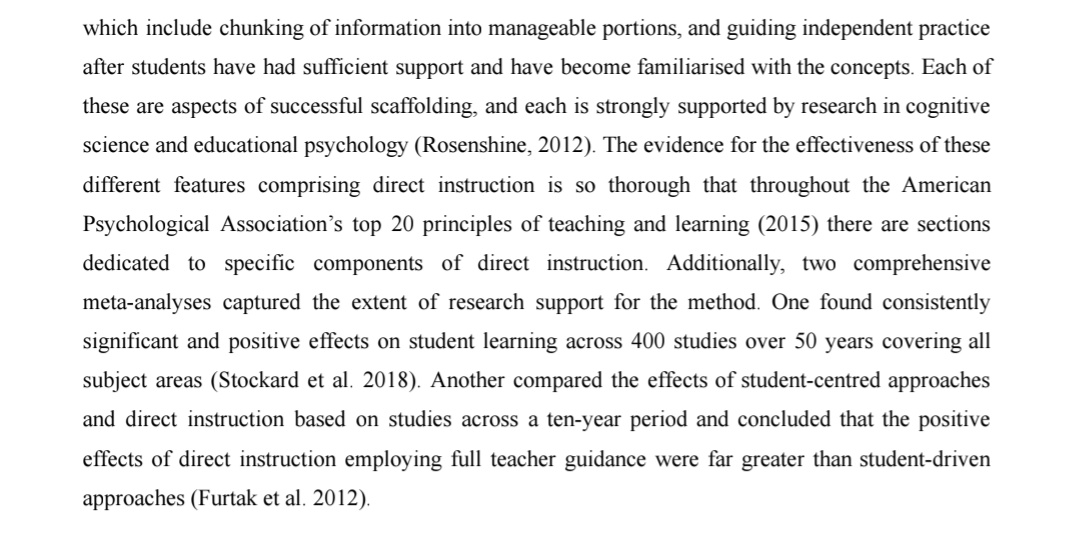

<a href="/dperkinsed/">Drew Perkins</a> There are so many examples but will continue to add to this one. From today. Stockard (D.I. in the Becker-Engelmann tradition) next to Rosenshine etc. If it's positive evidence, treated as 'the same'.
researchandeducation.ro/2025/06/30/dis…

Christian Bokhove (@cbokhove) 's Twitter Profile Photo

Interesting, but "our main outcome of interest was the first plausible value" - clearly, even in this journal, reviewers do not seem to know you should include all plausible values, otherwise you risk underestimating standard errors.

Christian Bokhove (@cbokhove) 's Twitter Profile Photo

There was an item in my calendar for an online meeting that I could not place at all anymore, also without online link. Apologies if I forgot a meeting with a 'Hughes'. 😇

Christian Bokhove (@cbokhove) 's Twitter Profile Photo

Despite its issues I see a lot of potential in AI in research. However, I get the impression that researchers are putting out research on AI far too quickly in attempts to be original.