
CSIS Critical Minerals Security Program (@csisminerals) 's Twitter Profile
CSIS Critical Minerals Security Program

@csisminerals

Developing policy solutions to build resilient critical minerals supply chains needed for national and energy security and economic competitiveness.

ID: 1840862491317854208

calendar_today30-09-2024 21:13:35

21 Tweet

268 Takipçi

305 Takip Edilen

CSIS Critical Minerals Security Program (@csisminerals) 's Twitter Profile Photo

What's the role of Australia's new $1.2 billion strategic reserve for critical minerals in its minerals security ambitions? Ambassador Kevin Rudd AC discusses with Gracelin Baskaran. The purpose of the reserve is to ensure that Australia can meet its own national security needs and

CSIS Critical Minerals Security Program (@csisminerals) 's Twitter Profile Photo

Is U.S.-Australia collaboration the answer to China’s critical minerals dominance? Ambassador Kevin Rudd AC argues yes, given the U.S. and Australia are both driving a whole-of-government approach—backed by industry, capital, and public investment—to build stronger, shared supply

CSIS Critical Minerals Security Program (@csisminerals) 's Twitter Profile Photo

Episode 5 of Mapping Minerals Diplomacy is live and this week, we turn to Australia. Australia remains one of America's closest allies and partners, having been the only country to fight alongside the U.S. in every major war since 1918. It's also a mineral powerhouse. With over

Episode 5 of Mapping Minerals Diplomacy is live and this week, we turn to Australia. Australia remains one of America's closest allies and partners, having been the only country to fight alongside the U.S. in every major war since 1918. It's also a mineral powerhouse. With over
CSIS Critical Minerals Security Program (@csisminerals) 's Twitter Profile Photo

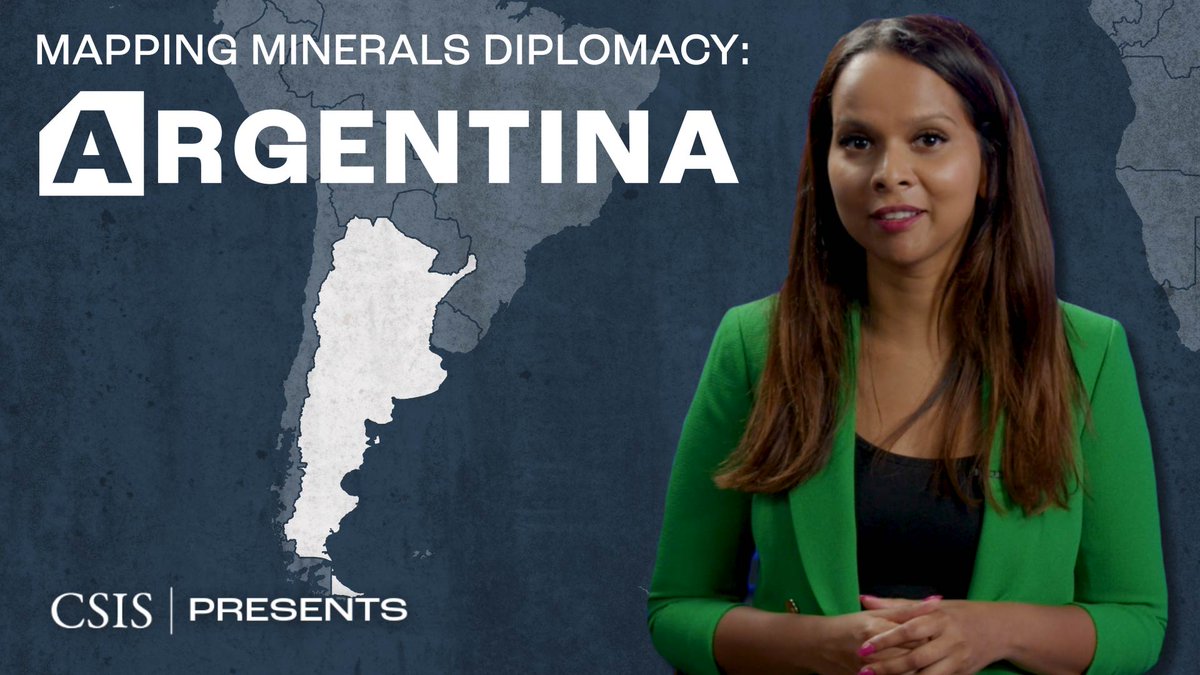
A new episode of Mapping Minerals Diplomacy is out—this time spotlighting Argentina. With world-class reserves of copper and lithium, Argentina is fast becoming one of the most dynamic frontiers for critical minerals—and could soon power the next wave of AI data centers. In this

A new episode of Mapping Minerals Diplomacy is out—this time spotlighting Argentina. With world-class reserves of copper and lithium, Argentina is fast becoming one of the most dynamic frontiers for critical minerals—and could soon power the next wave of AI data centers.

In this
CSIS Critical Minerals Security Program (@csisminerals) 's Twitter Profile Photo

Argentina is emerging as one of the world’s hottest mineral exploration frontiers. Exploration budgets have quadrupled—from $124M in 2015 to nearly $500M in 2024. Lithium exploration spending has skyrocketed from just $3.4M in 2015 to almost $140M in 2023, while copper has

CSIS Critical Minerals Security Program (@csisminerals) 's Twitter Profile Photo

Argentina is doubling down on investment incentives to unlock its mining potential. Since 1993, the country has had a regime specifically designed to promote mining investment—allowing companies to import capital goods without tariffs or duties. Now, as of July 2024, Argentina

CSIS Critical Minerals Security Program (@csisminerals) 's Twitter Profile Photo

Argentina is rolling out bold new incentives to attract mining investment—and global majors are taking notice. The new regime guarantees: 30 years of tax credits, reduced customs duties, progressive easing of capital controls, and access to international dispute courts. The

CSIS Critical Minerals Security Program (@csisminerals) 's Twitter Profile Photo

What makes Argentina a crucial partner for the U.S. in enhancing its minerals security strategy? 1️⃣ The U.S. and Argentina maintain a strong trade relationship, with a $6.5 billion trade balance in favor of the United States. 2️⃣ The U.S. cannot meet its rising copper demand

CSIS Critical Minerals Security Program (@csisminerals) 's Twitter Profile Photo

A new episode of Mapping Minerals Diplomacy is here and today, we look at the Partnership for Global Infrastructure and Investment (PGI). PGI is considered one of the U.S.'s most powerful tools in minerals diplomacy. Launched by the G7, PGI aims to mobilize $600 billion by 2027

A new episode of Mapping Minerals Diplomacy is here and today, we look at the Partnership for Global Infrastructure and Investment (PGI). PGI is considered one of the U.S.'s most powerful tools in minerals diplomacy. Launched by the G7, PGI aims to mobilize $600 billion by 2027
CSIS Critical Minerals Security Program (@csisminerals) 's Twitter Profile Photo

Since 2013, China’s Belt and Road Initiative has funneled nearly $96 billion into the metals and mining sector, reaching a record $12.6 billion in 2024 alone. More than half of that investment was concentrated in mineral-rich regions like Indonesia, the DRC, Peru, and Guinea.

CSIS Critical Minerals Security Program (@csisminerals) 's Twitter Profile Photo

The Lobito Corridor is a transformative PGI project connecting Angola, Zambia, and the DRC to global markets. By upgrading 1,289 km of rail and adding 350 miles of new track in Zambia, the corridor will offer a faster route for critical minerals like copper, cobalt, lithium, and

CSIS Critical Minerals Security Program (@csisminerals) 's Twitter Profile Photo

Building the infrastructure for a resilient critical minerals supply chain is capital intensive. By joining forces, institutions like the U.S. International Development Finance Corporation and Export-Import Bank can catalyze private capital, speed up progress, and deliver shared

CSIS Critical Minerals Security Program (@csisminerals) 's Twitter Profile Photo

The first $5 billion invested in the Lobito Corridor didn’t fund mining directly - but sustained U.S. commitment and strong engagement from partner countries are now driving fresh interest in the corridor’s mining jurisdictions, particularly Zambia and the DRC. From new

CSIS Critical Minerals Security Program (@csisminerals) 's Twitter Profile Photo

The Lobito Corridor and the Partnership for Global Infrastructure and Investment (PGI) are reshaping the future of minerals diplomacy. This isn’t just about investing in commodities; it's about unlocking broader economic development opportunities across regions. By linking

CSIS Critical Minerals Security Program (@csisminerals) 's Twitter Profile Photo

A new episode of Mapping Minerals Episode has dropped! This week we spotlight Kazakhstan - the world’s top uranium producer and a pivotal player in global nuclear energy security. Meirzhan Yussupov, CEO of the Kazatomprom, joins Gracelin Baskaran to discuss: 🔹 How Kazakhstan

A new episode of Mapping Minerals Episode has dropped! This week we spotlight Kazakhstan - the world’s top uranium producer and a pivotal player in global nuclear energy security. Meirzhan Yussupov, CEO of the <a href="/NAC_Kazatomprom/">Kazatomprom</a>, joins <a href="/GraceBaskaran/">Gracelin Baskaran</a> to discuss:
🔹 How Kazakhstan
CSIS Critical Minerals Security Program (@csisminerals) 's Twitter Profile Photo

New episode of Mapping Minerals Diplomacy! The signing of the U.S.-Ukraine Joint Reconstruction Investment Fund marked a turning point in efforts to rebuild Ukraine’s economic security and integrate its vast mineral reserves – which are among the largest in Europe - into allied

New episode of Mapping Minerals Diplomacy! The signing of the U.S.-Ukraine Joint Reconstruction Investment Fund marked a turning point in efforts to rebuild Ukraine’s economic security and integrate its vast mineral reserves – which are among the largest in Europe - into allied
CSIS Critical Minerals Security Program (@csisminerals) 's Twitter Profile Photo

America’s true strength lies in its ingenuity. As global copper ore grades decline and conventional processing struggles to keep pace, Brandon Craig, President of BHP Americas, highlights how U.S. innovation—powered by its venture capital ecosystem—can unlock breakthrough

CSIS Critical Minerals Security Program (@csisminerals) 's Twitter Profile Photo

Brandon Craig, President of BHP Americas notes that Resolution Copper has the potential to supply up to a quarter of the U.S.’ copper needs based on current demand, and given its size and high ore grades, will have a substantial impact on U.S supply chain security. Watch the

CSIS Critical Minerals Security Program (@csisminerals) 's Twitter Profile Photo

Global uranium demand for nuclear reactors is set to surge nearly 30% within five years. Yet as demand rises, U.S. nuclear production is slowing — and by 2030, China is projected to lead in global nuclear capacity. In this shifting landscape, Kazakhstan’s role is pivotal.

CSIS Critical Minerals Security Program (@csisminerals) 's Twitter Profile Photo

Leaders from the United States and five Central Asian states – Kazakhstan, the Kyrgyz Republic, Tajikistan, Turkmenistan, and Uzbekistan – met today for the C5+1 Summit. With China and Russia rapidly expanding their reach across the region’s mining, processing, and infrastructure

Leaders from the United States and five Central Asian states – Kazakhstan, the Kyrgyz Republic, Tajikistan, Turkmenistan, and Uzbekistan – met today for the C5+1 Summit. With China and Russia rapidly expanding their reach across the region’s mining, processing, and infrastructure