Can Demircan (@can_demircann) 's Twitter Profile
Can Demircan

@can_demircann

phd student @cpilab working on machine learning/cognitive science

ID: 1623247942327930880

linkhttps://candemircan.github.io calendar_today08-02-2023 09:10:53

32 Tweet

95 Takipçi

261 Takip Edilen

Tankred Saanum (@tankredsaanum) 's Twitter Profile Photo

Object slots are great for compositional generalization, but can models without these inductive biases learn compositional representations without supervision too? Yes! Unsupervised learning on object videos yields entangled, yet compositional latent codes for objects!

Marcel Binz (@marcel_binz) 's Twitter Profile Photo

Excited to announce Centaur -- the first foundation model of human cognition. Centaur can predict and simulate human behavior in any experiment expressible in natural language. You can readily download the model from Hugging Face and test it yourself: huggingface.co/marcelbinz/Lla…

Alireza Modirshanechi (@modirshanechi) 's Twitter Profile Photo

🚨Preprint alert🚨 In an amazing collaboration with Gruaz Lucas, Sophia Becker, & J Brea, we explored a major puzzle in neuroscience & psychology: *What are the merits of curiosity⁉️* osf.io/preprints/psya… 1/7

Tankred Saanum (@tankredsaanum) 's Twitter Profile Photo

Super excited to be going to #NeurIPS to present new work on softly state-invariant world models! We introduce an info bottleneck making world models represent action effects more consistently in latent space, improving prediction and planning! Reach out if you want to meet!

Super excited to be going to #NeurIPS to present new work on softly state-invariant world models! We  introduce an info bottleneck making world models represent action effects more consistently in latent space, improving prediction and planning! Reach out if you want to meet!
Tankred Saanum (@tankredsaanum) 's Twitter Profile Photo

Super happy that this has been accepted to ICLR 2026 ! Me and Can Demircan will be there to talk about what we can learn about in-context learning using SAEs See you in Singapore 🇸🇬

Luca Schulze Buschoff (@lucaschubu) 's Twitter Profile Photo

In previous work we found that VLMs fall short of human visual cognition. To make them better, we fine-tuned them on visual cognition tasks. We find that while this improves performance on the fine-tuning task, it does not lead to models that generalize to other related tasks:

In previous work we found that VLMs fall short of human visual cognition. To make them better, we fine-tuned them on visual cognition tasks. We find that while this improves performance on the fine-tuning task, it does not lead to models that generalize to other related tasks:
Alireza Modirshanechi (@modirshanechi) 's Twitter Profile Photo

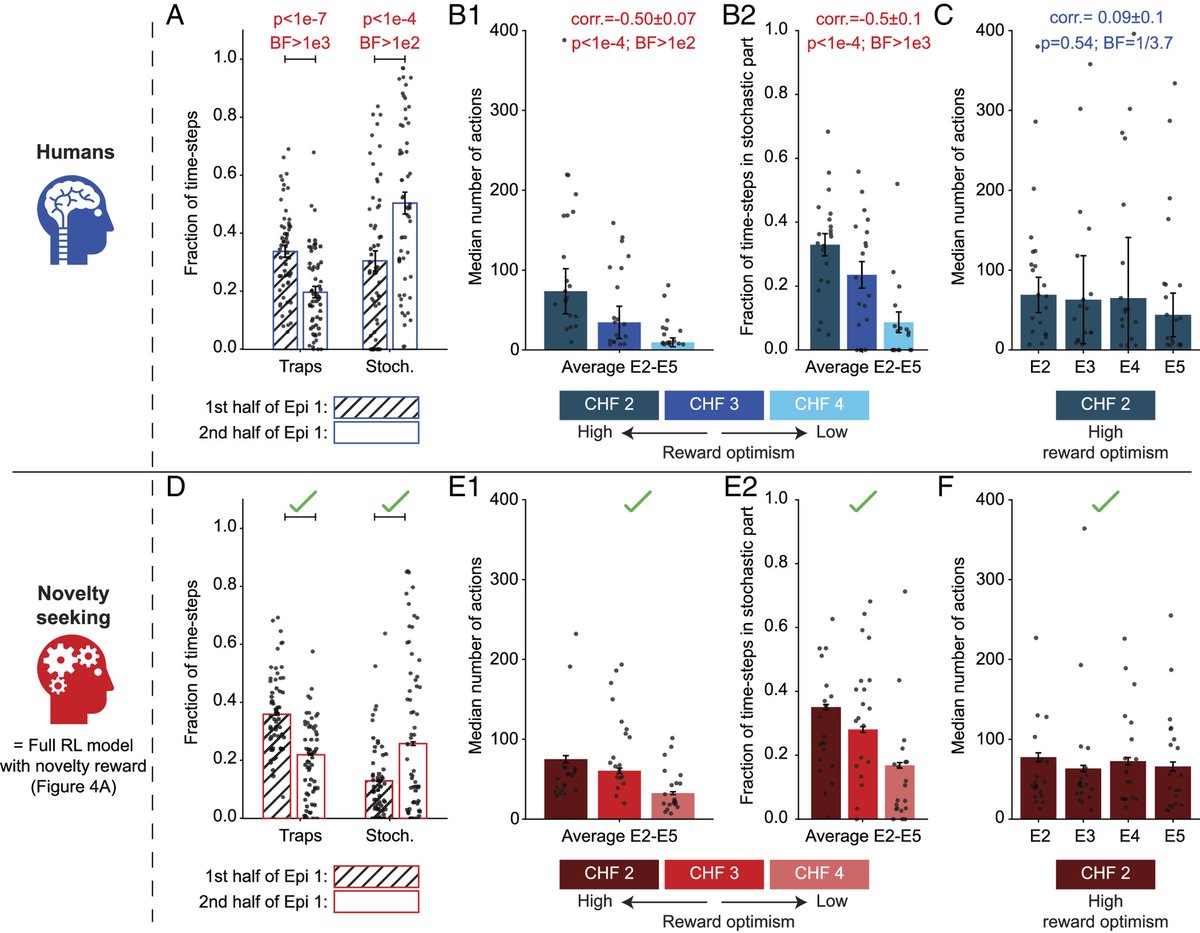
New in PNASNews: doi.org/10.1073/pnas.2… We study how humans explore a 61-state environment with a stochastic region that mimics a “noisy-TV.” Results: Participants keep exploring the stochastic part even when it’s unhelpful, and novelty-seeking best explains this behavior.

New in <a href="/PNASNews/">PNASNews</a>: doi.org/10.1073/pnas.2…

We study how humans explore a 61-state environment with a stochastic region that mimics a “noisy-TV.”

Results: Participants keep exploring the stochastic part even when it’s unhelpful, and novelty-seeking best explains this behavior.
Can Demircan (@can_demircann) 's Twitter Profile Photo

Turns out some induction heads are very good at learning hierarchical sequences. Check out our work below on the mechanisms behind this!