Brandon Amos (@brandondamos) 's Twitter Profile
Brandon Amos

@brandondamos

research scientist @MetaAI (FAIR) | optimization, machine learning, control, transport | PhD from @SCSatCMU

ID: 2303004390

linkhttp://bamos.github.io calendar_today21-01-2014 12:23:31

4,4K Tweet

18,18K Takipçi

2,2K Takip Edilen

Thomas Lew (@thomas__lew) 's Twitter Profile Photo

I'm excited to share new optimality conditions for nonlinear stochastic optimal control, and the first indirect shooting method for solving these problems! 📖 arxiv.org/abs/2502.06726 💡 How? Using rough path theory ⬇️

Ruilong Li (@ruilong_li) 's Twitter Profile Photo

For everyone interested in precise 📷camera control 📷 in transformers [e.g., video / world model etc] Stop settling for Plücker raymaps -- use camera-aware relative PE in your attention layers, like RoPE (for LLMs) but for cameras! Paper & code: liruilong.cn/prope/

For everyone interested in precise 📷camera control 📷 in transformers [e.g., video / world model etc]

Stop settling for Plücker raymaps -- use camera-aware relative PE in your attention layers, like RoPE (for LLMs) but for cameras! 

Paper & code: liruilong.cn/prope/
Jiaxin Shi (@thjashin) 's Twitter Profile Photo

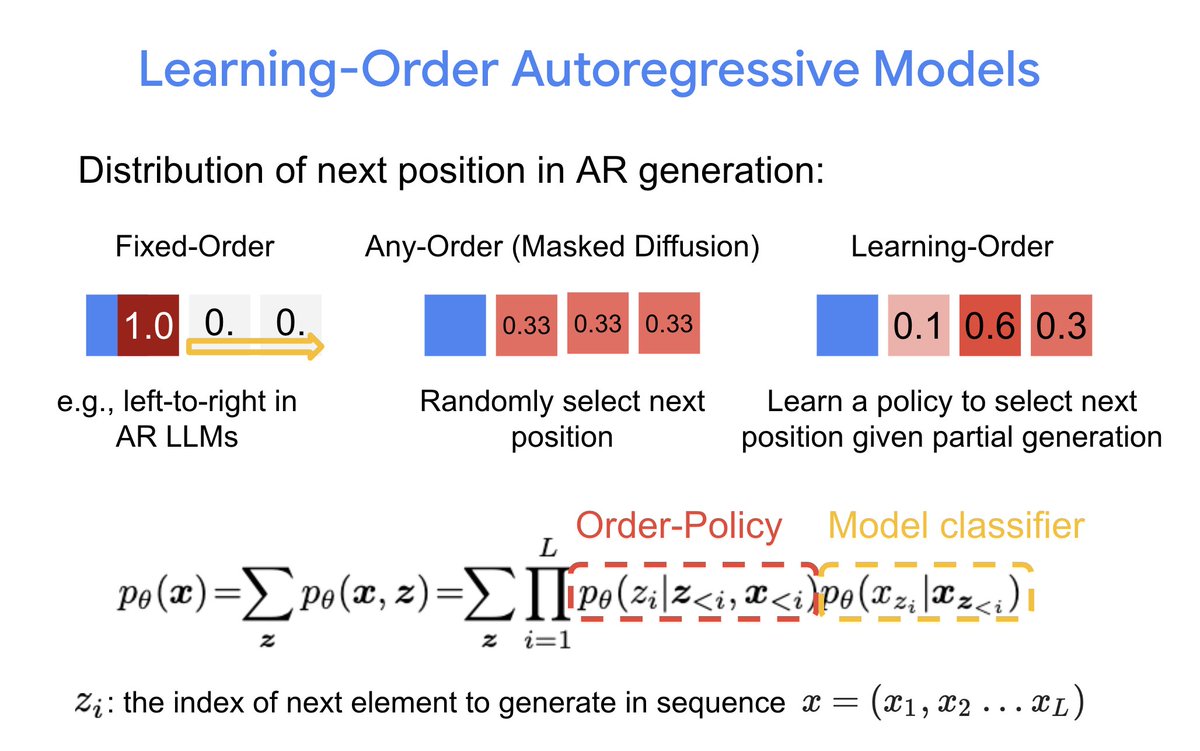
Autoregressive models are too restrictive by forcing a fixed generation order, while masked diffusion is wasteful as it fits all possible orders. Can our model dynamically decide the next position to generate based on context? Learn more in our ICML paper arxiv.org/abs/2503.05979

Autoregressive models are too restrictive by forcing a fixed generation order, while masked diffusion is wasteful as it fits all possible orders. Can our model dynamically decide the next position to generate based on context? Learn more in our ICML paper

arxiv.org/abs/2503.05979
Grigory Bartosh (@grigorybartosh) 's Twitter Profile Photo

📢Presenting SDE Matching🔥🔥🔥 🚀We extend diffusion models to construct a simulation-free framework for training Latent SDEs. It enables sampling from the exact posterior process marginals without any numerical simulations. 📜: arxiv.org/abs/2502.02472 🧵1/8

Alexander Wei (@alexwei_) 's Twitter Profile Photo

1/N I’m excited to share that our latest OpenAI experimental reasoning LLM has achieved a longstanding grand challenge in AI: gold medal-level performance on the world’s most prestigious math competition—the International Math Olympiad (IMO).

1/N I’m excited to share that our latest <a href="/OpenAI/">OpenAI</a> experimental reasoning LLM has achieved a longstanding grand challenge in AI: gold medal-level performance on the world’s most prestigious math competition—the International Math Olympiad (IMO).
Laker Newhouse (@lakernewhouse) 's Twitter Profile Photo

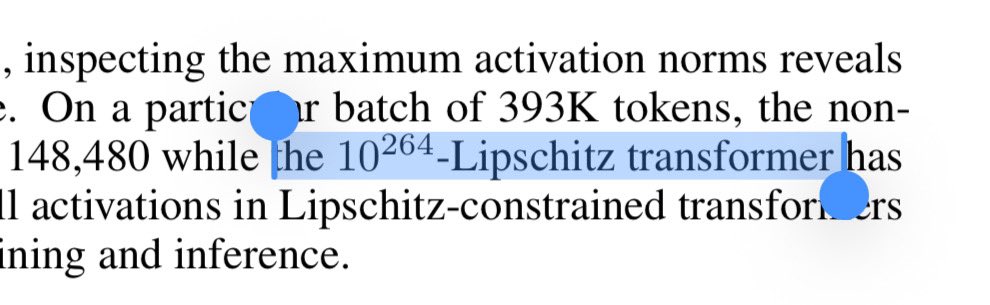
[1/9] We created a performant Lipschitz transformer by spectrally regulating the weights—without using activation stability tricks: no layer norm, QK norm, or logit softcapping. We think this may address a “root cause” of unstable training.

[1/9] We created a performant Lipschitz transformer by spectrally regulating the weights—without using activation stability tricks: no layer norm, QK norm, or logit softcapping. We think this may address a “root cause” of unstable training.
Mihir Prabhudesai (@mihirp98) 's Twitter Profile Photo

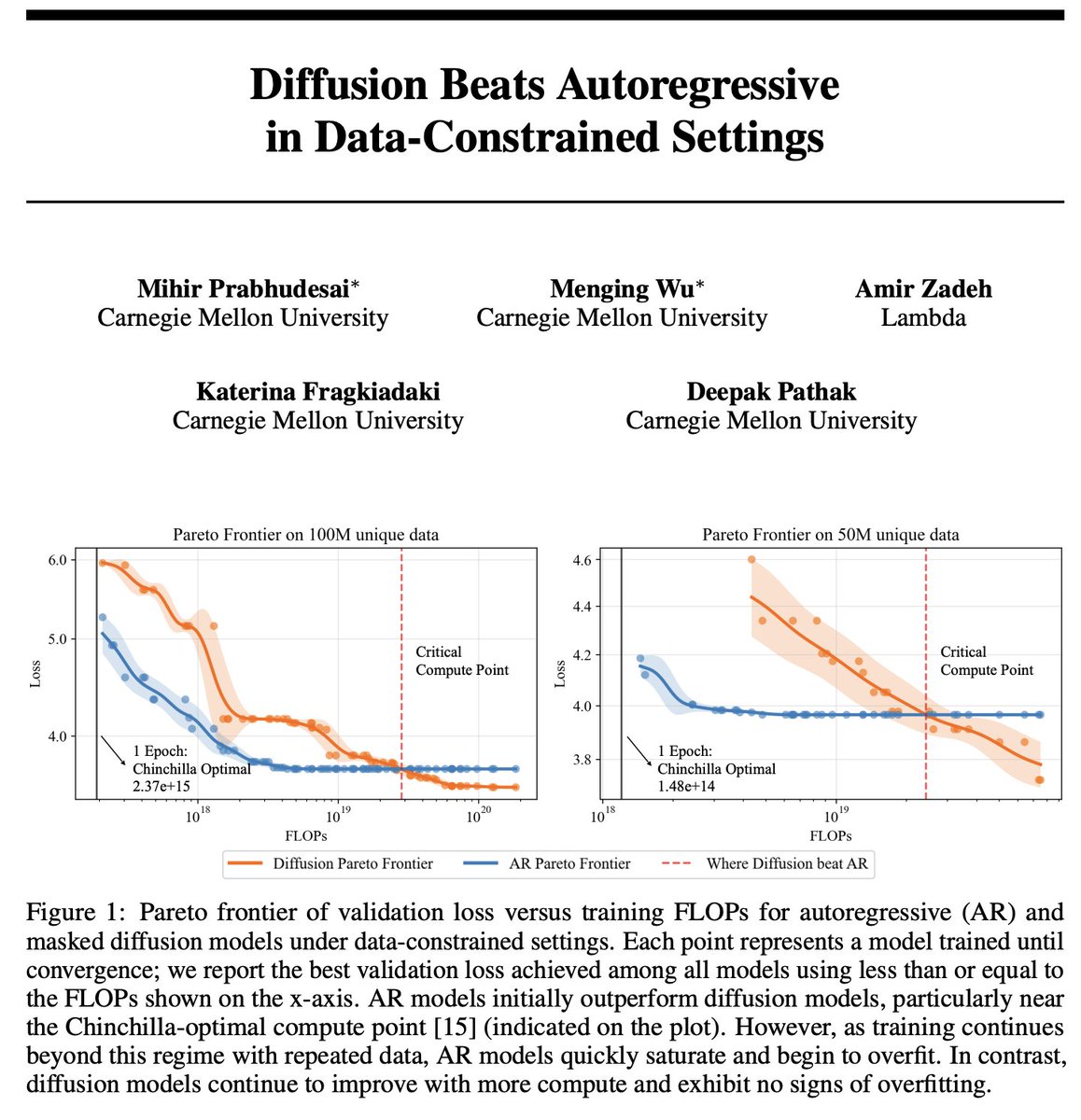
🚨 The era of infinite internet data is ending, So we ask: 👉 What’s the right generative modelling objective when data—not compute—is the bottleneck? TL;DR: ▶️Compute-constrained? Train Autoregressive models ▶️Data-constrained? Train Diffusion models Get ready for 🤿 1/n

🚨 The era of infinite internet data is ending, So we ask:

👉 What’s the right generative modelling objective when data—not compute—is the bottleneck?

TL;DR:

▶️Compute-constrained? Train Autoregressive models

▶️Data-constrained? Train Diffusion models

Get ready for 🤿  1/n
Qinyuan Ye (👀Jobs) (@qinyuan_ye) 's Twitter Profile Photo

1+1=3 2+2=5 3+3=? Many language models (e.g., Llama 3 8B, Mistral v0.1 7B) will answer 7. But why? We dig into the model internals, uncover a function induction mechanism, and find that it’s broadly reused when models encounter surprises during in-context learning. 🧵

1+1=3
2+2=5
3+3=?

Many language models (e.g., Llama 3 8B, Mistral v0.1 7B) will answer 7. But why?

We dig into the model internals, uncover a function induction mechanism, and find that it’s broadly reused when models encounter surprises during in-context learning. 🧵
Michael Black (@michael_j_black) 's Twitter Profile Photo

Here's how my recent papers & reviews are going: * To solve a vision problem today, the sensible thing is to leverage a pre-trained VLM or video diffusion model. Such models implicitly represent a tremendous amount about the visual world that we can exploit. * Figure out how to

Anne Ouyang (@anneouyang) 's Twitter Profile Photo

KernelBench v0.1 is out, featuring: - A guideline on analyzing the validity of results and ruling out physically impossible performance claims. - Support for randomized testing beyond normal distributions. - Fixed problem sizes and improved numerics

KernelBench v0.1 is out, featuring:
- A guideline on analyzing the validity of results and ruling out physically impossible performance claims.
- Support for randomized testing beyond normal distributions.
- Fixed problem sizes and improved numerics
机器之心 JIQIZHIXIN (@synced_global) 's Twitter Profile Photo

ByteDance is exploring diffusion LLMs too! 👀 Seed Diffusion Preview: a blazing-fast LLM for code, built on discrete-state diffusion. With 2,146 tokens/sec inference on H20 GPUs, it outpaces Mercury & Gemini Diffusion, while matching their performance on standard code

ByteDance is exploring diffusion LLMs too! 👀

Seed Diffusion Preview: a blazing-fast LLM for code, built on discrete-state diffusion.

With 2,146 tokens/sec inference on H20 GPUs, it outpaces Mercury &amp; Gemini Diffusion, while matching their performance on standard code
clem 🤗 (@clementdelangue) 's Twitter Profile Photo

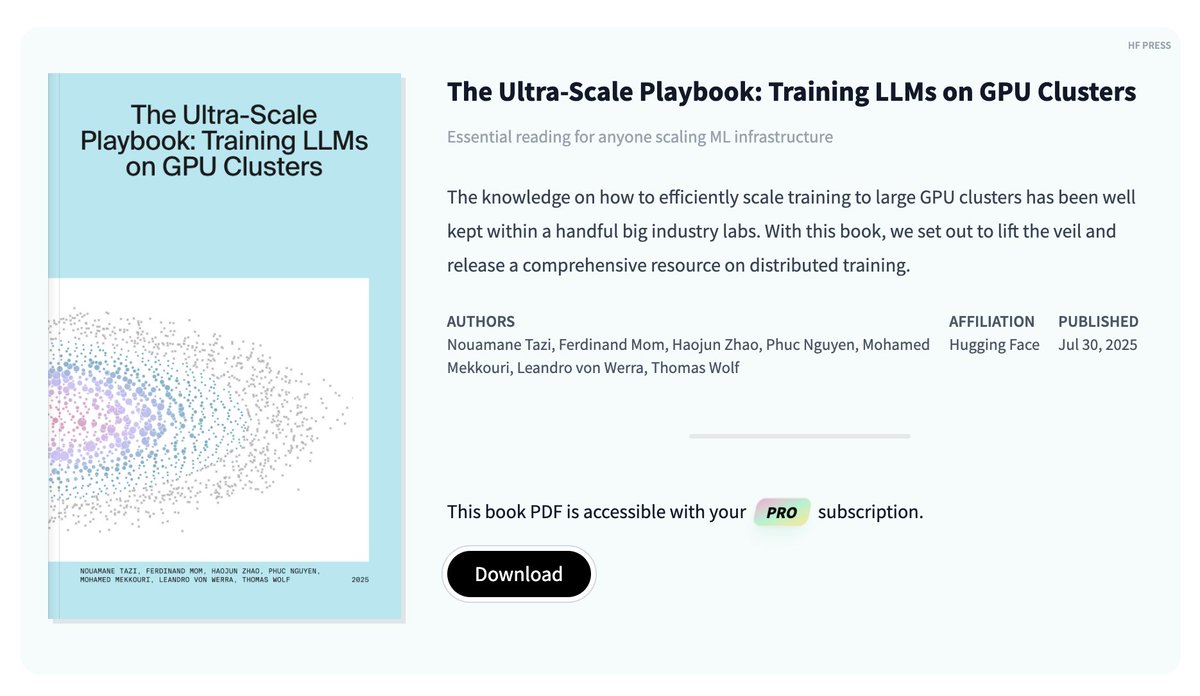
Every tech company can and should train their own deepseek R1, Llama or GPT5, just like every tech company writes their own code (and AI is no more than software 2.0). This is why we're releasing the Ultra-Scale Playbook. 200 pages to master: - 5D parallelism (DP, TP, PP, EP,

Every tech company can and should train their own deepseek R1, Llama or GPT5, just like every tech company writes their own code (and AI is no more than software 2.0).

This is why we're releasing the Ultra-Scale Playbook. 200 pages to master:
- 5D parallelism (DP, TP, PP, EP,
Leo Zhang (@leoeleoleo1) 's Twitter Profile Photo

Wrote up some notes providing an introduction to discrete diffusion models, going into the theory of time-inhomogeneous CTMCs via generators/time-evolution systems. What motivated me was the sheer difficulty of finding a useful reference which laid out the theory (e.g.

Jack Parker-Holder (@jparkerholder) 's Twitter Profile Photo

Genie 3 feels like a watershed moment for world models 🌐: we can now generate multi-minute, real-time interactive simulations of any imaginable world. This could be the key missing piece for embodied AGI… and it can also create beautiful beaches with my dog, playable real time

Tim Rocktäschel (@_rockt) 's Twitter Profile Photo

Harder, Better, Faster, Stronger, Real-time! We are excited to reveal Genie 3, our most capable real-time foundational world model. Fantastic cross-team effort led by Jack Parker-Holder and Shlomi Fruchter. Below some interactive worlds and capabilities that were highlights for me


Feng Yao (@fengyao1909) 's Twitter Profile Photo

Failing on 𝐥𝐚𝐫𝐠𝐞-𝐬𝐜𝐚𝐥𝐞 𝐑𝐋 with VeRL? ⚠️ Mixing inference backend (𝐯𝐋𝐋𝐌/𝐒𝐆𝐋𝐚𝐧𝐠) with training backends (𝐅𝐒𝐃𝐏/𝐌𝐞𝐠𝐚𝐭𝐫𝐨𝐧) 𝐬𝐞𝐜𝐫𝐞𝐭𝐥𝐲 𝐭𝐮𝐫𝐧𝐬 𝐲𝐨𝐮𝐫 𝐑𝐋 𝐢𝐧𝐭𝐨 𝐨𝐟𝐟-𝐩𝐨𝐥𝐢𝐜𝐲 — even if they share the same weights! 📉 Blog:

Failing on 𝐥𝐚𝐫𝐠𝐞-𝐬𝐜𝐚𝐥𝐞 𝐑𝐋 with VeRL?

⚠️ Mixing inference backend (𝐯𝐋𝐋𝐌/𝐒𝐆𝐋𝐚𝐧𝐠) with training backends (𝐅𝐒𝐃𝐏/𝐌𝐞𝐠𝐚𝐭𝐫𝐨𝐧) 𝐬𝐞𝐜𝐫𝐞𝐭𝐥𝐲 𝐭𝐮𝐫𝐧𝐬 𝐲𝐨𝐮𝐫 𝐑𝐋 𝐢𝐧𝐭𝐨 𝐨𝐟𝐟-𝐩𝐨𝐥𝐢𝐜𝐲 — even if they share the same weights!

📉 Blog: