AUTOLab (@autolab_cal) 's Twitter Profile
AUTOLab

@autolab_cal

Automation Lab @Cal @UCBerkeley directed by Prof. @Ken_Goldberg

ID: 722845796530401281

linkhttps://autolab.berkeley.edu/ calendar_today20-04-2016 17:54:02

40 Tweet

291 Followers

100 Following

Berkeley School of Information (@berkeleyischool) 's Twitter Profile Photo

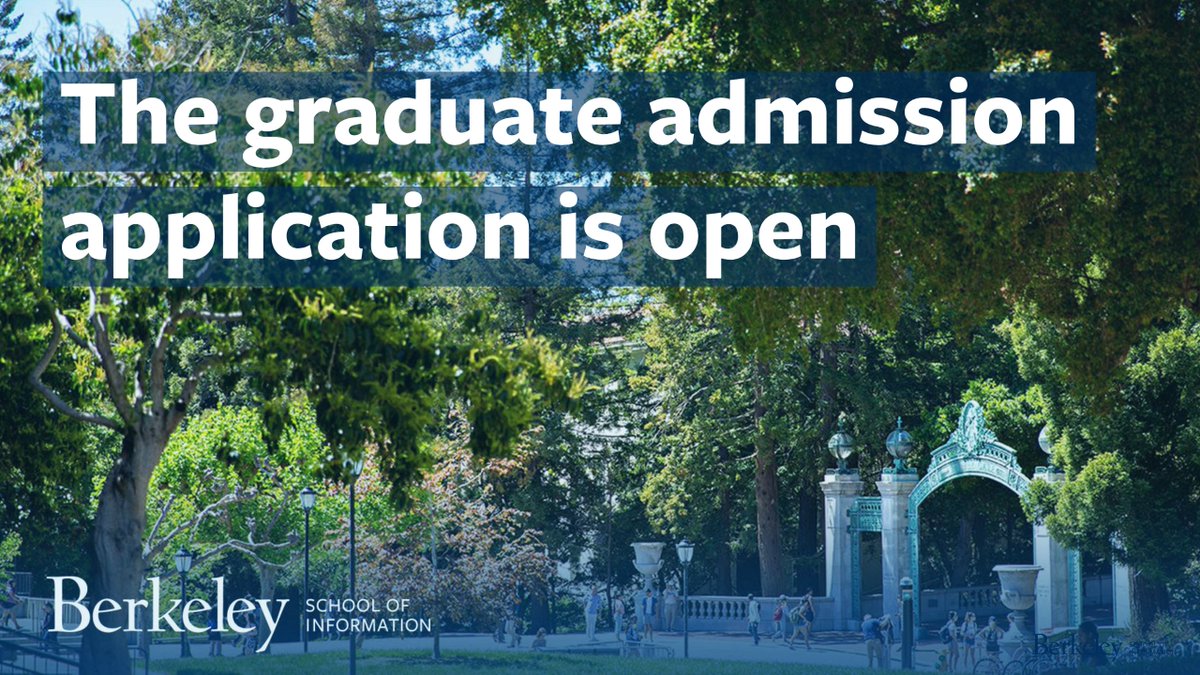
📝 The graduate admission application is open! 📆 Deadlines: ✔️ PhD: 12/1/21 ✔️ MIMS: 1/6/22 ✔️ 5th Year MIDS: Early (app fee waived!) - 11/4/21; Final - 3/2/22 ✔️ MIDS & MICS: rolling throughout the year! Grad app: bit.ly/3zsoOVZ

📝 The graduate admission application is open!

📆  Deadlines:
✔️  PhD: 12/1/21
✔️  MIMS: 1/6/22
✔️  5th Year MIDS: Early (app fee waived!) - 11/4/21; Final - 3/2/22
✔️  MIDS & MICS: rolling throughout the year!

Grad app: bit.ly/3zsoOVZ
Ken Goldberg (@ken_goldberg) 's Twitter Profile Photo

“…What started in 2017 as an email discussion and later a Facebook Group has grown into a global movement of 3,800 members in more than 50 countries. Black in AI works in academics, advocacy, entrepreneurship, financial support, and summer research programs.”

Stephen James (@stepjamuk) 's Twitter Profile Photo

'basketball_in_hoop'; one of many new tasks joining the #RLBench family of 100+ tasks in V1.2. Coming early November! 🤖 RLBench is still the hardest manipulation sim-benchmark to date due to its large-scale focus on vision, sparse rewards, and multi-stage tasks.

Chung Min Kim (@chungminkim) 's Twitter Profile Photo

It’s notoriously difficult to model the mechanics of compliant robot jaw tips during grasping! We found that a new tool from computer graphics can help. IPC-GraspSim, from AUTOLab UC Berkeley. Paper, data, video: sites.google.com/berkeley.edu/i… (1/9)

Sergey Levine (@svlevine) 's Twitter Profile Photo

Why is generalization hard in RL? Can "just adding more data" fix it? Turns out that in general, the answer is no. In a new blog post, Dibya Ghosh discusses this question: bair.berkeley.edu/blog/2021/11/0… Trying to generalize induces a POMDP, even if the problem is an MDP!

Raven Huang (@ravenhuang4) 's Twitter Profile Photo

Planar Robot Casting for deformable materials aims to achieve a desired final state from one dynamic launching action. Our work from AUTOLab @Berkeley_AI learn it using a self-supervised “Real2Sim2Real” framework. Data, paper, and presentation: tinyurl.com/robotcast (1/8)

Ken Goldberg (@ken_goldberg) 's Twitter Profile Photo

Unlike fly-fishing, shuffleboard, and bowling, Planar Robot Casting allows self-supervised learning. This real-world robot control problem includes nondeterminism, surface friction, and deformable materials, and it's relatively easy to set up; hoping others study it also:

Ken Goldberg (@ken_goldberg) 's Twitter Profile Photo

Robots can be designed to be symbiotic with workers, freeing us to focus on the myriad of tasks AI can’t do well. Proud that this is an axiom for AmbiRobotics.

Max Fu (@letian_fu) 's Twitter Profile Photo

Can a robot teach itself to grasp complex objects? Learned Efficient Grasp Sets (LEGS) can help robots efficiently learn to grasp novel, out-of-distribution objects. Research from AUTOLab UC Berkeley. Paper, website: sites.google.com/view/legs-exp-… (1/8)

Ashwin Balakrishna (@ashwinb96) 's Twitter Profile Photo

Interested in safe and robust learning for control? Come check out our NeurIPS 2021 Workshop on Safe and Robust Control of Uncertain Systems (Website: sites.google.com/view/safe-robu……) on 12/13 from 8 AM - 4 PM PST! You can register here: neurips.cc.

Mathieu Blondel (@mblondel_ml) 's Twitter Profile Photo

JAXopt v0.2 is out! github.com/google/jaxopt/… The main highlight of this release is an implementation of OSQP, a GPU-friendly quadratic programming solver. Our implementation of course supports implicit differentiation ;) Thanks to our intern Louis Béthune for the hard work.