Gooner- Technical Writer (@writetechnical) 's Twitter Profile
Gooner- Technical Writer

@writetechnical

Arsenal fan, technical writer, wrote dozens of articles

ID: 2503276692

calendar_today18-05-2014 03:58:27

451 Tweet

148 Takipçi

282 Takip Edilen

Gooner- Technical Writer (@writetechnical) 's Twitter Profile Photo

If you are a Junior or Mid-level SDE today, and planning for a switch to a FAANG+ company & a salary bump of over 50%, please focus on these system design fundamentals seriously. This will keep your skills sharp. The market may be rough, but the only thing you truly control is

Gooner- Technical Writer (@writetechnical) 's Twitter Profile Photo

In a Meta E5 Interview you're asked to “Design Leetcode.” As a senior/principal level engineer, I would follow the following playbook to show my depth: The Playbook: [1] Requirements: Safety First - Don't just list features; frame the constraints. - The Trap: Treating this

Gooner- Technical Writer (@writetechnical) 's Twitter Profile Photo

Your system design knowledge, explaining: - gRPC - CDNs - WebSockets - Rate Limiting - API Gateways - Microservices - Redis Caching - Load Balancers - Message Queues - Database Sharding - Consistent Hashing - Eventual Consistency - Distributed Tracing - Horizontal Scaling -

Gooner- Technical Writer (@writetechnical) 's Twitter Profile Photo

Junior SWE: "I'll just use a simple if statement" Mid-level SWE: "Let me implement a strategy pattern with dependency injection" Senior SWE: "We need an event-driven microservices architecture with CQRS and eventual consistency" Principal SWE: "Just use an if statement" What

Gooner- Technical Writer (@writetechnical) 's Twitter Profile Photo

Do not sleep on System design if you are preparing for interviews. You have to understand how systems work. Fundamentals are not negligible. You can't run from it, hide from it. Here are 25 questions (51-75) that will help you with the fundamentals that you should master before

Do not sleep on System design if you are preparing for interviews.
You have to understand how systems work.
Fundamentals are not negligible.
You can't run from it, hide from it.

Here are 25 questions (51-75) that will help you with the fundamentals that you should master before
Gooner- Technical Writer (@writetechnical) 's Twitter Profile Photo

Junior SWE: “Let’s just build one backend and one DB for everything” Mid-level SWE: “We should move this into microservices with separate databases” Senior SWE: “We need sharding, Kafka, CQRS, Redis, S3, and a global cache” Principal SWE: “Can this just be a single service

Gooner- Technical Writer (@writetechnical) 's Twitter Profile Photo

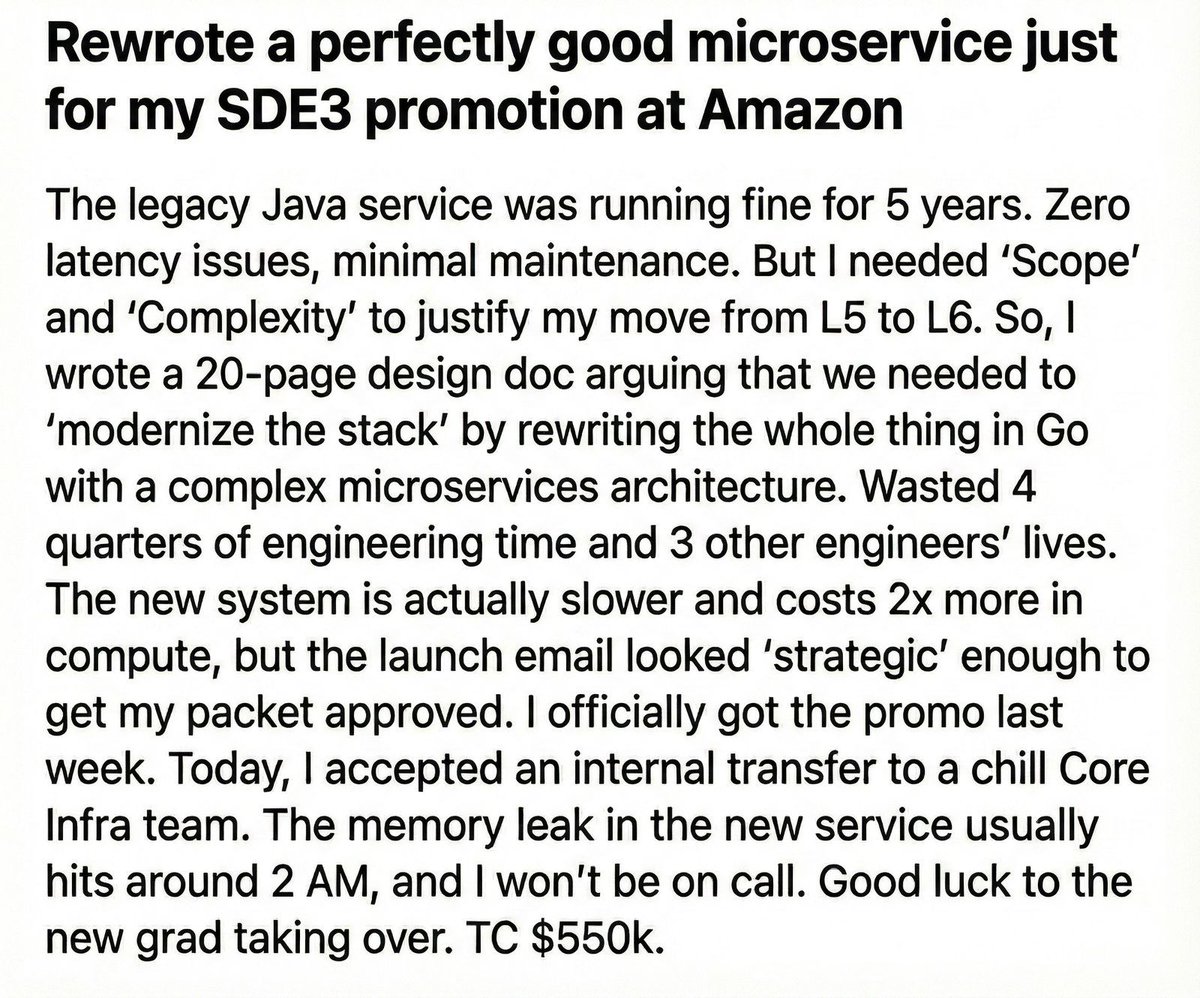
An Amazon employee rewrote a perfectly fine Java Microservice to Go and actually slowed the service down😄 Don't listen to noises, Java despite it's flaws is a great language for enterprises and if I had to start my career I'd start from Java again. As a Java dev, apart from

An Amazon employee rewrote a perfectly fine Java Microservice to Go and actually slowed the service down😄
Don't listen to noises, Java despite it's flaws is a great language for enterprises and if I had to start my career I'd start from Java again.

As a Java dev, apart from
Gooner- Technical Writer (@writetechnical) 's Twitter Profile Photo

As someone who has spent years in interviewing software engineers and in this time, one thing has become very clear to me about interviews: A good interview is never about proving you know more than the candidate. It is about finding out how far this person can grow with you.

As someone who has spent years in interviewing software engineers and in this time, one thing has become very clear to me about interviews:

A good interview is never about proving you know more than the candidate. It is about finding out how far this person can grow with you.
Gooner- Technical Writer (@writetechnical) 's Twitter Profile Photo

You aren't paid a Staff Engineer’s salary simply to write code faster than a Senior. If that were the goal, they would just hire two Seniors or buy an AI tool. On paper, a team of 15 containing four Staff Engineers looks inefficient. In reality, that ratio is the only thing

Gooner- Technical Writer (@writetechnical) 's Twitter Profile Photo

I want to talk to Java(or any other backend) developers today. If you are in a junior position who wants to excel in your career, below are some advices that'll surely help you moving forward: - If you try to solve problems very fast in order to impress seniors, don't do that,

Gooner- Technical Writer (@writetechnical) 's Twitter Profile Photo

I ran the gauntlet for Senior roles at multiple companies. I didn’t clear them all, but I learned enough to identify the patterns. Here are the 12 designs that actually matter, distilled from those loops that will teach us to design any system: (A) Booking & Discovery 1.

I ran the gauntlet for Senior roles at multiple companies. I didn’t clear them all, but I learned enough to identify the patterns.

Here are the 12 designs that actually matter, distilled from those loops that will teach us to design any system:

(A) Booking & Discovery

1.
Gooner- Technical Writer (@writetechnical) 's Twitter Profile Photo

I’ve been interviewing a lot recently, and one thing stood out clearly: System design interviews are wildly inconsistent. Interviews are half luck, you never know who you’ll get. At Amazon, Apple, and Google, the system design rounds felt collaborative. Interviewers asked

I’ve been interviewing a lot recently, and one thing stood out clearly:

System design interviews are wildly inconsistent. Interviews are half luck, you never know who you’ll get.

At Amazon, Apple, and Google, the system design rounds felt collaborative.
Interviewers asked
Gooner- Technical Writer (@writetechnical) 's Twitter Profile Photo

At senior levels and beyond, system design isn’t just boxes and arrows. How you keep the system healthy after launch matters just as much. Here’s the mental checklist I use for observability and health, in interviews and real systems. 1. Start with SLOs - Define “healthy” in

At senior levels and beyond, system design isn’t just boxes and arrows.
How you keep the system healthy after launch matters just as much.

Here’s the mental checklist I use for observability and health, in interviews and real systems.
1. Start with SLOs
- Define “healthy” in
Gooner- Technical Writer (@writetechnical) 's Twitter Profile Photo

The biggest breakthrough in my system design prep wasn’t another course. It was stopping the hunt for solutions and switching to frameworks. Early on, I tried memorizing “design X” answers - Twitter, Instagram, WhatsApp. Sadly enough, It didn’t help. Every new problem still

The biggest breakthrough in my system design prep wasn’t another course.

It was stopping the hunt for solutions and switching to frameworks.

Early on, I tried memorizing “design X” answers - Twitter, Instagram, WhatsApp.

Sadly enough, It didn’t help.
Every new problem still
Gooner- Technical Writer (@writetechnical) 's Twitter Profile Photo

From my experience, system design interviews don’t fall apart in the deep dives(say advanced stages). In fact, they fall apart much earlier during API design. As a senior(doesn't matter if you are a junior as well), you start to understand API design isn’t about naming endpoints

From my experience, system design interviews don’t fall apart in the deep dives(say advanced stages).
In fact, they fall apart much earlier during API design.

As a senior(doesn't matter if you are a junior as well), you start to understand API design isn’t about naming endpoints