Jack Dean (@jack_dean_996) 's Twitter Profile
Jack Dean

@jack_dean_996

Aspiring Astrophysicist

ID: 1196683577234202625

calendar_today19-11-2019 06:56:32

897 Tweet

71 Takipçi

1,1K Takip Edilen
Albert Einstein (@alberteinstein) 's Twitter Profile Photo

Isaac Newton’s laws of motion, quantum mechanics, Albert Einstein’s theories of special and general relativity — they’re all just pieces of a bigger story that quantum field theory wants to tell: bit.ly/43tLNQV (via Quanta Magazine)
Isaac Newton’s laws of motion, quantum mechanics, Albert Einstein’s theories of special and general relativity — they’re all just pieces of a bigger story that quantum field theory wants to tell: bit.ly/43tLNQV (via <a href="/QuantaMagazine/">Quanta Magazine</a>)
Chandra Observatory (@chandraxray) 's Twitter Profile Photo

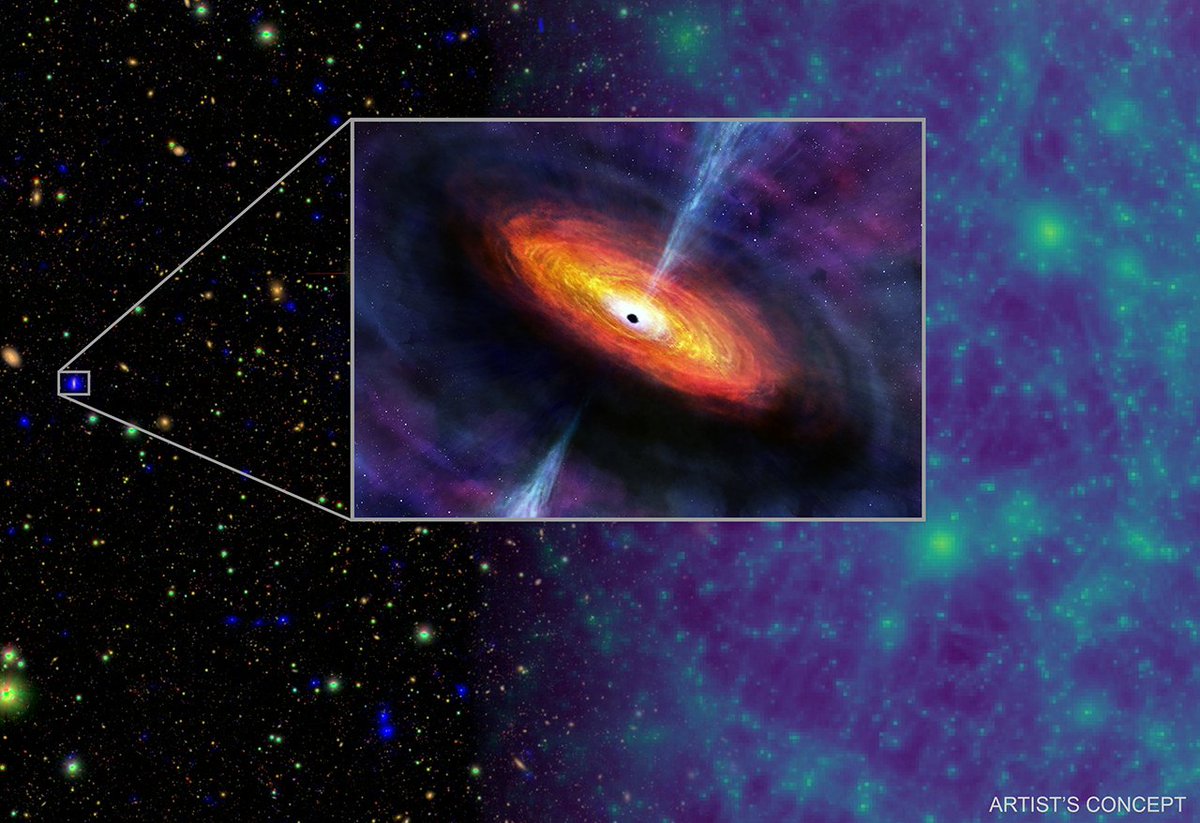
A new X-ray study of over 8,000 rapidly growing black holes, combined with state-of-the-art supercomputer simulations, has provided the best modeling to date of the growth of the supermassive black holes found in the centers of galaxies. More: s.si.edu/bhsim #AAS244 ⚫

A new X-ray study of over 8,000 rapidly growing black holes, combined with state-of-the-art supercomputer simulations, has provided the best modeling to date of the growth of the supermassive black holes found in the centers of galaxies. More: s.si.edu/bhsim #AAS244 ⚫
Hubble (@nasahubble) 's Twitter Profile Photo

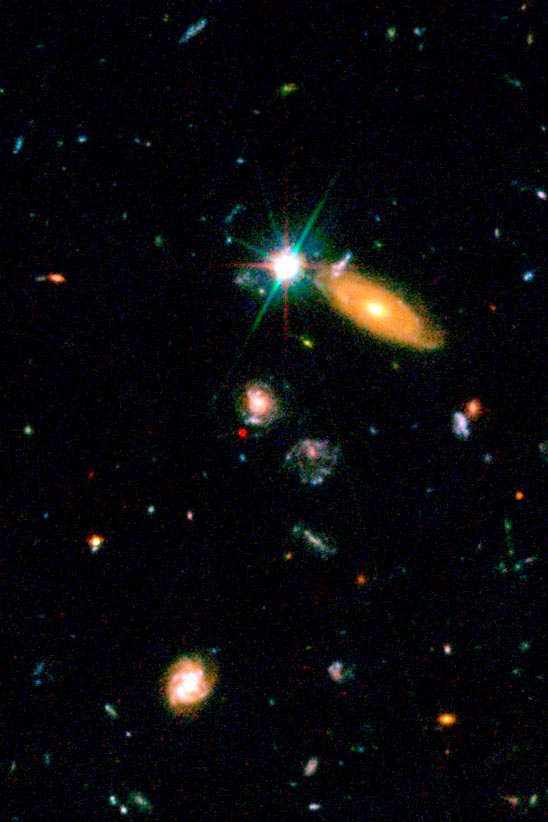
Can you spot the supernova? Hint: At the center of this image, the red dot shows a star's explosive death. Hubble's Advanced Camera for Surveys examined this distant supernova – 8 billion light-years away! – to learn more about our early universe: go.nasa.gov/45C0Aum

Can you spot the supernova?

Hint: At the center of this image, the red dot shows a star's explosive death.

Hubble's Advanced Camera for Surveys examined this distant supernova – 8 billion light-years away! – to learn more about our early universe: go.nasa.gov/45C0Aum
Physics In History (@physinhistory) 's Twitter Profile Photo

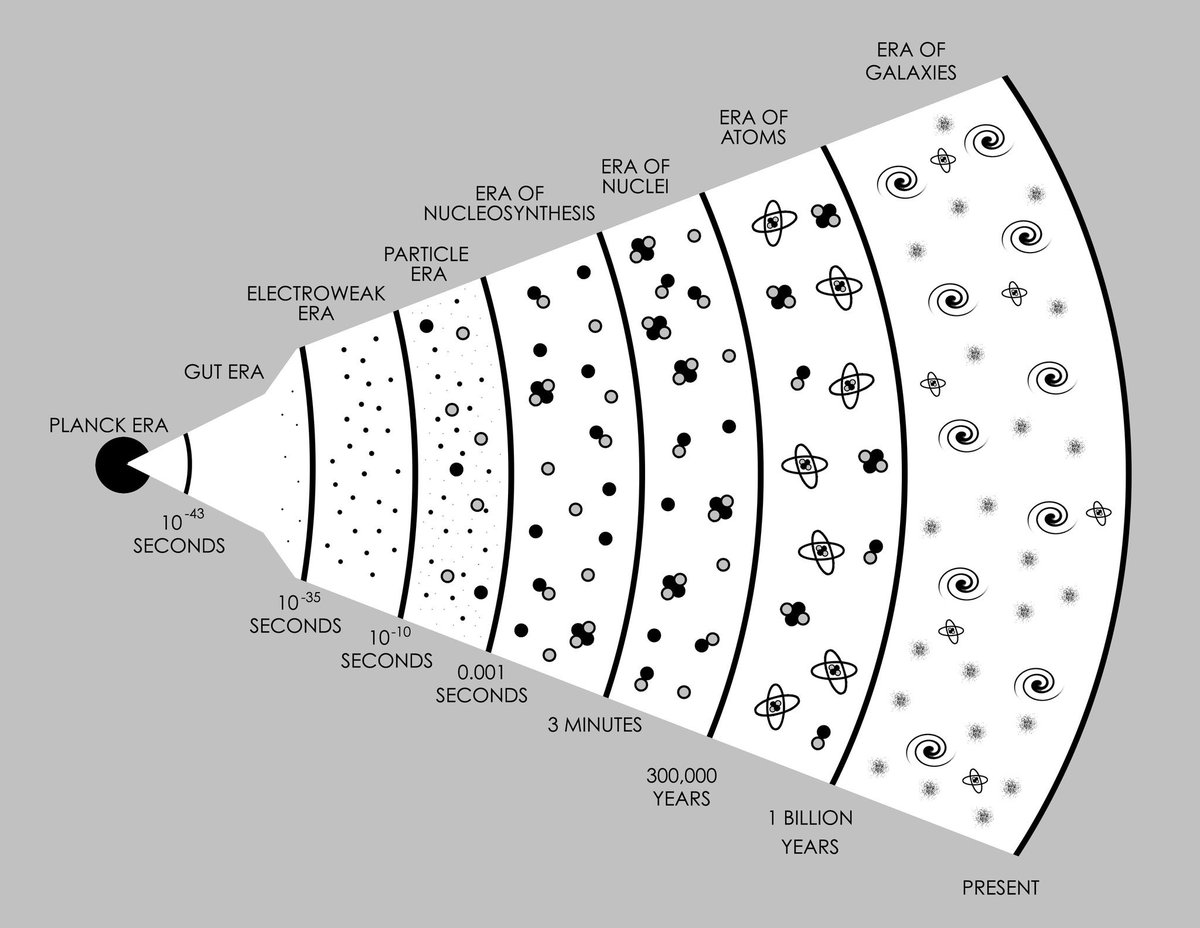
The big bang vs. Steady state theory 🌌 The big bang theory and the steady state theory are two competing models of the origin and evolution of the universe. They differ in their assumptions, predictions, and evidence. The big bang theory assumes that the universe began in a

The big bang vs. Steady state theory 🌌

The big bang theory and the steady state theory are two competing models of the origin and evolution of the universe. They differ in their assumptions, predictions, and evidence.

The big bang theory assumes that the universe began in a
Hubble Space Telescope (@hubbletelescope) 's Twitter Profile Photo

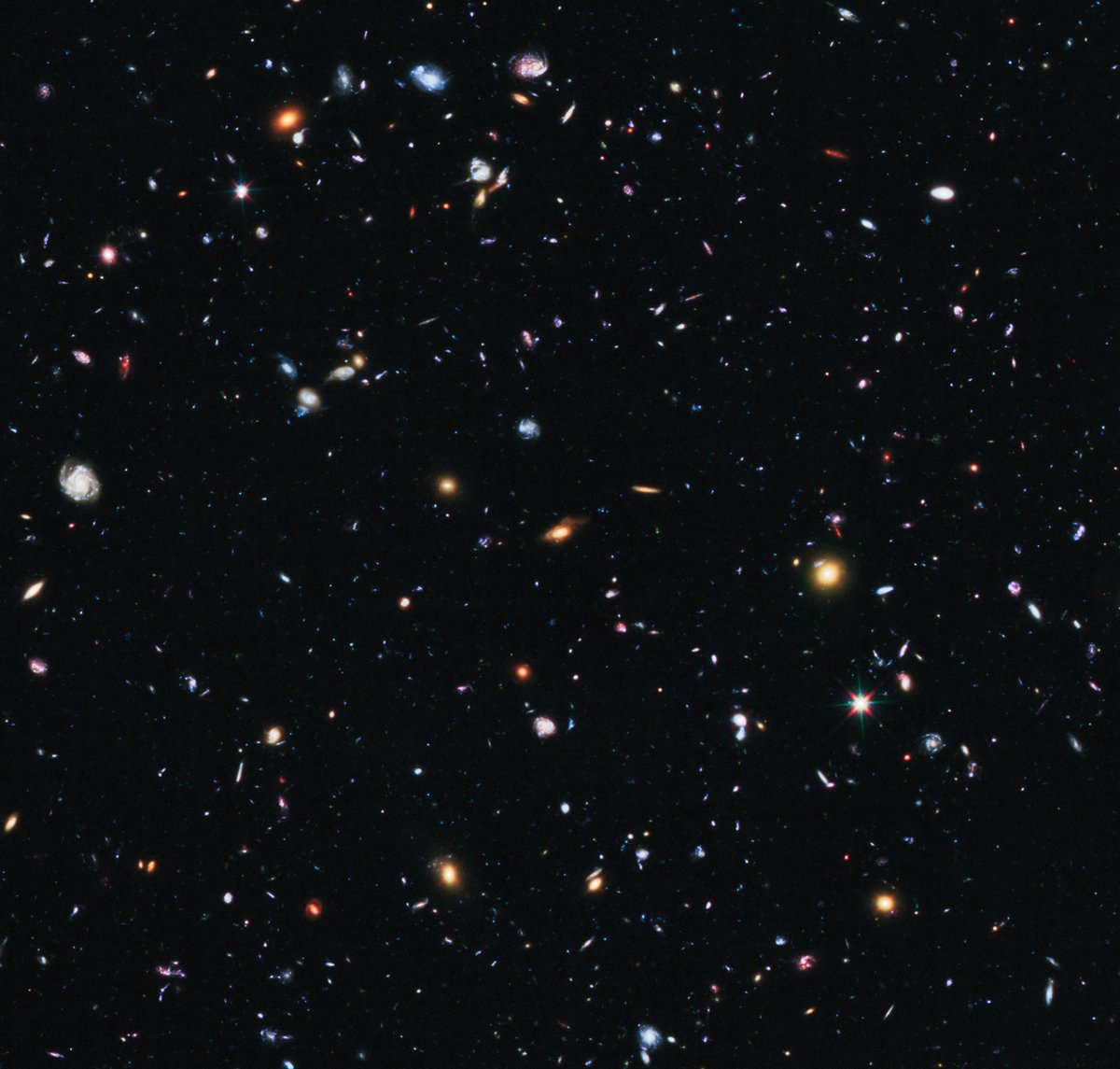
Over 12 billion years. More than 7,500 galaxies. One telescope. Hubble captured galaxies in various stages of assembly throughout most of the history of the universe. Click to explore: bit.ly/4bnEjC0

Over 12 billion years. More than 7,500 galaxies. One telescope. 

Hubble captured galaxies in various stages of assembly throughout most of the history of the universe. 

Click to explore: bit.ly/4bnEjC0
NASA Universe (@nasauniverse) 's Twitter Profile Photo

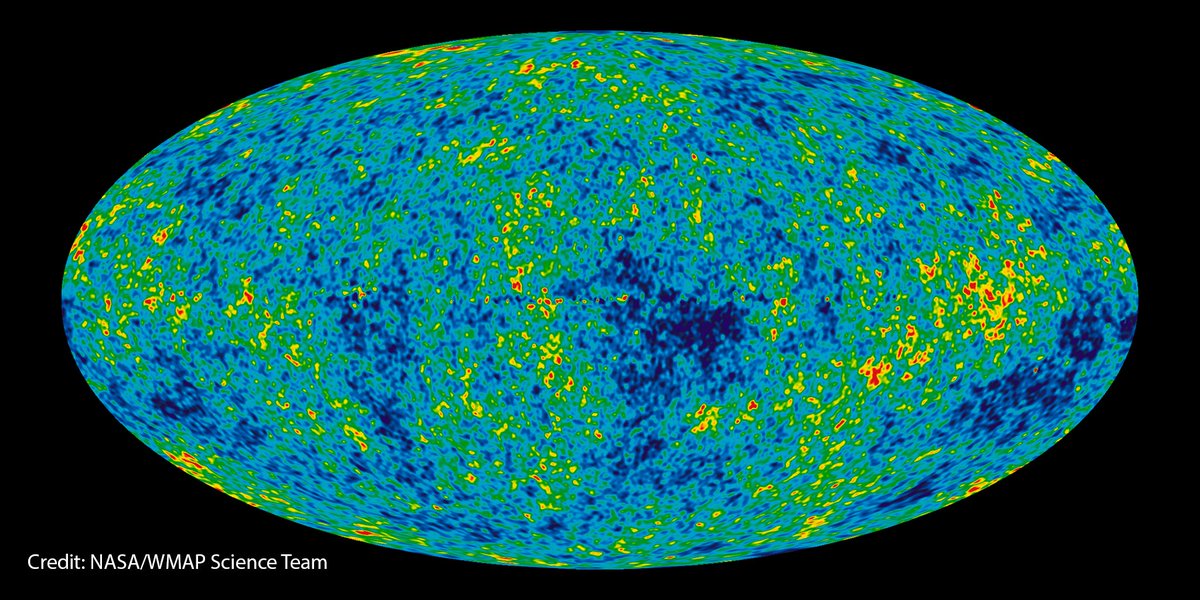
#TBT to June 30, 2001, when the Wilkinson Microwave Anisotropy Probe (WMAP) headed into space to take a “baby picture” of the universe. By collecting the oldest light in the cosmos, WMAP helped us learn about the structure of the universe around us today.

#TBT to June 30, 2001, when the Wilkinson Microwave Anisotropy Probe (WMAP) headed into space to take a “baby picture” of the universe. By collecting the oldest light in the cosmos, WMAP helped us learn about the structure of the universe around us today.
NASA Universe (@nasauniverse) 's Twitter Profile Photo

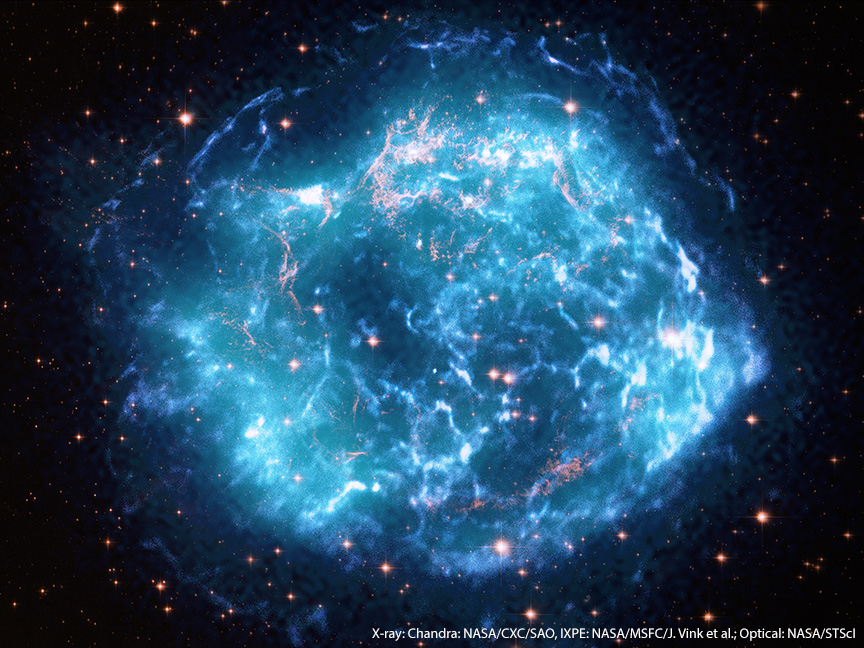
A massive star has a beautiful destiny. On its way to becoming a black hole or neutron star, it’ll shed its outer layers in a supernova explosion. This brilliant display leaves behind a picturesque remnant that expands for thousands of years. #MondayMotivation

A massive star has a beautiful destiny. On its way to becoming a black hole or neutron star, it’ll shed its outer layers in a supernova explosion. This brilliant display leaves behind a picturesque remnant that expands for thousands of years. #MondayMotivation
CERN (@cern) 's Twitter Profile Photo

#OnThisDay twelve years ago, two experiments at CERN announced the existence of a particle with characteristics consistent with those of the #HiggsBoson. Named after the late theoretical physicist Peter Higgs, its discovery crowned the #StandardModel of particle physics. In

NASA Universe (@nasauniverse) 's Twitter Profile Photo

Dark matter is a theorized material that doesn’t absorb, reflect, or emit enough light to be observable. But it can’t hide from gravity! Dark matter particles near a black hole would collide and produce gamma-ray light. #MondayMotivation

LIGO (@ligo) 's Twitter Profile Photo

🎂 Today is the 9th birthday of gravitational-wave astronomy Happy anniversary to GW150914, our first detection!

Phys.org (@physorg_com) 's Twitter Profile Photo

Theoretical physicists develop method to model a central theory of quantum #gravity in the laboratory @uni_wue @physrevlett arXiv.org phys.org/news/2024-09-t…

NASA Goddard (@nasagoddard) 's Twitter Profile Photo

No vampire baseball for this supermassive black hole team up! Using Hubble and Chandra together, researchers identified a pair of supermassive black holes in close proximity to each other — only about 300 light-years apart — in galaxy MCG-03-34-64. go.nasa.gov/3XAOKOw

Hubble Space Telescope (@hubbletelescope) 's Twitter Profile Photo

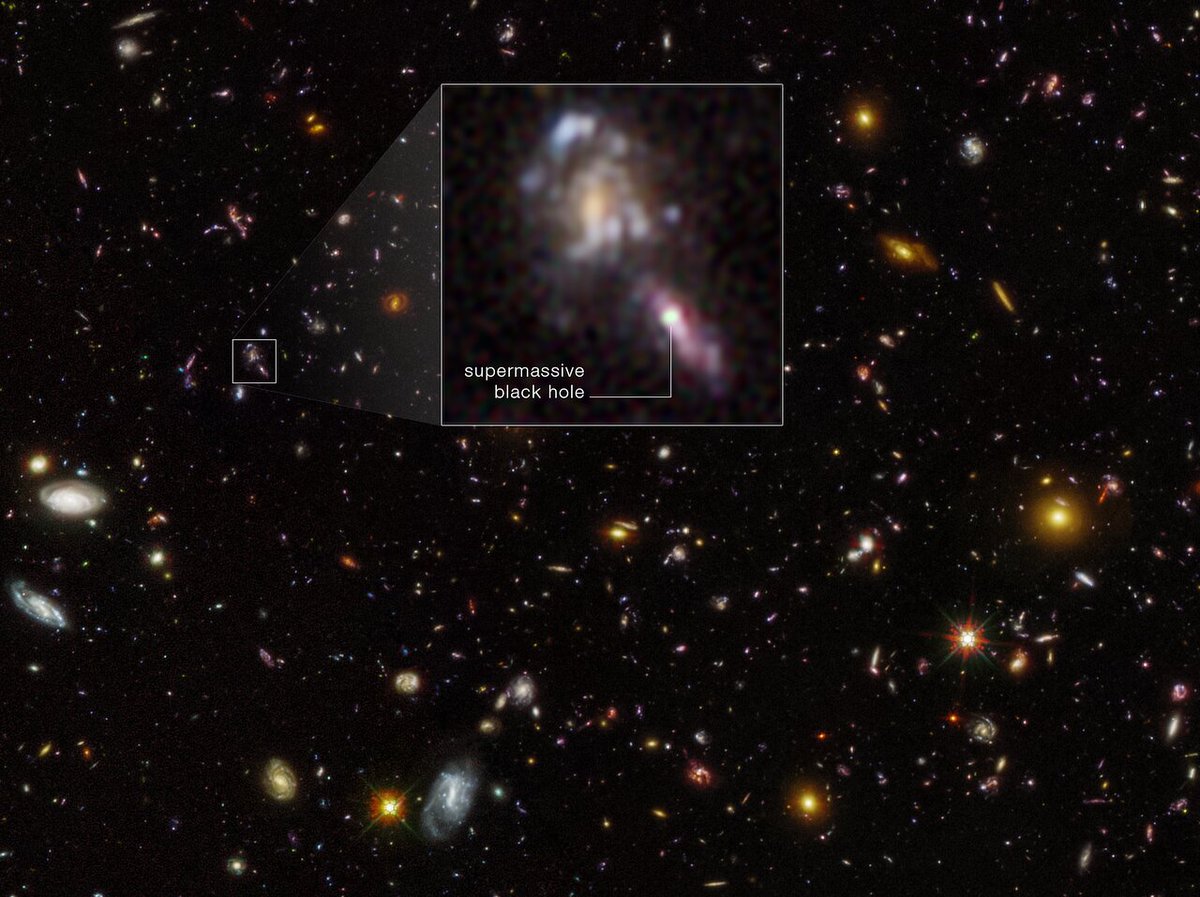
Using Hubble, astronomers have found more black holes in the early universe than previously thought. They went black hole hunting in the landmark Hubble Ultra Deep Field, first taken in 2004, and in following observations to look for black holes: bit.ly/4efOl9Q

Using Hubble, astronomers have found more black holes in the early universe than previously thought. They went black hole hunting in the landmark Hubble Ultra Deep Field, first taken in 2004, and in following observations to look for black holes: bit.ly/4efOl9Q
Hubble (@nasahubble) 's Twitter Profile Photo

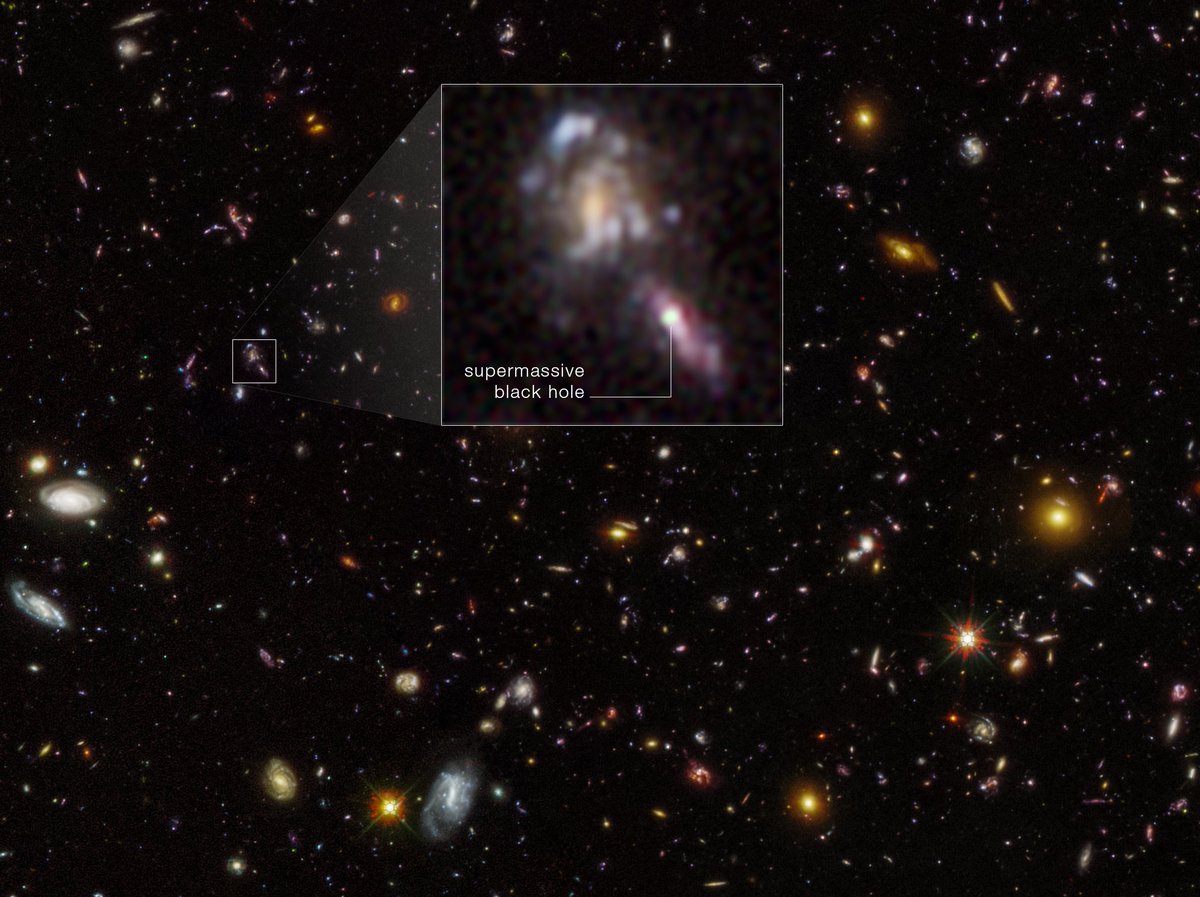
Coming back around ⏪ This is a new image of the iconic Hubble Ultra Deep Field. By revisiting this field and comparing images, astronomers found evidence for more supermassive black holes than expected in early galaxies: go.nasa.gov/3BaCR9p

Coming back around ⏪

This is a new image of the iconic Hubble Ultra Deep Field.

By revisiting this field and comparing images, astronomers found evidence for more supermassive black holes than expected in early galaxies: go.nasa.gov/3BaCR9p
BBC Sky at Night Magazine (@skyatnightmag) 's Twitter Profile Photo

There are far more black holes in the early Universe than expected, according to Hubble observations skyatnightmagazine.com/news/hubble-mo…

Physics In History (@physinhistory) 's Twitter Profile Photo

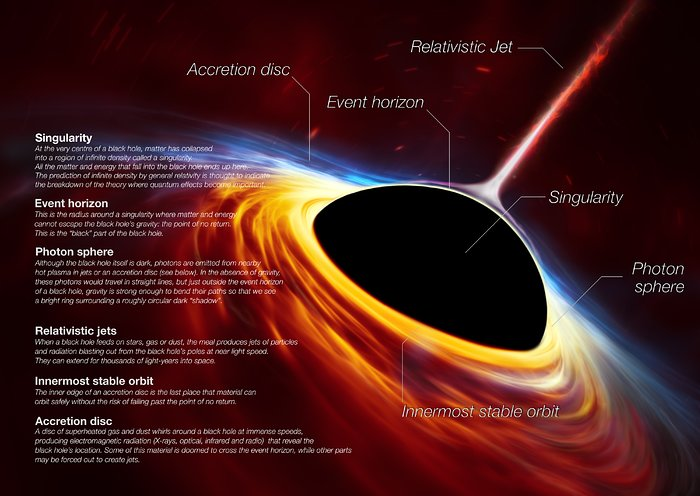
Anatomy of a Black Hole ✍️ 1. Event Horizon : Boundary where the velocity needed to escape the black hole equals light speed. 2. Accretion Disk : A hot disk of gas orbiting the black hole and its main source of light. 3. Singularity : A theoretical point at the very center of a

Anatomy of a Black Hole ✍️
1. Event Horizon : Boundary where the velocity needed to escape the black hole equals light speed.

2. Accretion Disk : A hot disk of gas orbiting the black hole and its main source of light.

3. Singularity : A theoretical point at the very center of a
Chandra Observatory (@chandraxray) 's Twitter Profile Photo

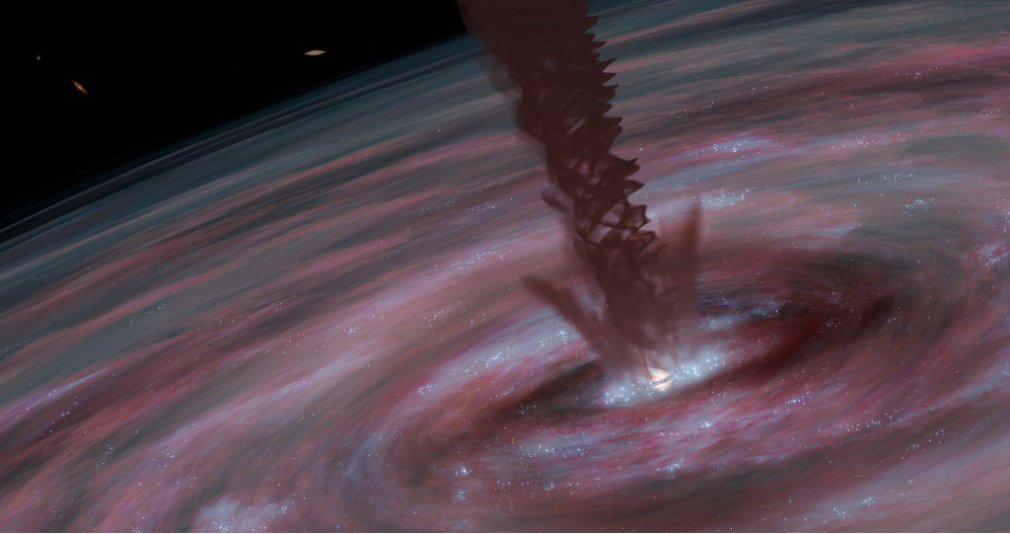
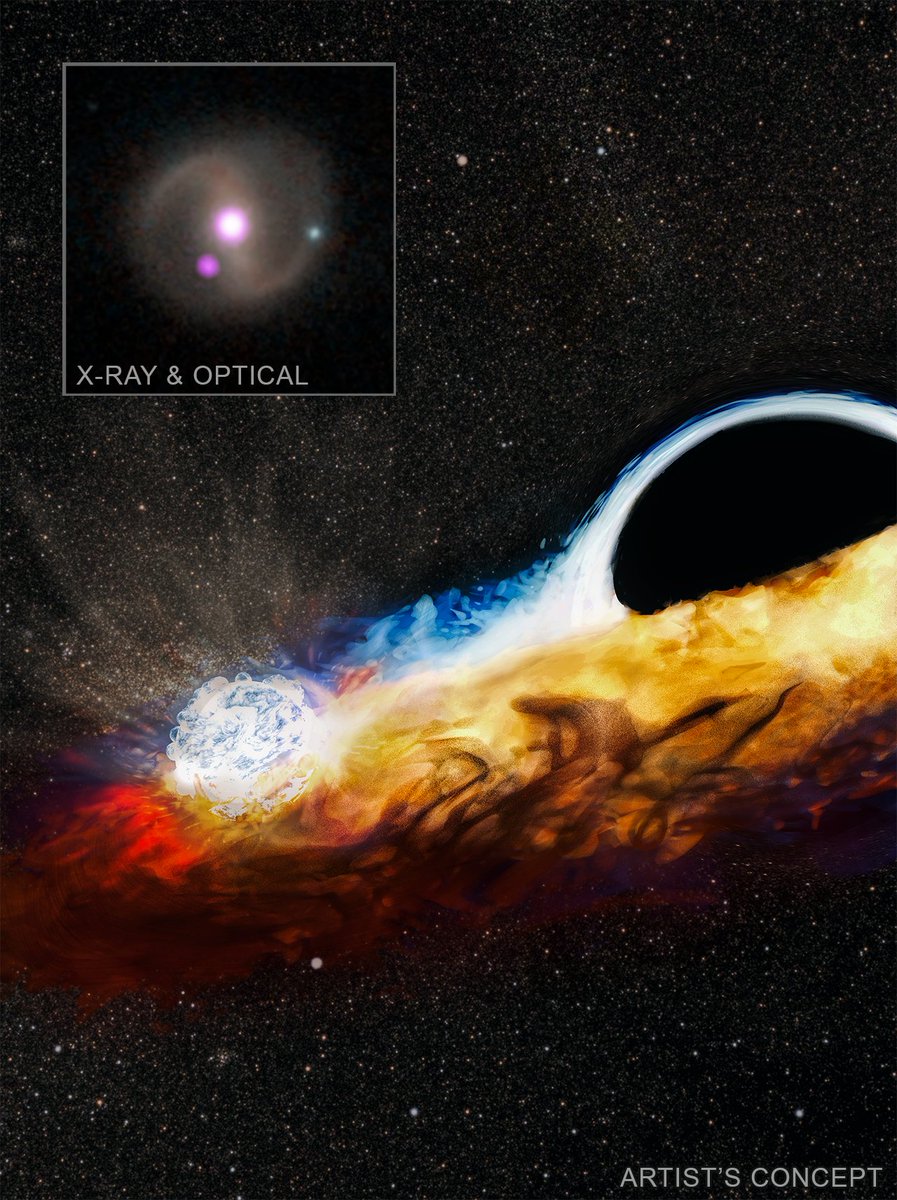
A giant black hole has destroyed a star and is now using that star's debris to pummel another star or smaller black hole about once every 48 hours! This new result helps link two cosmic phenomena that astronomers previously were unsure were unconnected: s.si.edu/tde24

A giant black hole has destroyed a star and is now using that star's debris to pummel another star or smaller black hole about once every 48 hours! This new result helps link two cosmic phenomena that astronomers previously were unsure were unconnected: s.si.edu/tde24