The Game UX Podcast (and Book) (@gamesurbook) 's Twitter Profile
The Game UX Podcast (and Book)

@gamesurbook

The Games UX Podcast and Games User Research Book edited and produced by @andersdrachen @Pejman_MB @acagamic

ID: 962684011

linkhttp://www.gurbook.com calendar_today21-11-2012 16:23:01

355 Tweet

673 Takipçi

3 Takip Edilen

Professor Anders Drachen (@andersdrachen) 's Twitter Profile Photo

I have been wondering how AI might find use in game UX. Prof Lennart Nacke, PhD, @pejman_MB and I sat down and had a chat about it: youtu.be/Lc4b7fqyOGQ #grux #gameux #ux

Benjamin Linz (@benthuxiastic) 's Twitter Profile Photo

A pod on how #AI can help in #gamesUR, simulating player behaviour, experience personalisation, large scale data analysis, the user research process, reporting & communication, user communication analysis as well as challenges, benefits & current limitations of AI in #UXresearch.

Spielsinn Podcast (@spielsinn) 's Twitter Profile Photo

In Folge #48 sprachen wir mit Johannes Pfau über KI in der Spieleentwicklung, besonders bzgl. der Verhaltenssimulation von Spieler:innen. Prof Lennart Nacke, PhD, den wir in Folge #50 zu Gast hatten, hat mit seinen Kollegen von The Game UX Podcast (and Book) nun einen Abriss über KI im #gamesUR gesprochen.

The Game UX Podcast (and Book) (@gamesurbook) 's Twitter Profile Photo

Have you seen our latest podcast episode yet? Find The Game UX Podcast on your favourite podcasting app or find the video on YouTube. In the most recent episode, we chatted about AI in game UX.

Prof Lennart Nacke, PhD (@acagamic) 's Twitter Profile Photo

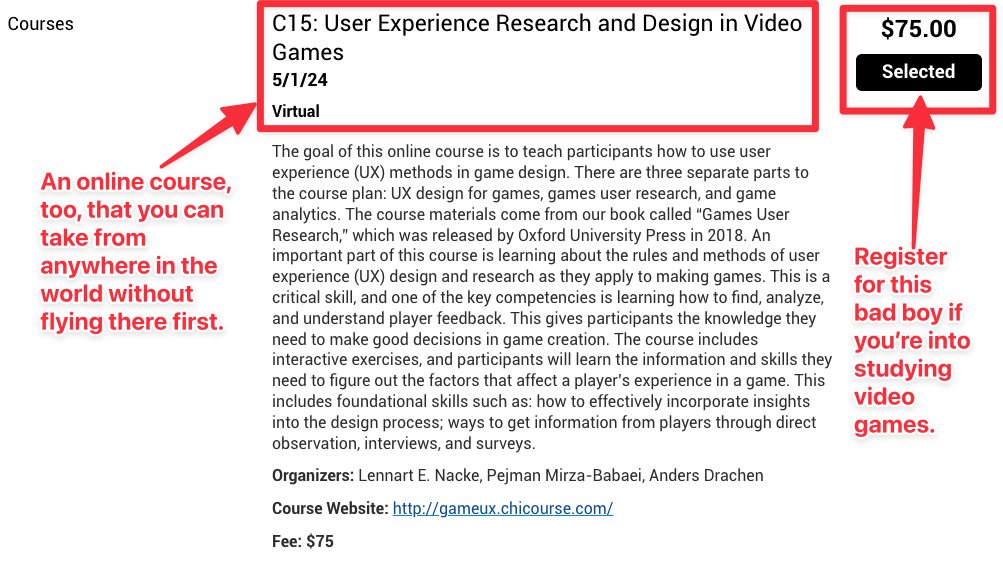
And in case, you're into video games research and user experience design at #chi2024, don't miss out on this other online course we are offering: C15: UX Research and Design in Video Games

And in case, you're into video games research and user experience design at #chi2024, don't miss out on this other online course we are offering:

C15: UX Research and Design in Video Games
The Game UX Podcast (and Book) (@gamesurbook) 's Twitter Profile Photo

Most GUR professionals need graduate degrees in psychology, computer science, or HCI. Here's what they actually do: - Design playtesting or user studies - Collect and synthesize data - Deliver actionable insights Without this foundation, games user research is guesswork.

The Game UX Podcast (and Book) (@gamesurbook) 's Twitter Profile Photo

5 core roles in games user research teams: Researcher - designs studies & analyzes data Moderator - runs player tests & collects feedback Analyst - crunches numbers & finds patterns Recruiter - finds the right players to test Lab Tech - keeps equipment running smoothly

5 core roles in games user research teams:

Researcher - designs studies & analyzes data
Moderator - runs player tests & collects feedback
Analyst - crunches numbers & finds patterns
Recruiter - finds the right players to test
Lab Tech - keeps equipment running smoothly
The Game UX Podcast (and Book) (@gamesurbook) 's Twitter Profile Photo

Great user research starts with great briefings. Use a standard template to cover: - Player profiles and demographics - Hard deadlines and milestones - Clear research objectives - Previous study findings Templates let junior researchers ask the same smart questions as seniors.

The Game UX Podcast (and Book) (@gamesurbook) 's Twitter Profile Photo

Rookie Game UX researchers: - Ask random questions - Wing client meetings - Miss critical details Veteran Game UX researchers: - Cover all key areas systematically - Follow detailed templates - Document everything live Preparation separates pros from amateurs.

The Game UX Podcast (and Book) (@gamesurbook) 's Twitter Profile Photo

Small GUR teams: - Complete tasks in sequence - One person does everything - Slow turnaround times Mature GUR teams: - Deliver player insights faster - Specialized role divisions - Parallel task execution Scale changes everything.

The Game UX Podcast (and Book) (@gamesurbook) 's Twitter Profile Photo

Traditional UX removes every obstacle. Game design creates them intentionally. What does this mean for Game UX? Apps make us passive consumers, while games make us active problem-solvers. Maybe the secret to engagement isn't removing friction but designing the right friction.

The Game UX Podcast (and Book) (@gamesurbook) 's Twitter Profile Photo

3 reasons to template your user research briefings: Creates live documentation during meetings Standardizes knowledge across your team No critical questions get missed The best UX researchers never wing the most crucial conversation.

The Game UX Podcast (and Book) (@gamesurbook) 's Twitter Profile Photo

Most game companies start their user research with one person doing everything. Recruiting players, running tests, analyzing data, fixing equipment. But as teams grow, smart companies split these roles. Why? Parallel work beats sequential work every time.

The Game UX Podcast (and Book) (@gamesurbook) 's Twitter Profile Photo

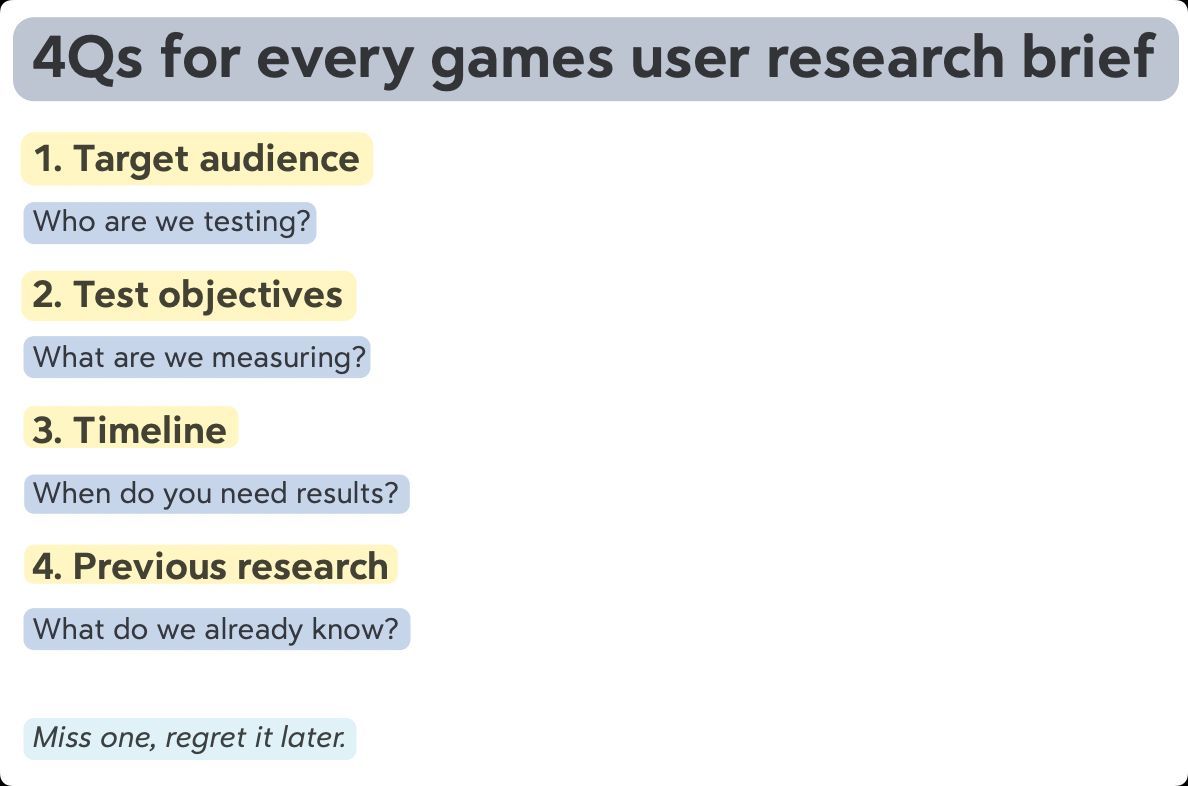
4 essential questions for every games research brief: Target audience - who are we testing? Test objectives - what are we measuring? Timeline - when do you need results? Previous research - what do we already know? Miss one, regret it later.

4 essential questions for every games research brief:

Target audience - who are we testing?
Test objectives - what are we measuring?
Timeline - when do you need results?
Previous research - what do we already know?

Miss one, regret it later.
The Game UX Podcast (and Book) (@gamesurbook) 's Twitter Profile Photo

3 reasons to split GUR responsibilities across multiple people: 1. Aligns research timeline with game production 2. Develops deep expertise in each area 3. Enables parallel workflow execution One researcher can start, but teams scale impact.

The Game UX Podcast (and Book) (@gamesurbook) 's Twitter Profile Photo

Game designers know about dopamine and Skinner Boxes. But that explains only 20% of what makes games compelling. Why most designers plateau (and what to learn instead):