
Evgeniia (Yev) Diachek (@ediachek) 's Twitter Profile
Evgeniia (Yev) Diachek

@ediachek

Cognitive Scientist | Formerly @VanderbiltU ⚓️ | she/her

ID: 1010600655575273472

calendar_today23-06-2018 19:09:07

193 Tweet

356 Takipçi

470 Takip Edilen

Neal Morton (@nealwmorton) 's Twitter Profile Photo

Free recall experiments provide rich information about memory function, but analyzing free recall data can be complex and difficult. My Python package, Psifr, makes it easy to perform sophisticated analysis of free recall performance and organization. psifr.readthedocs.io/en/latest/inde… 🧵

Free recall experiments provide rich information about memory function, but analyzing free recall data can be complex and difficult. My Python package, Psifr, makes it easy to perform sophisticated analysis of free recall performance and organization. psifr.readthedocs.io/en/latest/inde… 🧵
Evgeniia (Yev) Diachek (@ediachek) 's Twitter Profile Photo

Stop by our #psynom22 poster tonight 5:00-7:00pm! Sarah Brown-Schmidt and I looked at how various linguistic features of spontaneous speech such as disfluency and backchanneling impact conversational recall.

Stop by our #psynom22 poster tonight 5:00-7:00pm! <a href="/brownschmidt/">Sarah Brown-Schmidt</a> and I looked at how various linguistic features of spontaneous speech such as disfluency and backchanneling impact conversational recall.
Psychonomic Society (@psychonomic_soc) 's Twitter Profile Photo

Great conversations starting at the poster session! Here's Evgeniia (Yev) Diachek talking about her work on factors that predict what people remember from conversations!
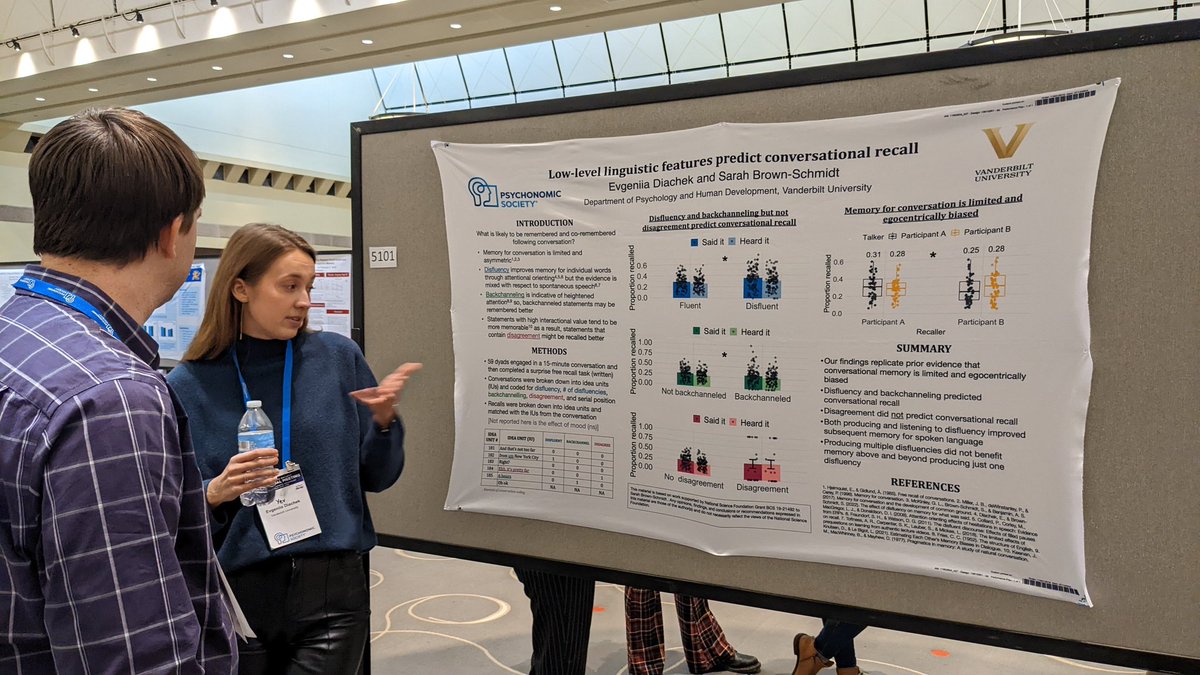

Great conversations starting at the poster session!

Here's <a href="/ediachek/">Evgeniia (Yev) Diachek</a> talking about her work on factors that predict what people remember from conversations!

Ethan Mollick (@emollick) 's Twitter Profile Photo

Avoiding "ums" and "ahs" when you speak may actually make what you say less memorable, since these "speech disfluencies" appear to serve a real purpose. They boost a listener's memory of whatever comes immediately afterwards by focusing our attention. psycnet.apa.org/fulltext/2022-…
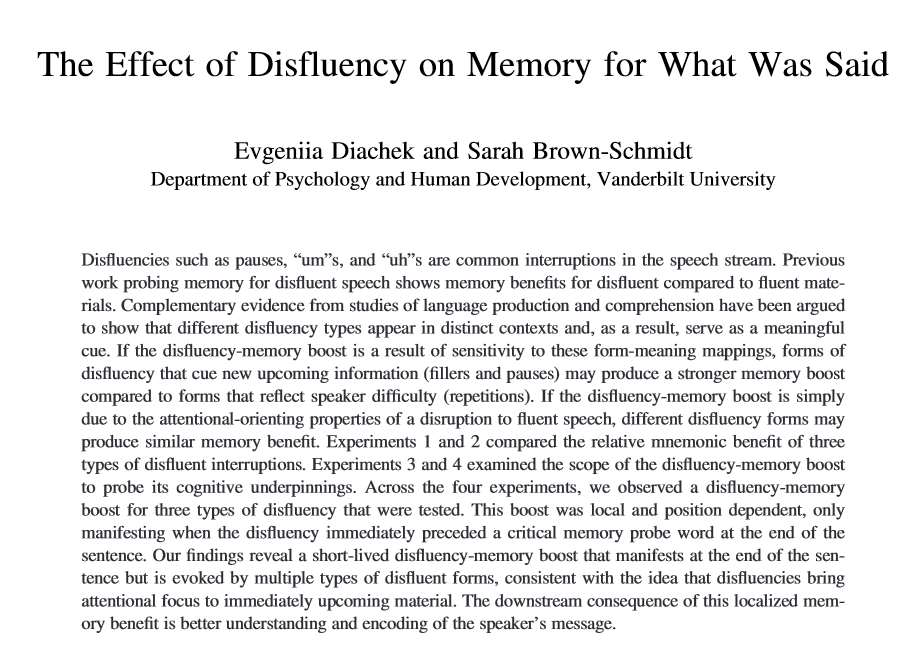
Avoiding "ums" and "ahs" when you speak may actually make what you say less memorable, since these "speech disfluencies" appear to serve a real purpose.

They boost a listener's memory of whatever comes immediately afterwards by focusing our attention. psycnet.apa.org/fulltext/2022-…

CogitErgo (@asso_cogitergo) 's Twitter Profile Photo

Une récente étude de #psychologie (Diachek & Brown-Schmidt, 2022) montre que ponctuer son discours de "euh" permettrait d'en faciliter sa mémorisation ! Voici un court thread 🧵 pour vous expliquer comment les chercheurs sont venus à cette conclusion.

Adam Grant (@adammgrant) 's Twitter Profile Photo

It's a mistake to stop saying "um" and "uh" altogether. Evidence: filler words signal that new information is coming, making it easier for listeners to understand and remember what comes next. Hesitations don't make you sound weak. They help you... uh... communicate clearly.

It's a mistake to stop saying "um" and "uh" altogether.

Evidence: filler words signal that new information is coming, making it easier for listeners to understand and remember what comes next.

Hesitations don't make you sound weak. They help you... uh... communicate clearly.
Evgeniia (Yev) Diachek (@ediachek) 's Twitter Profile Photo

Love seeing so much interest in our work🤩 That’s right: speech disfluencies aid language processing and improve memory for what was said Sarah Brown-Schmidt Posting the link to our American Psychological Association JEP:LMC paper for anyone who might be interested psycnet.apa.org/doiLanding?doi…

Psychonomic Society (@psychonomic_soc) 's Twitter Profile Photo

We started our new Science Communication internship, and in this interview, Laura Mickes interviewed new intern, Raunak Pillai. Get to know him here, and stay tuned for his upcoming posts. featuredcontent.psychonomic.org/interview-with…

We started our new Science Communication internship, and in this interview, <a href="/lmickes/">Laura Mickes</a> interviewed new intern, <a href="/PillaiRaunak/">Raunak Pillai</a>. Get to know him here, and stay tuned for his upcoming posts.

featuredcontent.psychonomic.org/interview-with…
Steven Kapp (@drstevenkapp) 's Twitter Profile Photo

Speech disfluencies (e.g. "um", "uh" improve listeners' memory for speech (new research). They might also buy time for speakers to think (my commentary). *Other* researchers make ableist claim that "um" is better than "uh" because autistics say it less. 🔗ir.vanderbilt.edu/bitstream/hand…

Sarah Brown-Schmidt (@brownschmidt) 's Twitter Profile Photo

My lab is hiring a project coordinator! The Conversation Lab at Vanderbilt University is accepting applications for the position of Project Coordinator in the lab of Dr. Sarah Brown-Schmidt at Vanderbilt University. Info about the lab: sarahbrownschmidt.com/lab-page/

Gavin Newsom (@gavinnewsom) 's Twitter Profile Photo

Tennessee has the 8th highest murder rate in the nation. It ranks 44th among states for health outcomes. And this is what the Governor is focused on.

Laura Gwilliams (@gwilliamsl) 's Twitter Profile Photo

⚡️The Laboratory of Speech Neuroscience Wu Tsai Neurosciences Institute is hiring a Lab Manager!⚡️ Successful candidates will have a passion for scientific discovery and a love of IRB protocols :) To be considered, please complete this application: forms.gle/tahitsPXokMX3F… Grateful for RTs! 🙌

OOIR (@observeir) 's Twitter Profile Photo

Trending in #ExperimentalPsychology: ooir.org/index.php?fiel… 1) Happiness strategies (Nature Human Behaviour) 2) Effect of disfluency on memory for what was said 3) AI & the essence of human empathy 4) Scientific publishing has a language problem 5) Empowerment leads to exploration
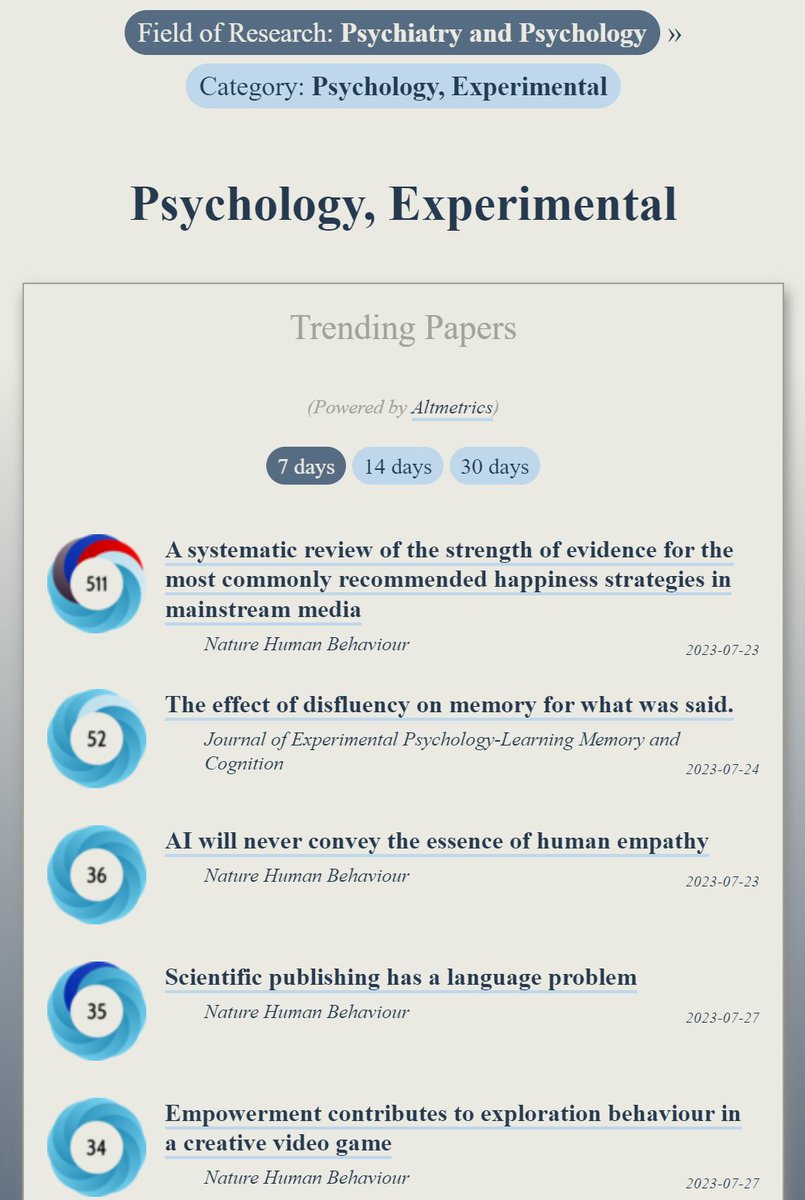
Trending in #ExperimentalPsychology:
ooir.org/index.php?fiel…

1) Happiness strategies (<a href="/NatureHumBehav/">Nature Human Behaviour</a>)

2) Effect of disfluency on memory for what was said

3) AI &amp; the essence of human empathy

4) Scientific publishing has a language problem

5) Empowerment leads to exploration