Ziv Reich's lab (@zivreichlab) 's Twitter Profile
Ziv Reich's lab

@zivreichlab

Account managed by members of Ziv Reich's lab at the Weizmann Institute

ID: 1554006896226566148

calendar_today01-08-2022 07:31:47

13 Tweet

33 Followers

51 Following

Maor Knafo (@maorknak) 's Twitter Profile Photo

🎉New publication alert!🎉 (First yeast one!!🍞🍺) Ever wondered what your life could have been if you'd made different choices? How much of you is determined by your genes? For yeast cells, we have answers! [1/9] journals.plos.org/plosone/articl…

Maor Knafo (@maorknak) 's Twitter Profile Photo

🚨 New preprint alert! 🚨 biorxiv.org/content/10.110… Is microbiome surveying accurate? Meaningful? Robust? For the most part, the answer is sadly underwhelming, especially for those working in undersampled niches. 1/8

Maor Knafo (@maorknak) 's Twitter Profile Photo

A new #preprint! Variability is strange, right? Especially when it arises in the background of an identical genetic background. Why would cells, having the same machinery, regulation, and environment, behave differently? Why would there be #noise? 1/13 rb.gy/45y36m

A new #preprint! Variability is strange, right? Especially when it arises in the background of an identical genetic background. Why would cells, having the same machinery, regulation, and environment, behave differently? Why would there be #noise? 1/13 rb.gy/45y36m
PacBio (@pacbio) 's Twitter Profile Photo

Here, the authors describe CosMIC as a hybrid approach for large-scale, high-resolution microbial profiling of novel niches. This powerful tool for profiling microbial diversity detected over 40,000 novel small subunits. bit.ly/3RFSw6o #PoweredByPacBio

Here, the authors describe CosMIC as a hybrid approach for large-scale, high-resolution microbial profiling of novel niches. This powerful tool for profiling microbial diversity detected over 40,000 novel small subunits.

bit.ly/3RFSw6o

#PoweredByPacBio
Maor Knafo (@maorknak) 's Twitter Profile Photo

We (finally) managed to publish the first part of my PhD! In many ways, this work challenged most of the fundamental stuff I think about how yeast adapt to stress, the roles and mechanisms of inducing variability, and how we should even approach approximating it.

PRX Life (@prx_life) 's Twitter Profile Photo

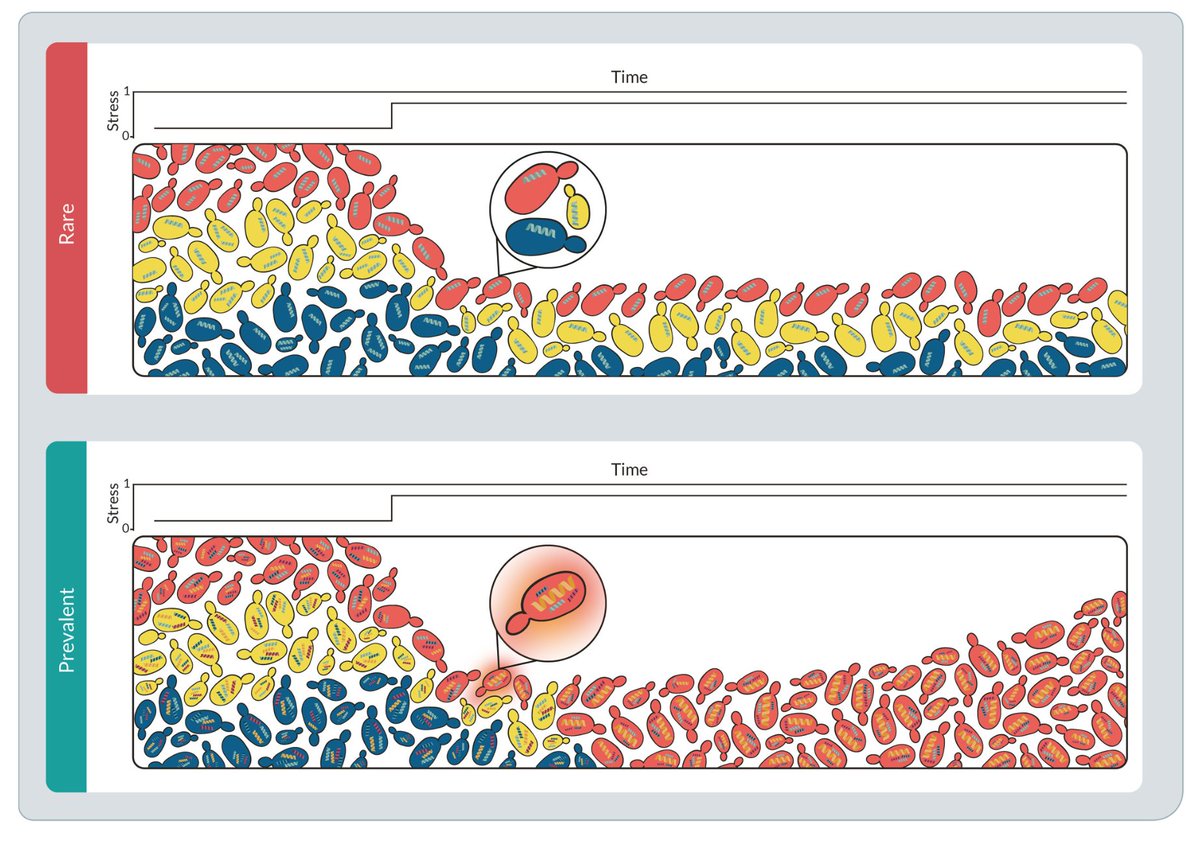
With a DNA barcoding method called gUMI-BEAR, scientists show how yeast populations adapt to environmental stressors through two distinct modes depending on stress type — rare or prevalent — indicated by their gene expression variability. Read the paper: go.aps.org/40W3OrX

With a DNA barcoding method called gUMI-BEAR, scientists show how yeast populations adapt to environmental stressors through two distinct modes depending on stress type — rare or prevalent — indicated by their gene expression variability.

Read the paper: go.aps.org/40W3OrX