SolarCoin (@solarcoin_slr) 's Twitter Profile
SolarCoin

@solarcoin_slr

We bring the #Solarity. Free Reward for solar energy producers in +130 countries. medium.com/solarcoin/sola…

ID: 2244295159

linkhttps://solarcoin.org calendar_today13-12-2013 18:28:25

3,3K Tweet

7,7K Followers

2,2K Following

SolarCoin (@solarcoin_slr) 's Twitter Profile Photo

Beyond the major markets, "Other Countries" contribute 6M <20kW systems, adding $3B–$60B in potential SolarCoin market cap—proof that the long tail of rooftops really matters.

SolarCoin (@solarcoin_slr) 's Twitter Profile Photo

A 20% global growth rate in <20kW installs during 2025 implies ~9M new potential SolarCoin nodes in a single year, layering $4.5B–$90B in incremental network value.

SolarCoin (@solarcoin_slr) 's Twitter Profile Photo

Europe's triad—Germany, Italy, Netherlands—totals ~8.9M small systems, implying $4.45B–$89B in SolarCoin market cap potential from just three tightly connected markets.

SolarCoin (@solarcoin_slr) 's Twitter Profile Photo

Slower-growth but mature markets such as the UK still play a key role for SolarCoin, anchoring stable node clusters that complement hyper-growth regions like India and Brazil.

SolarCoin (@solarcoin_slr) 's Twitter Profile Photo

In emerging markets like Brazil and India, policy support plus falling PV costs are turning every new rooftop into a potential SolarCoin node—high-growth network capital in the making.

SolarCoin (@solarcoin_slr) 's Twitter Profile Photo

Put together, non‑China solar nodes by end‡2025 make SolarCoin one of the few crypto networks whose addressable market is physically installed and metered today—ready to be tokenized country by country.

SolarCoin (@solarcoin_slr) 's Twitter Profile Photo

AI inference just broke every record in the history of technology learning curves. 89.1% cost reduction per doubling of cumulative production — the highest Wright's Law learning rate ever measured across 150 technologies. Not Moore's Law. Not solar. NOTHING comes close. 🌊

SolarCoin (@solarcoin_slr) 's Twitter Profile Photo

Solar PV's ~20% learning rate rewired the global electricity grid & made fossil fuels cry uncle. AI inference is at 89%. If solar was a garden hose of abundance, AI inference is Niagara Falls. Every doubling of usage = costs nearly halved again. This is not hype. This is

SolarCoin (@solarcoin_slr) 's Twitter Profile Photo

Wright's Law: every time cumulative production doubles, costs fall by a fixed %. First observed in airplane manufacturing in 1936. It's the secret physics of industrial civilization. Solar, batteries, DNA sequencing — all follow it. Now AI inference tops them all. ✨

SolarCoin (@solarcoin_slr) 's Twitter Profile Photo

The paper introduces “Phi-s” — Symbolic Efficacy — combining compute cost, energy efficiency, algorithmic gains & deployment reach. From 2012–2024, Phi-s grew ~10⁸x, doubling every 6 months. Moore’s Law doubled every ~2 years. AI is lapping it twice over. 🚀

SolarCoin (@solarcoin_slr) 's Twitter Profile Photo

The flipside of Wright's Law: nuclear power shows NEGATIVE learning (-88.1%). Every time we doubled nuclear production, it got MORE expensive. The more we built, the worse it got. Meanwhile AI inference shows +89.1% learning. Light and dark sides of the same empirical law. ⛛️❌

SolarCoin (@solarcoin_slr) 's Twitter Profile Photo

Carbon removal (CDR) tech shows early learning rates of 5–16% — exactly where solar PV was in the 1980s. Solar in the 80s looked too expensive to matter. Now it’s the cheapest electricity in history. CDR is at the same inflection. Deploy more → costs crater. 🌱

SolarCoin (@solarcoin_slr) 's Twitter Profile Photo

In 1990, a phone call from NYC to London cost $3/min. Cumulative volume drove it to fractions of a cent. AI inference is on the same trajectory but 4x faster. The intelligence phone call is becoming too cheap to meter — delivering benefits to the global south & small businesses

SolarCoin (@solarcoin_slr) 's Twitter Profile Photo

The GPU compute cost curve has R² = 0.995. That means Wright’s Law explains 99.5% of the variance in AI cost declines. This isn’t a theory or a projection — it’s one of the tightest empirical fits in the history of technology economics. Plan accordingly. 📉

SolarCoin (@solarcoin_slr) 's Twitter Profile Photo

The median learning rate across 150 technologies is 20.9%. If you’re modeling AI inference costs as “flat” or “slowly declining,” your model is wrong by a factor of 4x. Policy, procurement, and investment models built on static AI cost assumptions will be obsolete before they’re

SolarCoin (@solarcoin_slr) 's Twitter Profile Photo

Solar didn’t just get cheap. It restructured geopolitics, democratized energy, & is decarbonizing civilization. AI inference is following a faster, steeper learning curve & will do the same for intelligence itself. This paper is the empirical proof. Read it. New paper by

Bloomberg (@business) 's Twitter Profile Photo

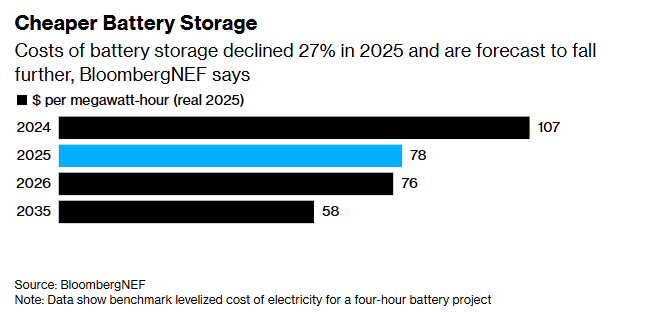
A US solar trade group sees the energy storage market growing by 21% this year as demand for batteries outweighs policy headwinds bloomberg.com/news/articles/…

pv magazine (@pvmagazine) 's Twitter Profile Photo

Solar LCOE to fall 30% by 2035, says BloombergNEF: Analysis from BloombergNEF finds the levelized cost of electricity (LCOE) of a typical fixed-axis solar farm increased by 6% year-on-year in 2025 to stand… dlvr.it/TR6MSh #Photovoltaics #EnergyStorage #RenewableEnergy

Solar LCOE to fall 30% by 2035, says BloombergNEF: Analysis from BloombergNEF finds the levelized cost of electricity (LCOE) of a typical fixed-axis solar farm increased by 6% year-on-year in 2025 to stand… dlvr.it/TR6MSh #Photovoltaics #EnergyStorage #RenewableEnergy