Rhien Hare (@rhienehare) 's Twitter Profile
Rhien Hare

@rhienehare

MPH @SFU | @goufv alum | Menstrual Health | Proteomics | Communicating science @stellatecomms |she/her 🩸👩🏼‍🔬🏳️‍🌈

ID: 1449108532217847809

calendar_today15-10-2021 20:23:04

245 Tweet

150 Followers

358 Following

Lin Tian, PhD (@lintianphd) 's Twitter Profile Photo

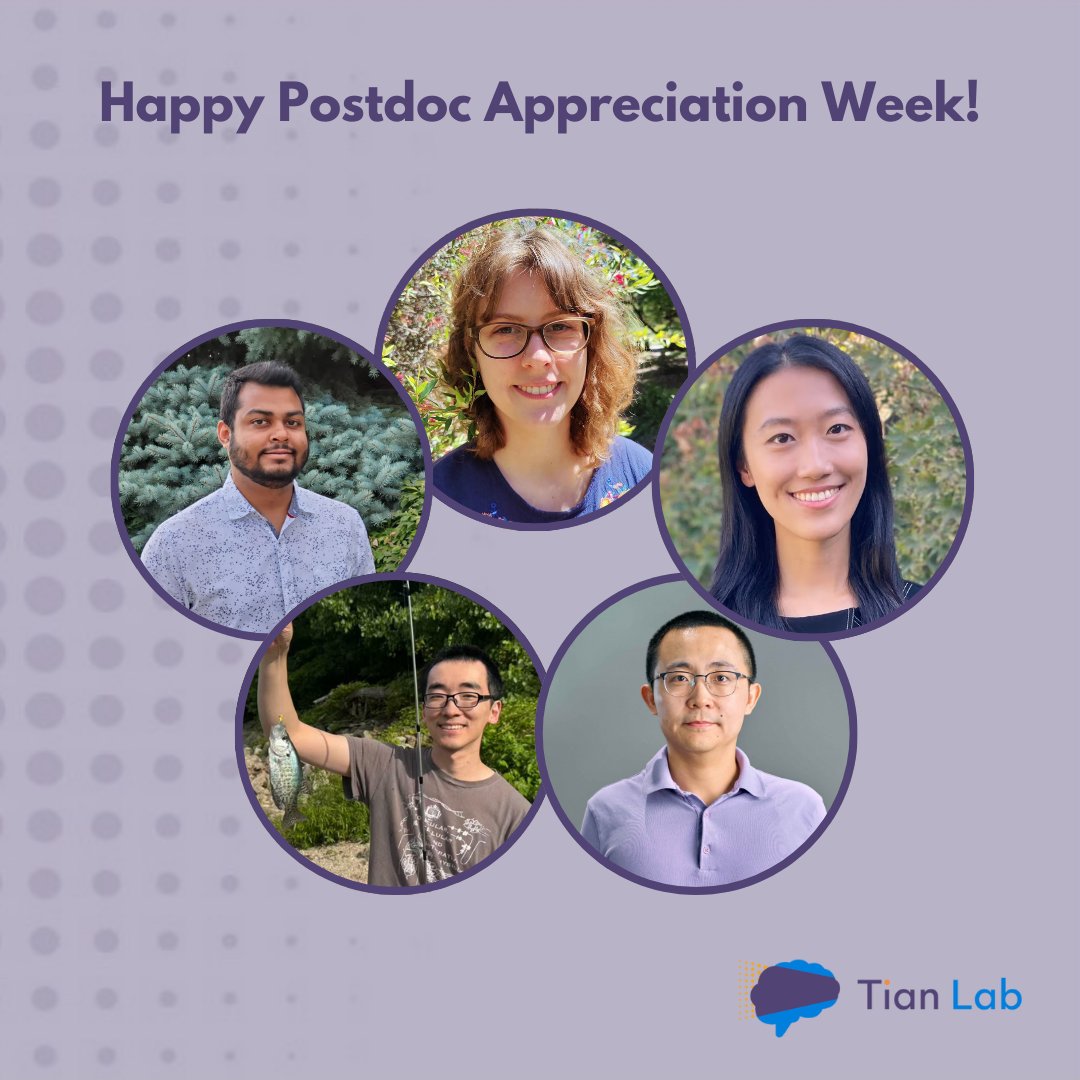
This week is National Postdoc Appreciation Week, and we couldn't be prouder of our postdocs in the Tian Lab! ✨ Our postdocs drive forward research, plan and lead projects, mentor students, present and publish work, and much more. I am grateful for you every day! #NPAW2025

This week is National Postdoc Appreciation Week, and we couldn't be prouder of our postdocs in the Tian Lab! ✨

Our postdocs drive forward research, plan and lead projects, mentor students, present and publish work, and much more. I am grateful for you every day!

#NPAW2025
Arc Institute (@arcinstitute) 's Twitter Profile Photo

In another preprint from the @brianhie Lab and Xiaojing Gao, they introduce Germinal, a generative AI system for de novo antibody design. Germinal produces functional nanobodies in just dozens of tests, making custom antibody design more accessible than ever before.
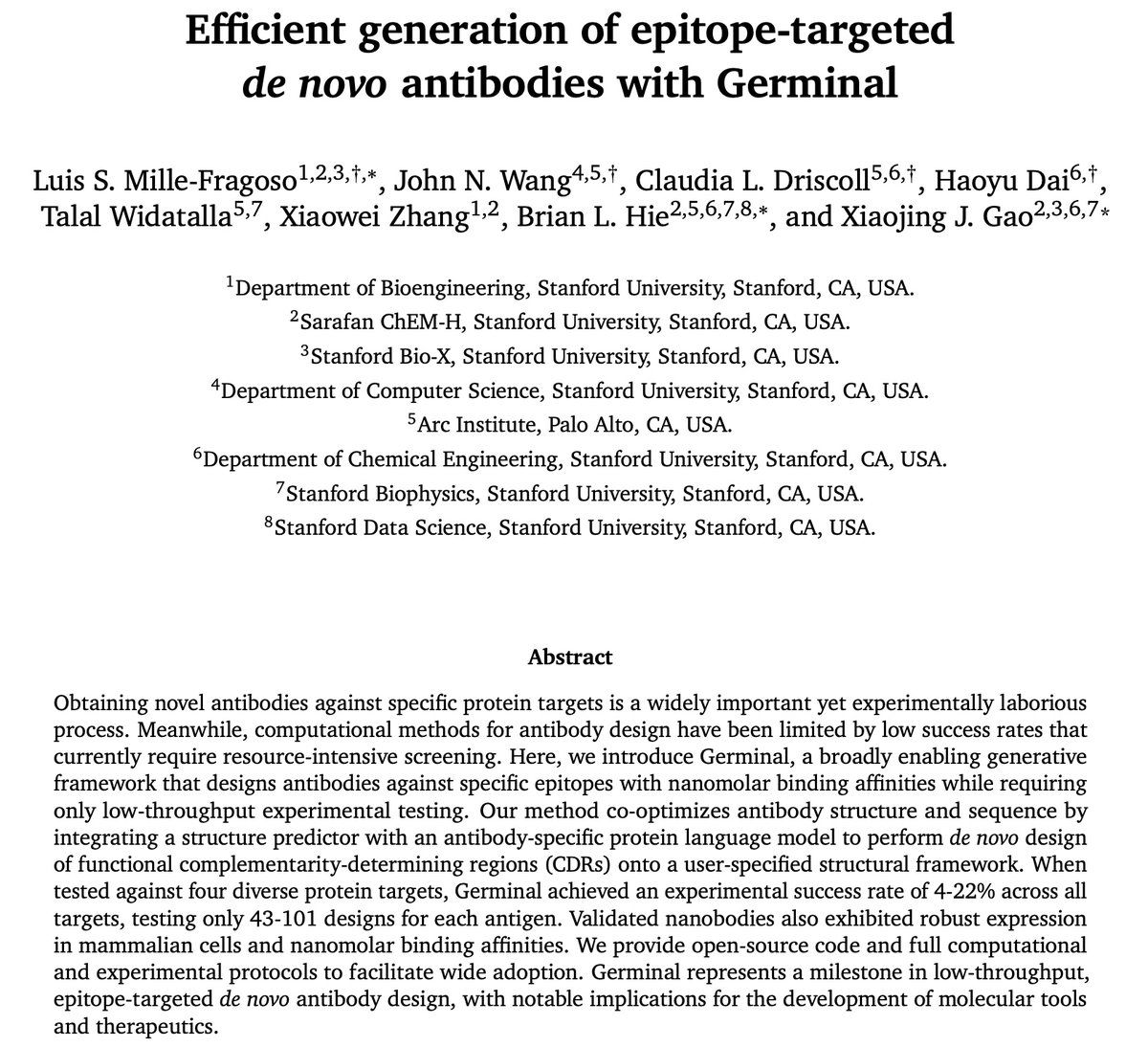
In another preprint from the @brianhie Lab and <a href="/SynBioGaoLab/">Xiaojing Gao</a>, they introduce Germinal, a generative AI system for de novo antibody design.

Germinal produces functional nanobodies in just dozens of tests, making custom antibody design more accessible than ever before.
Arc Institute (@arcinstitute) 's Twitter Profile Photo

For decades, human genome editing has been limited to small, localized modifications. Today, in a new paper published in Science Magazine, researchers from the Patrick Hsu lab show that bridge recombinase technology is capable of large-scale genomic rearrangements in human cells.
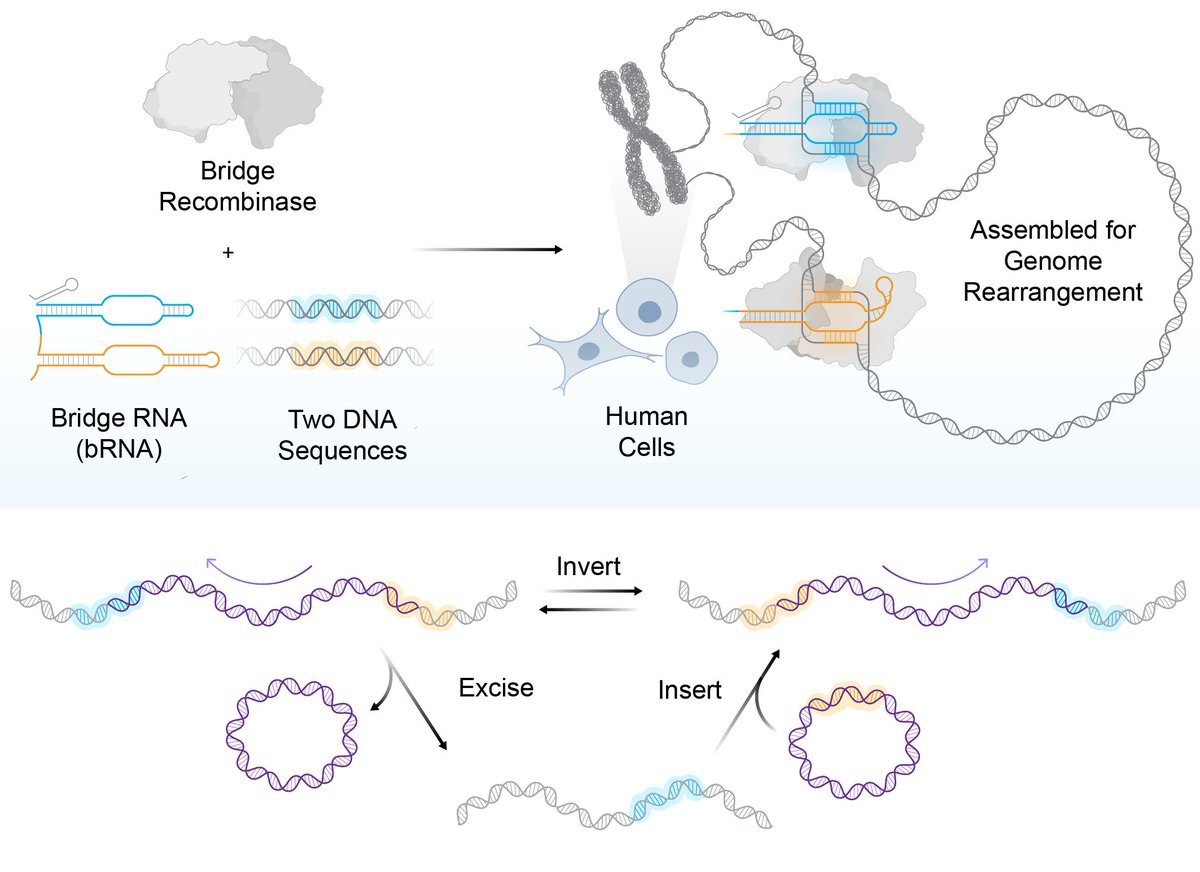
For decades, human genome editing has been limited to small, localized modifications.

Today, in a new paper published in <a href="/ScienceMagazine/">Science Magazine</a>, researchers from the <a href="/pdhsu/">Patrick Hsu</a> lab show that bridge recombinase technology is capable of large-scale genomic rearrangements in human cells.
Nicholas Perry (@ntperry13) 's Twitter Profile Photo

Excited to share that my PhD thesis work is out in Science Magazine today. We demonstrate robust rearrangement of the human genome using bridge recombinases, performing programmable insertions, excisions, and inversions at megabase-scale.


Excited to share that my PhD thesis work is out in <a href="/ScienceMagazine/">Science Magazine</a> today. We demonstrate robust rearrangement of the human genome using bridge recombinases, performing programmable insertions, excisions, and inversions at megabase-scale.

Yasmin Hurd, PhD (@neurovoice) 's Twitter Profile Photo

Happy to share that our Comprehensive Adolescent Rehabilitation and Education Service (CARES) is now in a new location where we're better equipped to help the youth of New York. Congratulations to the team, and special shout out to CARES Director, Shilpa Taufique 🎉

Happy to share that our Comprehensive Adolescent Rehabilitation and Education Service (CARES) is now in a new location where we're better equipped to help the youth of New York.

Congratulations to the team, and special shout out to CARES Director, Shilpa Taufique 🎉
Ignacio Saez, PhD (@ignaciosaezphd) 's Twitter Profile Photo

I left this year’s One Mind music festival feeling truly inspired by the advances in mental health research & awareness that, together, are cracking the future of care wide open. Proud to be part of this community alongside peers like Maryam Shanechi & Lugo Lab!

I left this year’s <a href="/OneMindOrg/">One Mind</a> music festival feeling truly inspired by the advances in mental health research &amp; awareness that, together, are cracking the future of care wide open.

Proud to be part of this community alongside peers like <a href="/MaryamShanechi/">Maryam Shanechi</a> &amp; <a href="/the_lugo_lab/">Lugo Lab</a>!
Arc Institute (@arcinstitute) 's Twitter Profile Photo

Arc's community continues to grow this fall with our 9th Core Investigator John Pluvinage and 3rd Science Fellow Maya Arce joining us in Palo Alto, along with 7 Innovation Investigators and 15 Ignite Awardees at our partner universities. Learn more: arcinstitute.org/news/faculty-a…

Ignacio Saez, PhD (@ignaciosaezphd) 's Twitter Profile Photo

"It takes a village!" and I'm incredibly grateful to be a part of this one. It’s inspiring to witness the growing community driving cutting-edge #BCI research from the bench to real life at #NYBCI25. Thanks to @mountsinaineuro and all attendees for a great event 🧠

Optogenetics Gordon Research Conference (@optogrc) 's Twitter Profile Photo

In 2016, the first Opto GRC was created to bring together scientists pushing the boundaries of optogenetics research 🧠🌟 Join us to celebrate 10 incredible years of collaboration and discovery—applications for #OptoGRC2026 are now open! Apply now: grc.org/optogenetic-ap…

In 2016, the first Opto GRC was created to bring together scientists pushing the boundaries of optogenetics research 🧠🌟

Join us to celebrate 10 incredible years of collaboration and discovery—applications for #OptoGRC2026 are now open!

Apply now: grc.org/optogenetic-ap…
Arc Institute (@arcinstitute) 's Twitter Profile Photo

Published today in Nature Biotechnology, Laine Goudy. LukeGilbert, Alex Marson, and colleagues report a new epigenetic editing platform that safely reprograms multiple genes in human T cells without many of the challenges & risks associated with traditional gene editing approaches.


Published today in <a href="/NatureBiotech/">Nature Biotechnology</a>, <a href="/LaineGoudy/">Laine Goudy</a>. <a href="/LukeGilbertSF/">LukeGilbert</a>, Alex Marson, and colleagues report a new epigenetic editing platform that safely reprograms multiple genes in human T cells without many of the challenges &amp; risks associated with traditional gene editing approaches.
Caitlin Vander Weele, PhD (@caitvw) 's Twitter Profile Photo

👩🏻‍🔬Stellate Communications began with the idea that science deserves to be shared, understood & celebrated. This month we celebrate 5 years! To my team: thank you for believing in this dream as much as I do. You’re the magic behind it all & I'm so proud of what we’ve built ✨

Ignacio Saez, PhD (@ignaciosaezphd) 's Twitter Profile Photo

Must-read #NYBCI25 coverage by Naveen Rao in Forbes. My key takeaway on cognitive BCI: Our biggest limiting factor isn't tech—it's fundamental scientific understanding. We can’t advance the tech until we define the disorder. Basic research must lead the way!

Ignacio Saez, PhD (@ignaciosaezphd) 's Twitter Profile Photo

How mood states shift in the brain remains one of psychiatry’s biggest mysteries. With generous support from BD², our Friedman Brain Institute team will apply cutting-edge techniques to map these transitions—aiming to build the most precise understanding of bipolar disorder yet.

Arc Institute (@arcinstitute) 's Twitter Profile Photo

The genetic code is full of synonymous codons that, for decades, were assumed to be interchangeable. Today, with @NVIDIA, co-led by Hani Goodarzi, we announce CodonFM, a family of open-source AI models that reveal the grammar underlying codon choice: developer.nvidia.com/blog/introduci…

Arc Institute (@arcinstitute) 's Twitter Profile Photo

Welcome to our 9th Core Investigator and first physician-scientist, John Pluvinage (John Pluvinage). His team investigates the hidden overlap between autoimmunity and neurodegeneration, developing targeted treatments for mysterious neurological cases and common dementias.
Welcome to our 9th Core Investigator and first physician-scientist, John Pluvinage (<a href="/jvpluv/">John Pluvinage</a>). His team investigates the hidden overlap between autoimmunity and neurodegeneration, developing targeted treatments for mysterious neurological cases and common dementias.
Ignacio Saez, PhD (@ignaciosaezphd) 's Twitter Profile Photo

What does "Human-centered neural engineering and AI" mean? It means prioritizing the patient across the entire pipeline: Discovery, Design, and Delivery of neuro-engineering treatments for psychiatric disorders. Join me to discuss at IEEE Engineering Medicine and Biology Society #NER25 hosted by One Mind Accelerator
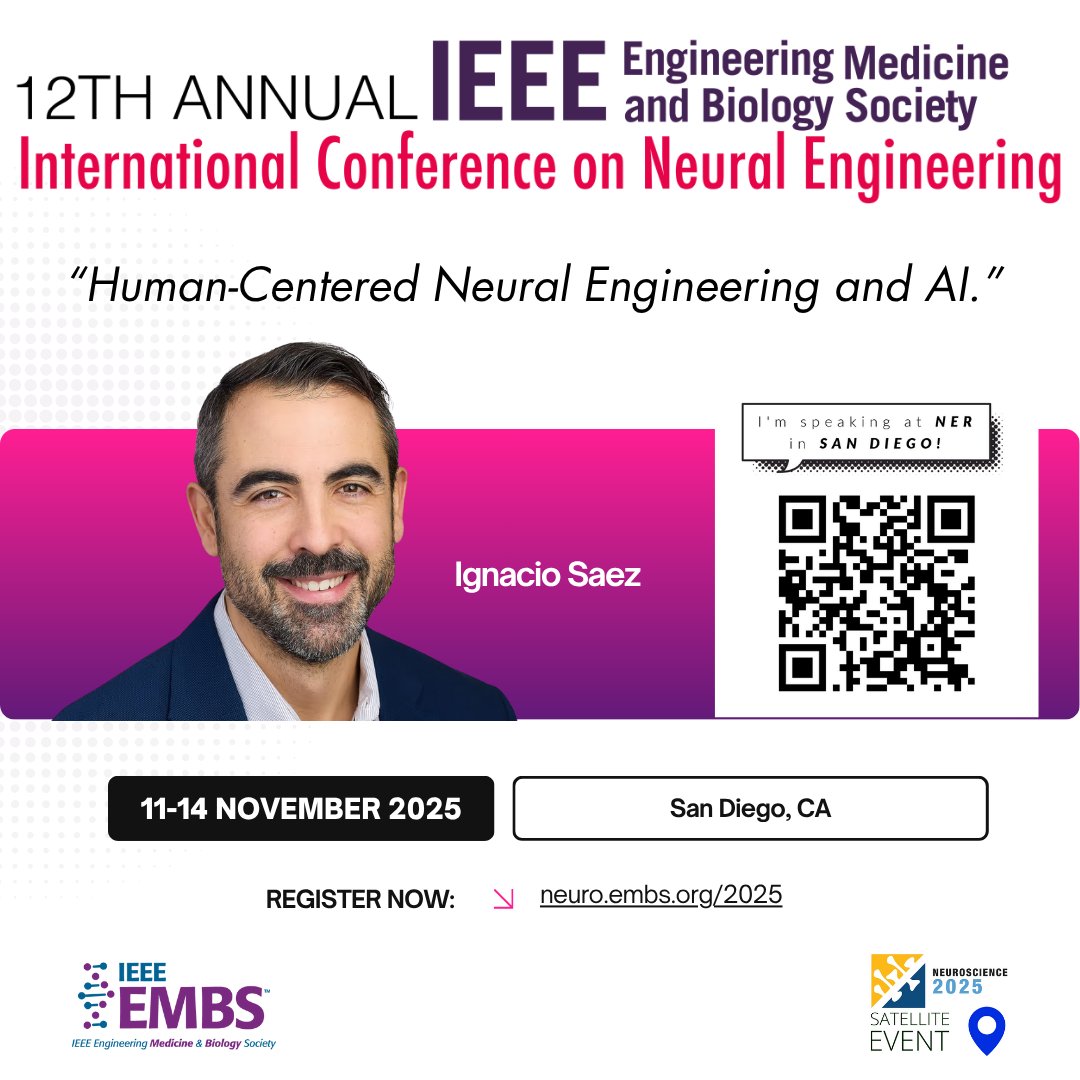
What does "Human-centered neural engineering and AI" mean?

It means prioritizing the patient across the entire pipeline: Discovery, Design, and Delivery of neuro-engineering treatments for psychiatric disorders.

Join me to discuss at <a href="/IEEEembs/">IEEE Engineering Medicine and Biology Society</a> #NER25 hosted by <a href="/OMAccelerator/">One Mind Accelerator</a>
Arc Institute (@arcinstitute) 's Twitter Profile Photo

A study out today in Nature Genetics from Core Investigator LukeGilbert, Haolong Li & others identifies PTGES3 as a critical regulator of androgen receptor (AR) protein levels in prostate cancer, revealing a potential new target for tumors that become treatment-resistant.

A study out today in <a href="/NatureGenet/">Nature Genetics</a> from Core Investigator <a href="/LukeGilbertSF/">LukeGilbert</a>, <a href="/li_haolong/">Haolong Li</a> &amp; others identifies PTGES3 as a critical regulator of androgen receptor (AR) protein levels in prostate cancer, revealing a potential new target for tumors that become treatment-resistant.
Arc Institute (@arcinstitute) 's Twitter Profile Photo

A study published today in Nature Biotechnology from the Patrick Hsu lab presents a new way to insert large DNA sequences into the genome using engineered recombinases that don’t require DNA cutting or rely on the cell's repair machinery.

A study published today in <a href="/NatureBiotech/">Nature Biotechnology</a> from the <a href="/pdhsu/">Patrick Hsu</a> lab presents a new way to insert large DNA sequences into the genome using engineered recombinases that don’t require DNA cutting or rely on the cell's repair machinery.
Arc Institute (@arcinstitute) 's Twitter Profile Photo

Hear from lead author, Alison Fanton as she walks through how the team achieved these results and what they could mean for the future of gene editing. Blog: arcinstitute.org/news/large-ser… Video: youtube.com/watch?v=DHg_Tk…

Yasmin Hurd, PhD (@neurovoice) 's Twitter Profile Photo

Current research continues to emphasize that adolescents should not be consuming #cannabis and need to be better educated about its health impacts 🧠 Read more about the mental and physical effects of cannabis use on the brain ⬇️ psychologytoday.com/ca/blog/addict…