Reuben Hurst (@reubenhurst2) 's Twitter Profile
Reuben Hurst

@reubenhurst2

Assistant Professor at @SmithSchool via @UMich, @LSEnews, and @Dartmouth.

ID: 2347875006

linkhttps://sites.google.com/umich.edu/reubenhurst calendar_today17-02-2014 04:10:43

111 Tweet

232 Takipçi

899 Takip Edilen

Charlotte Cavaille (@charlottecavai1) 's Twitter Profile Photo

People who favor a policy do not always care about it to the same degree. In this paper, forthcoming at PSRM, we examine alternative ways of measuring differences in "preference intensity" (1/5) charlottecavaille.wordpress.com/published-pape…

Chris Rider (chrisrider.bsky.social) (@profchrisrider) 's Twitter Profile Photo

Join us at the inaugural *Equitable Opportunity Conference* at Ross School of Business on June 6-7, 2024. Theme: Organizations shape socioeconomic opportunities in ways that more/less align w/notions of fairness & justice. Submission/registration link below. tinyurl.com/UMRSB-EOC


Max Kagan (@max_kagan) 's Twitter Profile Photo

Polarization is a rising issue. We worry about political sorting in social media and in real life. But what about at work? Is work a place where we are exposed to partisan diversity, or just another echo chamber? Read on for a 🧵about our working paper… papers.ssrn.com/sol3/papers.cf…

American Political Science Review (@apsrjournal) 's Twitter Profile Photo

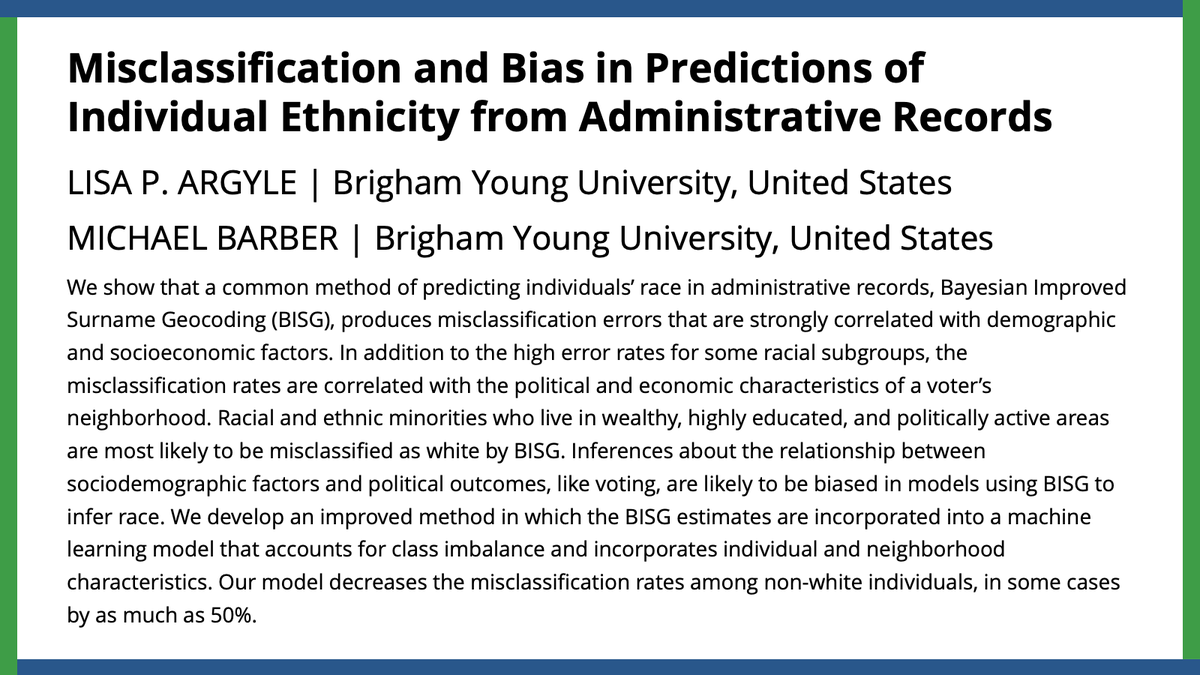
In this #APSRNewIssue article, Lisa Argyle & Mike Barber introduce a new machine learning influenced method to correct for misclassification in Bayesian Improved Surname Geocoding (BISG), reducing the misclassification error by up to 50 percent. ow.ly/9xwe50RIzQi

In this #APSRNewIssue article, <a href="/lpargyle/">Lisa Argyle</a> &amp; <a href="/mbarber83/">Mike Barber</a> introduce a new machine learning influenced method to correct for misclassification in Bayesian Improved Surname Geocoding (BISG), reducing the misclassification error by up to 50 percent. 

ow.ly/9xwe50RIzQi
Brian Kelleher Richter (@briankrichter) 's Twitter Profile Photo

Find my co-authored paper "Are Firms Gerrymandered", forthcoming at American Political Science Review, in open-access pre-print online. In it we provide the first evidence that firms, not jut voters, are gerrymandered. #gerrymandering


Find my co-authored paper "Are Firms Gerrymandered", forthcoming at <a href="/apsrjournal/">American Political Science Review</a>, in open-access  pre-print online.  

In it we provide the first evidence that firms, not jut voters, are gerrymandered.  

#gerrymandering
Benjamin Egerod (@bcegerod) 's Twitter Profile Photo

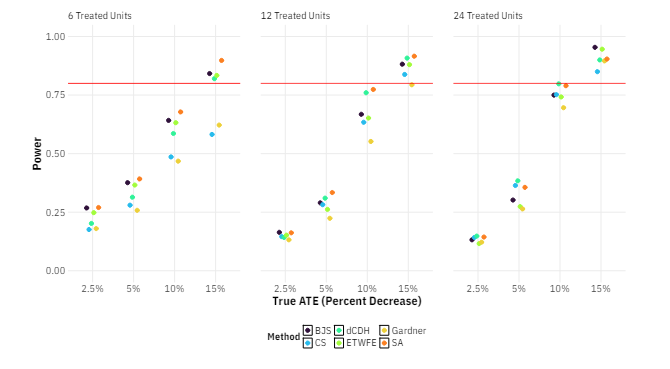
How much data do you need to conduct an informative staggered diff-in-diff? In our new working paper Florian Hollenbach 🤷🏻‍♂️ and I simulate the power of #DiD estimators, and find that you might need *a lot*, even to detect large effects. We also provide suggestions for improving power 1/
How much data do you need to conduct an informative staggered diff-in-diff? In our new working paper <a href="/fhollenbach/">Florian Hollenbach 🤷🏻‍♂️</a> and I simulate the power of #DiD estimators, and find that you might need *a lot*, even to detect large effects. We also provide suggestions for improving power 1/
Max Kagan (@max_kagan) 's Twitter Profile Photo

Very interesting data on segregation by gender in the US workforce. In a working paper with Reuben Hurst and Justin Frake we use administrative data and find that gender segregation is about the same size as segregation by political partisanship. hq.ssrn.com/submissions/Ab…

Jon Hartley (@jon_hartley_) 's Twitter Profile Photo

Excited to see our paper published in JPE Micro! “Do Pre-Registration and Pre-Analysis Plans Reduce p-Hacking and Publication Bias?: Evidence from 15,992 Test Statistics and Suggestions for Improvement” w/ Abel Brodeur, Nikolai Cook (Nikolai M. Cook), and Anthony Heyes. A thread🧵

Grady Raines (@gradyraines_) 's Twitter Profile Photo

Excited to share the first chapter of my dissertation, out at ASQ Journal: "Cultural Norms and the Gendered Impact of Entrepreneurship Policy in Mexico," joint with Peter Polhill, Shon R. Hiatt, and Dr. Ryan Coles. A quick thread... journals.sagepub.com/doi/10.1177/00…

Excited to share the first chapter of my dissertation, out at <a href="/ASQJournal/">ASQ Journal</a>: "Cultural Norms and the Gendered Impact of Entrepreneurship Policy in Mexico," joint with <a href="/PeterPolhill/">Peter Polhill</a>, <a href="/ShonHiatt/">Shon R. Hiatt</a>, and <a href="/rcoles0007/">Dr. Ryan Coles</a>.

A quick thread... 
journals.sagepub.com/doi/10.1177/00…
Evan Starr (@evanpstarr) 's Twitter Profile Photo

My cousin’s artisan wood furniture business in Asheville, NC was completely destroyed by Hurricane Helene. Please consider donating to help him rebuild, or read his story and share with others. 🙏 gofundme.com/f/help-matt-ch…

Max Kagan (@max_kagan) 's Twitter Profile Photo

1/ Excited to share our new paper on measuring workforce politics with Reuben Hurst and Justin Frake , where we measure the partisan composition (Democrats and Republicans) for over 3.5 million companies and nearly 28 million workers.

John B. Holbein (@johnholbein1) 's Twitter Profile Photo

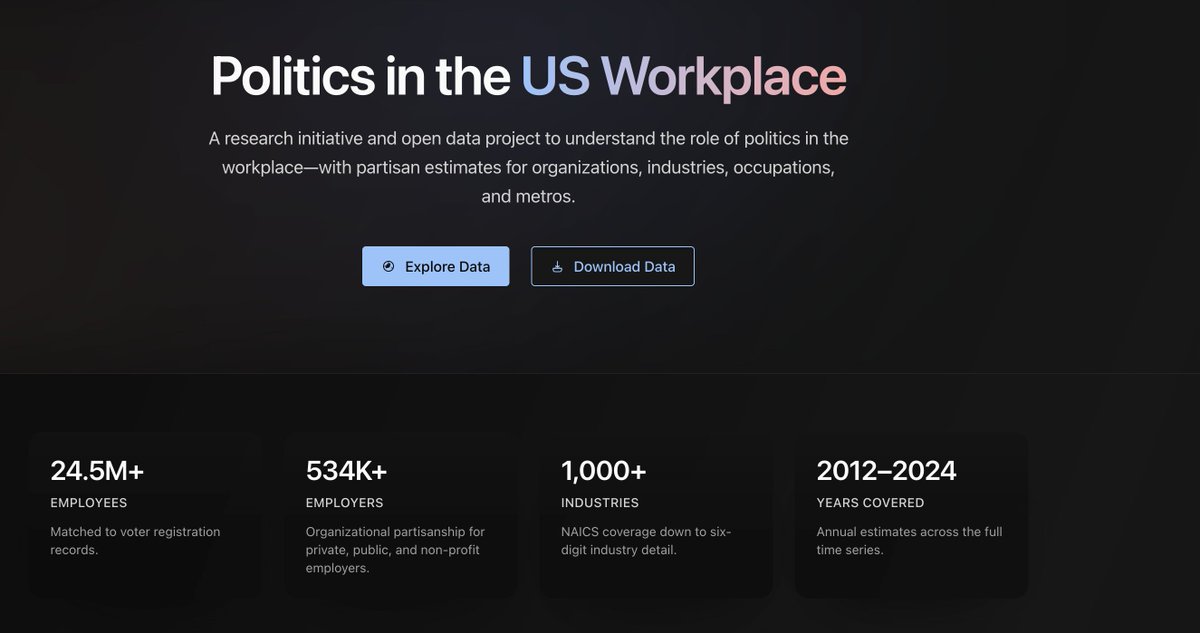
Wow! This project looks amazing. In it, three scientists at Columbia, Michigan, and Maryland introduce VRscores: a measure of the partisan leanings of employers in the United States. The dataset is constructed by linking U.S. voter registrations to online worker profiles.

Wow! This project looks amazing. 

In it, three scientists at Columbia, Michigan, and Maryland introduce VRscores: a measure of the partisan leanings of employers in the United States. 

The dataset is constructed by linking U.S. voter registrations to online worker profiles.
John B. Holbein (@johnholbein1) 's Twitter Profile Photo

Wow. This is wild. Researchers from Columbia, Michigan, and Maryland released VRscores. VRscores is a dataset linking voter registrations to online worker profiles that allow you to measure the partisan leanings of U.S. employers. 24.5M workers. 500k employers. 2012–2024.

Wow. This is wild.

Researchers from Columbia, Michigan, and Maryland released VRscores. 

VRscores is a dataset linking voter registrations to online worker profiles that allow you to measure the partisan leanings of U.S. employers.

24.5M workers. 500k employers. 2012–2024.
Max Kagan (@max_kagan) 's Twitter Profile Photo

🎉 Tremendously excited to announce the release of VRscores—an open-source dataset for researchers and journalists interested in studying the political lean of different employers.