
Dario Paniagua (@paniaguadario) 's Twitter Profile
Dario Paniagua

@paniaguadario

Helping amateur scribers become Professional Visual Thinkers.
dariopaniagua.com

ID: 601913199

linkhttps://instagram.com/dariobreadandwater/ calendar_today07-06-2012 12:33:16

217 Tweet

115 Takipçi

30 Takip Edilen

Dario Paniagua (@paniaguadario) 's Twitter Profile Photo

In Visual Thinking, anything can be transformed into a cage. The meaning we create will depend on two key factors: - The element we choose to transform into a cage. - What we decide to place inside it. Dario Paniagua Visual Thinkers Coach

Dario Paniagua (@paniaguadario) 's Twitter Profile Photo

Are we slaves to dates, meetings, weeks, and years? How can we communicate the idea of being slaves to our own time? Any object can be transformed into a cage if we play with its interior. Want to learn more about visual thinking? dariopaniagua.com/gift-ideas

Dario Paniagua (@paniaguadario) 's Twitter Profile Photo

Another simple way to create metaphors with cages is by using the contrarian thinking technique. This approach doesn’t change the shape of the cage but plays with the idea of opposites. Instead of showing what people expect, it flips the narrative to reveal the exact opposite.

Dario Paniagua (@paniaguadario) 's Twitter Profile Photo

Sometimes, things that aren't actually a cage can become one if we play with the elements we place inside them. Having the imagination to create a story is easy if you dare to do one thing: embrace absurdity.

Dario Paniagua (@paniaguadario) 's Twitter Profile Photo

Remove the Key Element! Many objects have a defining feature that makes them instantly recognizable. For a door, it might be the handle. For a plane, its wings. For a chair, its legs. Obviously, for a cage, it’s the bars. But what happens when you take them away?

Dario Paniagua (@paniaguadario) 's Twitter Profile Photo

We can create cages with flags, but it’s not just about the shape—it's about conveying messages. For example, I use the American flag to visualize an NBC News article by Julia E. Ainsley , Didi Martinez , and Laura V. Strickler . Download my free guide here: dariopaniagua.com/pl/2148634206

Dario Paniagua (@paniaguadario) 's Twitter Profile Photo

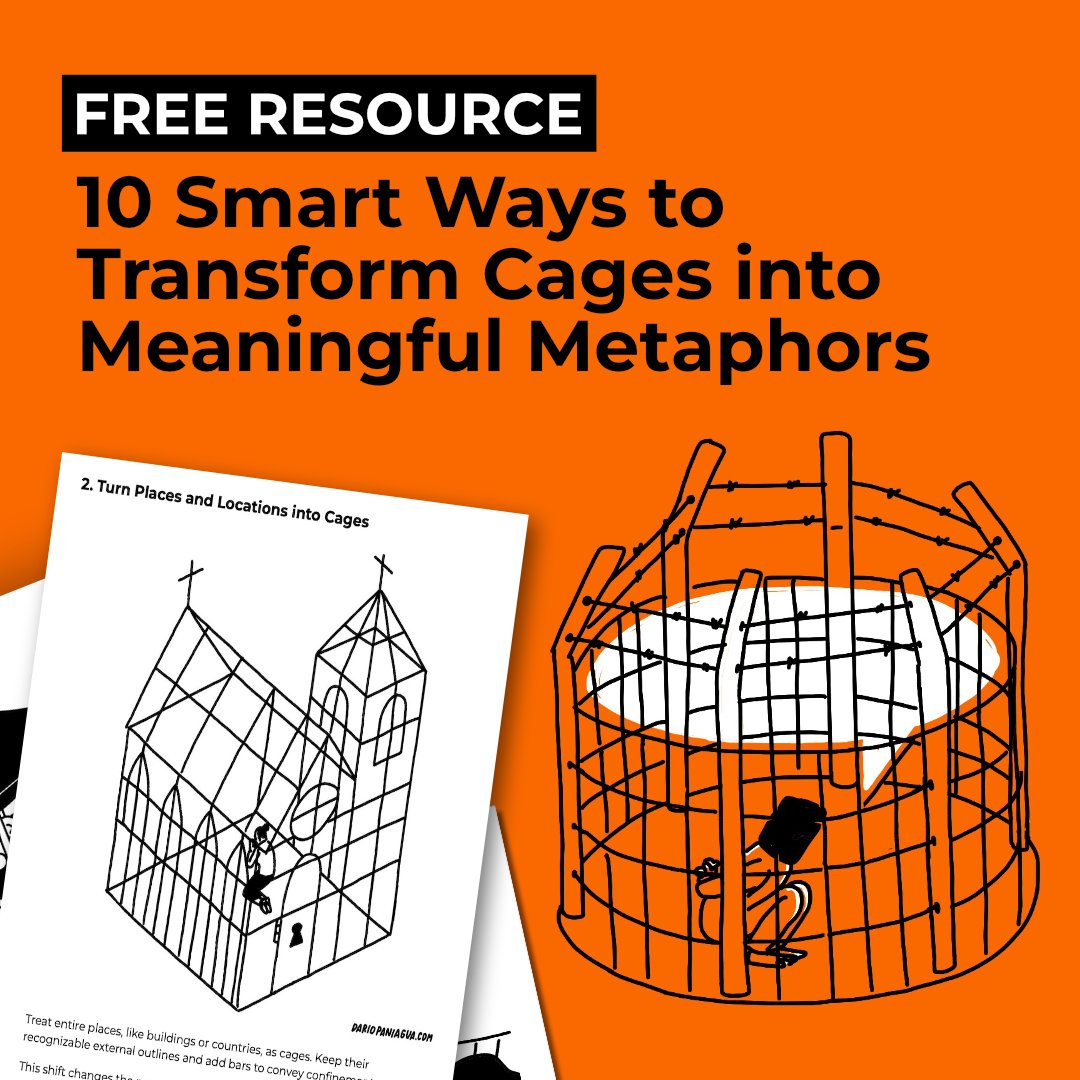
A cage isn’t just confinement, it’s a storytelling tool. Want to create bold visual metaphors? Grab my free guide: "Think Outside the Bars: 10 Creative Ways to Use Cages as Metaphors." Download here: dariopaniagua.com/pl/2148634206 #VisualThinking #Creativity #Metaphors

A cage isn’t just confinement, it’s a storytelling tool. 

Want to create bold visual metaphors? Grab my free guide: "Think Outside the Bars: 10 Creative Ways to Use Cages as Metaphors."

Download here: dariopaniagua.com/pl/2148634206

#VisualThinking #Creativity #Metaphors
Dario Paniagua (@paniaguadario) 's Twitter Profile Photo

Did you know that in my guide on creating metaphors with cages, I explain in a simple way how to build them using real places? Yes! Any place, any type of building, can become a cage. I’m still sharing the free guide with 10 tips: dariopaniagua.com/pl/2148634206

Did you know that in my guide on creating metaphors with cages, I explain in a simple way how to build them using real places?

Yes! Any place, any type of building, can become a cage.

I’m still sharing the free guide with 10 tips:
dariopaniagua.com/pl/2148634206
Dario Paniagua (@paniaguadario) 's Twitter Profile Photo

Do you know the the 'out of context' techni The idea is simple: take an object, person, or animal and place it in a completely different setting from the one we’re used to seeing it in. But here’s the catch: the new context should be impossible or highly unlikely.

Dario Paniagua (@paniaguadario) 's Twitter Profile Photo

The 'out of context' technique is so versatile that it also allows us to play with recognizable places or symbols that we typically associate with specific locations. What happens if we place iconic monuments in completely unexpected settings?

Dario Paniagua (@paniaguadario) 's Twitter Profile Photo

Sometimes, to place an element out of context, we can play with exaggerating its size, making something absurdly large or unusually small and then placing it in an improbable setting- The bird on the power line is disproportionately tiny compared to the woman.

Dario Paniagua (@paniaguadario) 's Twitter Profile Photo

Another way to create #metaphors using the out of context technique is through substitution. Instead of changing the setting where we typically see an object, we replace one element with another. You're taking things out of context while adding a new layer of meaning.

Dario Paniagua (@paniaguadario) 's Twitter Profile Photo

Another way to create metaphors using the out of context technique is by dressing the subject of an image in a completely absurd way for the situation they’re in.

Dario Paniagua (@paniaguadario) 's Twitter Profile Photo

Enlarging elements allows us to do two things: 1) Explore details more deeply. 2) Discover new shapes that can be transformed into unexpected settings. Every time you enlarge something, you create new spaces, new opportunities to place elements inside and create a metaphor.

Dario Paniagua (@paniaguadario) 's Twitter Profile Photo

#Metaphors: Check how powerful the out of context technique is. In this case, it helps us visually express a person’s thoughts or emotional state. We are transferring the qualities of the out-of-context element to the object or person it’s applied to.

Dario Paniagua (@paniaguadario) 's Twitter Profile Photo

Using the ‘out of context’ technique by placing objects on people’s heads is one of the richest ways to explore #metaphors. Anything we draw in this area of the body opens up endless possibilities for visualizing the human mind. What goes through a person’s head?

Dario Paniagua (@paniaguadario) 's Twitter Profile Photo

Check out my latest article: What Is a Visual Metaphor (and How to Create One That Really Works) linkedin.com/pulse/what-vis… via LinkedIn