Mohammed Elfadl (@mohammedelfadl8) 's Twitter Profile
Mohammed Elfadl

@mohammedelfadl8

ID: 1586461416214634497

calendar_today29-10-2022 20:54:28

2,2K Tweet

12 Takipçi

189 Takip Edilen

JAMA Cardiology (@jamacardio) 's Twitter Profile Photo

Meta-analysis of four randomized trials found β-blockers did not reduce mortality, recurrent #MyocardialInfarction (MI), heart failure, or revascularization in patients with preserved left ventricular ejection fraction after MI. ja.ma/3Nv7DQn

Meta-analysis of four randomized trials found β-blockers did not reduce mortality, recurrent #MyocardialInfarction (MI), heart failure, or revascularization in patients with preserved left ventricular ejection fraction after MI. ja.ma/3Nv7DQn
William Aird (@williamaird4) 's Twitter Profile Photo

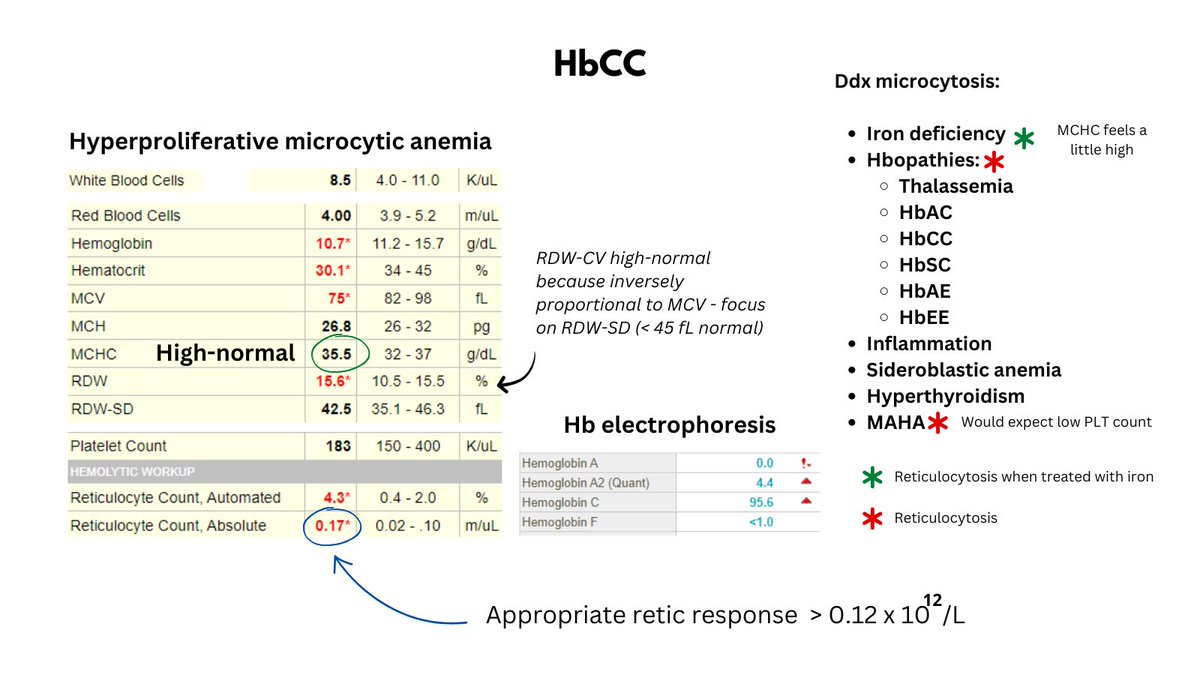
1/9 Yesterday I posted a CBC + reticulocyte count and asked for your diagnostic thoughts. Many of you offered great reasoning. The correct diagnosis was hemoglobin C disease. Let’s unpack why this case is such a good learning example. 👇

1/9

Yesterday I posted a CBC + reticulocyte count and asked for your diagnostic thoughts. Many of you offered great reasoning. The correct diagnosis was hemoglobin C disease. 

Let’s unpack why this case is such a good learning example. 👇
William Aird (@williamaird4) 's Twitter Profile Photo

3/9 Several people calculated the Mentzer index (MCV/RBC): 75 / 4.0 ≈ 18 → “suggests iron deficiency (ID).” Important teaching point: The Mentzer index was designed to distinguish thal trait vs ID. It is not validated for structural hemoglobinopathies like HbC or HbE.

William Aird (@williamaird4) 's Twitter Profile Photo

8/9 Bottom line teaching points: • Microcytosis ≠ just ID or thalassemia • Mentzer index is not a general microcytosis classifier • RDW-SD and RDW-CV are not interchangeable • High-normal MCHC = powerful clue to HbC • Retics help separate production vs turnover

William Aird (@williamaird4) 's Twitter Profile Photo

1/7 I posted a poll: New patient, otherwise well, with iron deficiency anemia. After examining nails and tongue, do you auscultate heart and lungs? Results: • 51% always • 18% usually • 20% rarely • 12% never That spread is fascinating, and very honest.

NEJM (@nejm) 's Twitter Profile Photo

Our latest video in our partnership with Dr. Glaucomflecken summarizes the POTCAST trial, which assessed a strategy of actively increasing plasma potassium levels to the high-normal range in patients at high risk for ventricular arrhythmias. Read the full study for free:


Paul Wischmeyer MD (@paul_wischmeyer) 's Twitter Profile Photo

What’s the optimal protein dose in ICU for best recovery of physical function & quality of life? A. <1.2 g/kg/d B. 1.2–1.5 g/kg/d C. 1.5–2.0 g/kg/d D. >2.0 g/kg/d #ASPEN26 #ICURehab #ICUNutrition

What’s the optimal protein dose in ICU for best recovery of physical function &amp; quality of life? 

A. &lt;1.2 g/kg/d
B. 1.2–1.5 g/kg/d
C. 1.5–2.0 g/kg/d
D. &gt;2.0 g/kg/d

#ASPEN26  
#ICURehab #ICUNutrition
Blood Academy (@blood_academy) 's Twitter Profile Photo

🩸 Test yourself 32-year-old male with fatigue Hb 41 g/L | WCC 8.5 ×10⁹/L | Platelets 190 ×10⁹/L What is the diagnosis? 🔬View the digital blood film: bit.ly/4reWuC9 📘 Interactive Cases launches 28 Feb 2026

🩸 Test yourself

32-year-old male with fatigue
Hb 41 g/L | WCC 8.5 ×10⁹/L | Platelets 190 ×10⁹/L
What is the diagnosis?

🔬View the digital blood film: bit.ly/4reWuC9

📘 Interactive Cases launches 28 Feb 2026
Blood Academy (@blood_academy) 's Twitter Profile Photo

🩸 Test yourself 50-year-old male with chest infection Hb 80 g/L | WCC 12.2 ×10⁹/L | Platelets 63 ×10⁹/L What’s the diagnosis? 🔬 Digital blood film: bit.ly/4qEZCGH #Haematology #BloodFilm

🩸 Test yourself

50-year-old male with chest infection
Hb 80 g/L | WCC 12.2 ×10⁹/L | Platelets 63 ×10⁹/L

What’s the diagnosis?

🔬 Digital blood film: bit.ly/4qEZCGH

#Haematology #BloodFilm
William Aird (@williamaird4) 's Twitter Profile Photo

UBIQUITOUSLY HIGH INR Is it just me, or does every inpatient have an INR of 1.2–1.4? Usually not true coagulopathy. Likely culprits are mild vit K deficiency (poor intake, antibiotics) and subtle hepatic dysfunction, which first show up as a factor VII‑mediated PT/INR bump.

NEJM (@nejm) 's Twitter Profile Photo

A woman with asthma and obstructive sleep apnea presented with a 1-month history of worsening dyspnea and dry cough. CT of the chest showed anterior bowing of the posterior wall of the intrathoracic trachea during expiration. Read the full case details in the Images in Clinical

A woman with asthma and obstructive sleep apnea presented with a 1-month history of worsening dyspnea and dry cough. CT of the chest showed anterior bowing of the posterior wall of the intrathoracic trachea during expiration. 

Read the full case details in the Images in Clinical
William Aird (@williamaird4) 's Twitter Profile Photo

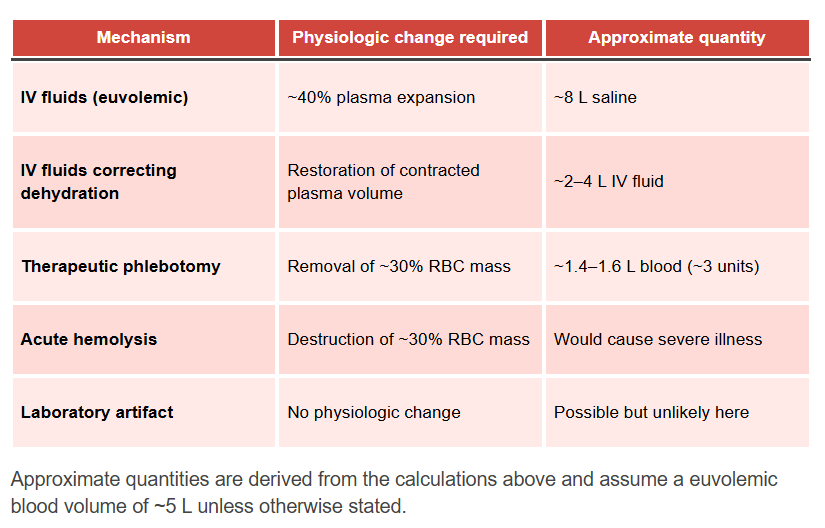
1/5 Poll results are in! A patient repeatedly presents with a high Hb that falls dramatically the next day. Phlebotomy? Fluids? Hemolysis? Artifact? Most chose IV fluids, which is correct. This isn’t intuition — a simple physiologic calculation predicts it. See table.

1/5

Poll results are in!

A patient repeatedly presents with a high Hb that falls dramatically the next day.

Phlebotomy?
Fluids?
Hemolysis?
Artifact?

Most chose IV fluids, which is correct.

This isn’t intuition — a simple physiologic calculation predicts it.

See table.
William Aird (@williamaird4) 's Twitter Profile Photo

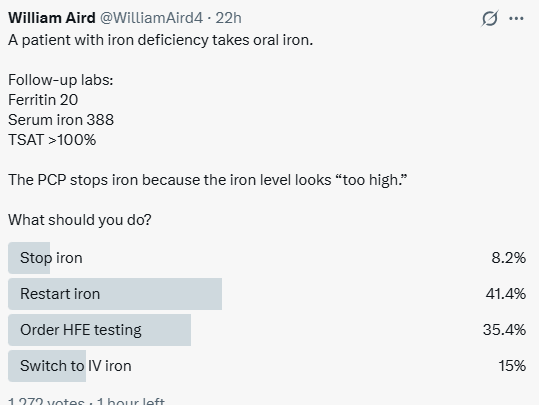
A patient with iron deficiency takes oral iron. Follow-up labs: Ferritin 20 Serum iron 388 TSAT >100% The PCP stops iron because the iron level looks “too high.” What should you do?

William Aird (@williamaird4) 's Twitter Profile Photo

The Fe Paradox: High Serum Fe in Fe Deficiency Poll results are in (≈1,200 votes). Iron deficient patient with: Ferritin 20 Serum Fe 388 TSAT >100% The PCP stopped oral Fe because the Fe looked “too high.” Interesting split in responses. Let’s walk through the physiology.

The Fe Paradox: High Serum Fe in Fe Deficiency

Poll results are in (≈1,200 votes).

Iron deficient patient with:
Ferritin 20
Serum Fe 388
TSAT &gt;100%

The PCP stopped oral Fe because the Fe looked “too high.”

Interesting split in responses.

Let’s walk through the physiology.
William Aird (@williamaird4) 's Twitter Profile Photo

Fun physiology poll: You’re about to move to high altitude. If you could choose, which shift in the oxygen–hemoglobin dissociation curve would you prefer?

William Aird (@williamaird4) 's Twitter Profile Photo

1/3 Poll results are in. If you were moving to high altitude, which shift in the oxygen–Hb dissociation curve (ODC) would you want? Left shift Right shift Most chose right shift. That’s also what humans do during acclimatization. But evolution tells a different story.

1/3

Poll results are in.

If you were moving to high altitude, which shift in the oxygen–Hb dissociation curve (ODC) would you want?

Left shift
Right shift
Most chose right shift.

That’s also what humans do during acclimatization.

But evolution tells a different story.
William Aird (@williamaird4) 's Twitter Profile Photo

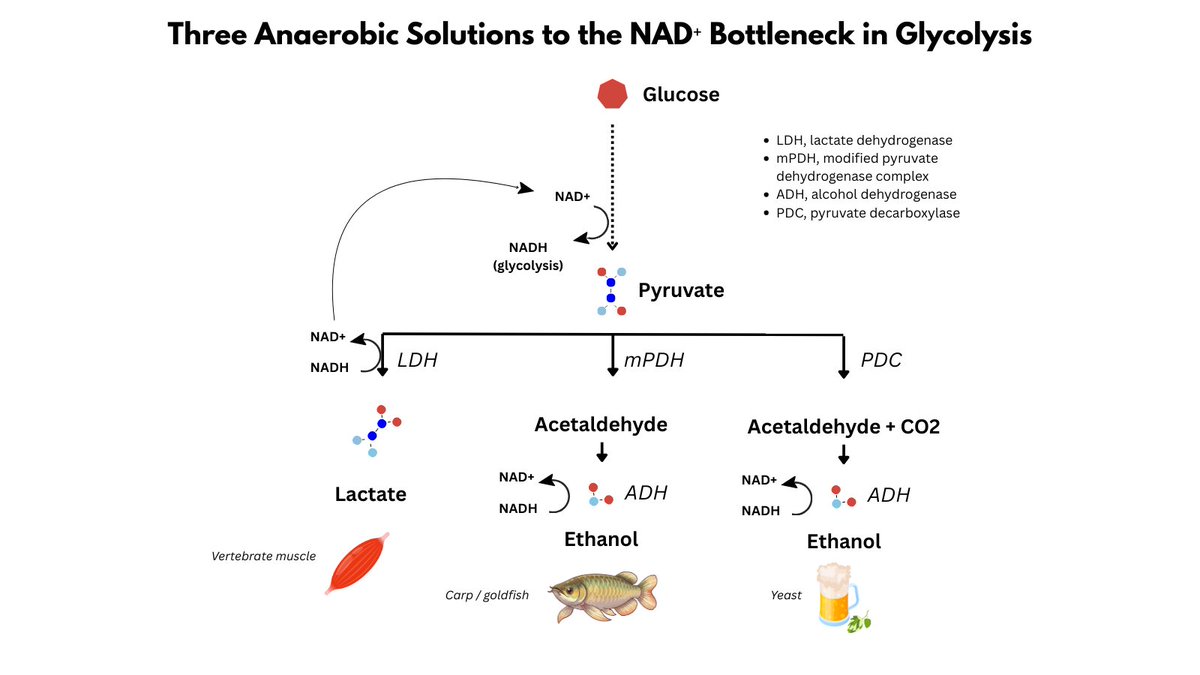
1/2 Last week I posted about goldfish surviving winter by fermenting like yeast. It reflects a deeper metabolic principle: When O₂ disappears, glycolysis can continue only if NAD⁺ is regenerated. Different organisms solve this constraint in different ways.

1/2

Last week I posted about goldfish surviving winter by fermenting like yeast.

It reflects a deeper metabolic principle:

When O₂ disappears, glycolysis can continue only if NAD⁺ is regenerated.

Different organisms solve this constraint in different ways.