Maya Talukdar (@mayatalukdar) 's Twitter Profile
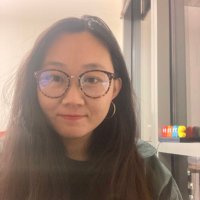
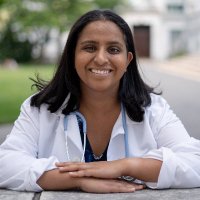
Maya Talukdar

@mayatalukdar

G3 @HarvardMITmdphd @BIG_Harvard_PhD w/ @PageLabXY & @ChrisAWalsh1. Using stats/comp genomics to study sex diffs, somatic mutations, neuro + their intersections

ID: 1087400981074272256

calendar_today21-01-2019 17:26:11

703 Tweet

1,1K Takipçi

898 Takip Edilen

Page Lab (@pagelabxy) 's Twitter Profile Photo

We made the cover of Genome Research! Check out our latest paper on DDX3X and DDX3Y - the first X-Y gene pair with cross regulatory capabilities (genome.cshlp.org/content/35/1/2…).

We made the cover of Genome Research!  Check out our latest paper on DDX3X and DDX3Y - the first X-Y gene pair with cross regulatory capabilities (genome.cshlp.org/content/35/1/2…).
Aoxing Liu (@aoxing2) 's Twitter Profile Photo

Sex chromosome trisomies - including 47,XXY, 47,XYY, and 47,XXX - are the most common type of chromosome abnormalities in humans. Yet, our understanding of the prevalence and associated health outcomes is primarily driven by observational studies of clinically diagnosed

Rory Vu Mather (@rvmather) 's Twitter Profile Photo

Excited that my first 1st authored paper from my PhD research has been published in Anesthesiology! We found that neural oscillations in the alpha band of frequencies (8-12 Hz) during anesthesia can predict the risk of postop mortality up to a year after surgery. 🧵 (1/3)

Excited that my first 1st authored paper from my PhD research has been published in Anesthesiology!

We found that neural oscillations in the alpha band of frequencies (8-12 Hz) during anesthesia can predict the risk of postop mortality up to a year after surgery.  🧵 (1/3)
Dr. Martha Gulati ♥️🫀❤️‍🩹🇨🇦 (@drmarthagulati) 's Twitter Profile Photo

During #HeartMonth it is important we recognize what needs to change in our clinical trials 📌include more women in trials 📌report the analysis by sex: even if no difference, we need to know that #goredforwomen #inclusion #clinicaltrials Women's Heart Alliance Baim Institute GoRedforWomen

During #HeartMonth it is important we recognize what needs to change in our clinical trials 
📌include more women in trials
📌report the analysis by sex: even if no difference, we need to know that 
#goredforwomen #inclusion #clinicaltrials <a href="/WHA/">Women's Heart Alliance</a> <a href="/BaimInstitute/">Baim Institute</a> <a href="/GoRedForWomen/">GoRedforWomen</a>
Jonathan Sebat (@sebatlab) 's Twitter Profile Photo

I'm excited to be launcing the new UCSD Verge Center, a highly integrated program in clinical psychiatry, neuroscience and data science. The goal is to take a DATA DRIVEN approach to elucidate how genes and neural processes influence mental health verge.ucsd.edu

Circulation (@circaha) 's Twitter Profile Photo

Dilated cardiomyopathy is diagnosed twice as often in males, but sex-specific diagnostics can reduce this bias. Understanding genetic & environmental factors is crucial for equitable care! James Ware Brian Halliday Kathryn McGurk Antonio de Marvao Chang Lu ahajournals.org/doi/full/10.11…
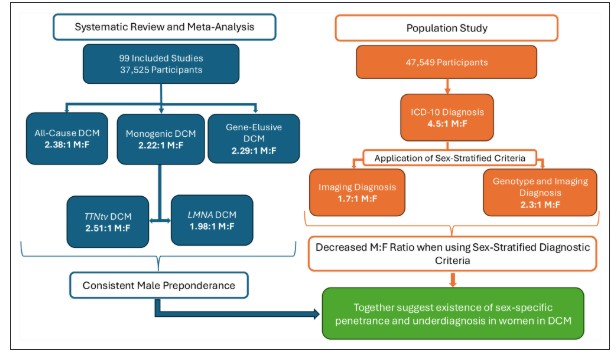
Dilated cardiomyopathy is diagnosed twice as often in males, but sex-specific diagnostics can reduce this bias. Understanding genetic &amp; environmental factors is crucial for equitable care! <a href="/drjamesware/">James Ware</a> <a href="/bp_halliday/">Brian Halliday</a> <a href="/KathrynMcGurk/">Kathryn McGurk</a> <a href="/AdeMarvao/">Antonio de Marvao</a> <a href="/luchang1230/">Chang Lu</a> ahajournals.org/doi/full/10.11…
Elliot Hershberg (@elliothershberg) 's Twitter Profile Photo

Gene therapy restores hearing (!!) This is the goal. Beautiful mechanistic therapies with effect sizes so big that they can be seen in the very first dozen patients dosed. Congrats to the one and only Steve Holtzman and the Decibel team for establishing this program, and to

Gene therapy restores hearing (!!)

This is the goal. Beautiful mechanistic therapies with effect sizes so big that they can be seen in the very first dozen patients dosed.

Congrats to the one and only Steve Holtzman and the Decibel team for establishing this program, and to
Jonathan Sebat (@sebatlab) 's Twitter Profile Photo

The public wants answers on WHAT ARE THE CAUSES OF #AUTISM. This lecture takes a deep dive on genes, environment and #vaccines and how it works. Video quality is poor in the beginning, but don't skip the first 5 slides or the segment at 20:00-25:00 youtube.com/watch?v=Jiy9qr…

Maya Talukdar (@mayatalukdar) 's Twitter Profile Photo

Really 🫶 STAT News reporting on our work & others about sex diffs in the heart + the current govt threats against sex diffs research. This field is so important for so many reasons (incl. women being 50% of the population!) and can ultimately drive better care for all people!

David Tang (@dtang2000) 's Twitter Profile Photo

excited to share our new preprint looking at mosaic chromosomal alterations in blood whole genome sequencing data! i learned tons working on this project, and i hope our findings are of interest to those thinking about CH, somatic mosaicism, and genetics. medrxiv.org/content/10.110…

Iain S. Forrest, PhD (@iainsforrest) 's Twitter Profile Photo

Most genetic reports label variants as ✅ “pathogenic” or ❌ “benign.” But what patients really want to know is: what are my chances of getting the disease? 🚨 In our new Science study, we used AI + 1.3M patient records to better answer that…

Most genetic reports label variants as ✅ “pathogenic” or ❌ “benign.”
But what patients really want to know is: what are my chances of getting the disease?
🚨 In our new Science study, we used AI + 1.3M patient records to better answer that…
Jonathan Sebat (@sebatlab) 's Twitter Profile Photo

Eric Topol NEJM Failure to detect a rare disease does not mean that the common disease was a misdiagnosis. Typically the rare mutation is NOT sufficient to cause the common Dx. The common Dx is STILL a polygenic trait even in the context of rare disease pubmed.ncbi.nlm.nih.gov/22424231/

David R. Liu (@davidrliu) 's Twitter Profile Photo

Tonight’s episode of 60 Minutes will include a segment on the impact of federally funded science and recent cuts to science funding. Our lab’s development of base editing and prime editing and their clinical applications will be among the work described in the episode.