Harry Crane (@harrydcrane) 's Twitter Profile
Harry Crane

@harrydcrane

statistics professor @RutgersU
probability, risk, gambling, common sense
YT: youtube.com/@harrydcrane

ID: 4145713119

linkhttp://harrycrane.com calendar_today09-11-2015 01:32:15

1,1K Tweet

24,24K Takipçi

140 Takip Edilen

Harry Crane (@harrydcrane) 's Twitter Profile Photo

Videos lectures for my entire First Course in Probability New material will be released every few days for the next several months. Subscribe for announcements. youtube.com/playlist?list=…

Richard H. Ebright (@r_h_ebright) 's Twitter Profile Photo

There is absolutely no defensible basis for non-uniform indirect cost rates and absolutely no defensible basis for >=60% indirect costs. The previous system was a colossal fraud.

Harry Crane (@harrydcrane) 's Twitter Profile Photo

Biomedical research replicates at a 10% rate. The field has been dead for a long time. All this does is spend less money (but still billions of dollars) on it.

Harry Crane (@harrydcrane) 's Twitter Profile Photo

If indirect costs are to be paid by grant agencies (big IF), they should be determined on aggregate basis of all grant funding - not grant-by-grant. The way economies of scale work is you only have to pay certain costs once. The costs don't scale with amount of grant funding.

Vinay Prasad MD MPH (@vprasadmdmph) 's Twitter Profile Photo

A 15% indirect is needed to "keep the lights on" A 60% indirect is needed for universities to have vast slush funds used for any purpose that they decide, often against the preferences of the majority of Americans whose hard earned money they are spending.

Harry Crane (@harrydcrane) 's Twitter Profile Photo

Funny how the main critique of NIH cutting indirect costs is a pedantic, academic argument that "60% indirect ≠ 60% of total". It doesn't matter. 60%, 37.5%, whatever it is - it's a huge, unjustified amount of money that goes unaccounted for and is often spent on stuff far

Harry Crane (@harrydcrane) 's Twitter Profile Photo

Let's go with this analogy. When you carry it to its logical end, you realize that 99% of scientific labs are businesses that run at a HUGE net operating loss. There's no conception of ROI because the money is free, and the costs are someone else's problem ("indirect" costs).

Harry Crane (@harrydcrane) 's Twitter Profile Photo

How about no federal dollars for publishing costs, period. The open access scam generates billions for publishing companies on the premise that taxpayers shouldn't "pay twice" for research. But who pays the open access fee? Taxpayers. Govt could stand up a site like arxiv for

Harry Crane (@harrydcrane) 's Twitter Profile Photo

Here is someone defending the $12,000 open access charge at nature I guarantee the NOBODY would pay this fee if it was their own money. But when it's "free" taxpayer money, the charge is justified. Same principle applies to $500/night conference hotels paid for by taxpayer $

Richard H. Ebright (@r_h_ebright) 's Twitter Profile Photo

Former NIH Acting Director Laurence Tabak, a participant in the cover-up of the lab origin of COVID, has resigned. Tabak combined shocking incompetence with shameless malfeasance. It is good he is gone. science.org/content/articl…

Harry Crane (@harrydcrane) 's Twitter Profile Photo

To say that Universities cannot survive on lower overhead costs suggests that universities are operating perfectly efficiently and there's nothing to cut. Is that the argument?

Harry Crane (@harrydcrane) 's Twitter Profile Photo

.Ryan Martin and I called out this nonsense 8+ years ago, way before it was cool. From our "manifesto" published at the founding of researchers.one Full manifesto available here: researchers.one/articles/18.07…
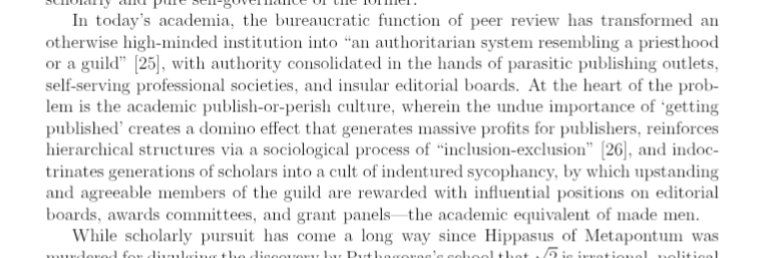

.<a href="/statsmartin/">Ryan Martin</a> and I called out this nonsense 8+ years ago, way before it was cool.

From our "manifesto" published at the founding of researchers.one

Full manifesto available here: 
researchers.one/articles/18.07…

Harry Crane (@harrydcrane) 's Twitter Profile Photo

My submission to the CFTC Comment on Sports Betting Markets is posted here. cftc.gov/media/12061/Ru… I lay out several key differences between betting markets and sportsbooks, and explain the need for exchanges to be regulated nationally, not state-by-state. Also mentioned: