Edoardo Pona (@edoardopona) 's Twitter Profile
Edoardo Pona

@edoardopona

ID: 3028907819

calendar_today10-02-2015 22:16:51

96 Tweet

56 Followers

611 Following

Eric Todd (@ericwtodd) 's Twitter Profile Photo

LLMs represent words as vector embeddings. Do they represent *functions* as vectors too? Yes! This has implications for how we think about “reasoning” in language models. New preprint w/ Millicent Li, Arnab Sen Sharma, Aaron Mueller, byron wallace, David Bau: functions.baulab.info

LLMs represent words as vector embeddings. Do they represent *functions* as vectors too?

Yes! This has implications for how we think about “reasoning” in language models. New preprint w/ <a href="/millicent_li/">Millicent Li</a>, <a href="/arnab_api/">Arnab Sen Sharma</a>, <a href="/amuuueller/">Aaron Mueller</a>, <a href="/byron_c_wallace/">byron wallace</a>, <a href="/davidbau/">David Bau</a>:
functions.baulab.info
Matt Shumer (@mattshumer_) 's Twitter Profile Photo

Here is a powerful Claude 3 prompt for engineers. Use it to automatically refactor, comment, and improve your code: --- <prompt_explanation> You are a skilled software engineer with deep expertise in code refactoring and optimization across multiple programming languages. Your

Here is a powerful Claude 3 prompt for engineers.

Use it to automatically refactor, comment, and improve your code:

---
&lt;prompt_explanation&gt;
You are a skilled software engineer with deep expertise in code refactoring and optimization across multiple programming languages. Your
Linus (@thesephist) 's Twitter Profile Photo

By end of 2024, steering foundation models in latent/activation space will outperform steering in token space ("prompt eng") in several large production deployments. I felt skeptical about this in summer '23, felt vaguely positive in Jan, and now think it's more likely than not,

Nicolas Yax (@nicolas__yax) 's Twitter Profile Photo

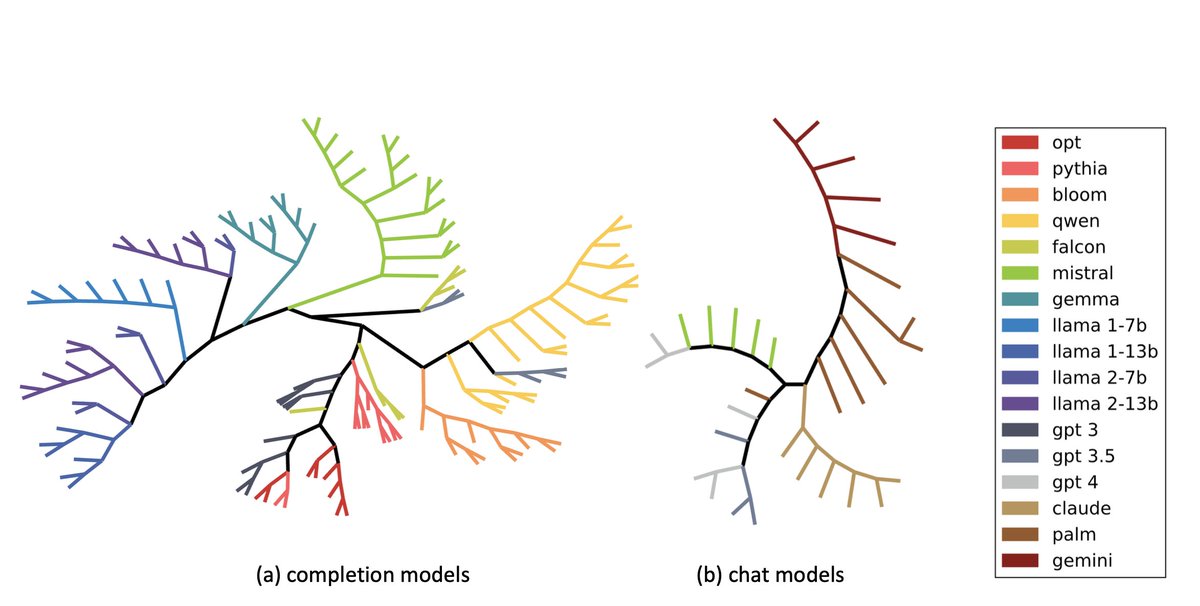
🚨New preprint🚨 Can LLM finetuning relationships be inferred only through model outputs ? We found that adapting phylogenetic algorithms 🧬 to language models 🤖 helps identify families of models and can even predict their performances with Stefano Palminteri (@stepalminteri.bsky.social) and Pierre-Yves Oudeyer ! 1/9
🚨New preprint🚨
Can LLM finetuning relationships be inferred only through model outputs ?
We found that adapting phylogenetic algorithms 🧬 to language models 🤖 helps identify families of models and can even predict their performances with <a href="/StePalminteri/">Stefano Palminteri (@stepalminteri.bsky.social)</a> and <a href="/pyoudeyer/">Pierre-Yves Oudeyer</a> ! 1/9
Richard Ngo (@richardmcngo) 's Twitter Profile Photo

Instead of analyzing whether AI takeoff will be “fast” or “slow”, I now prefer to think about the spectrum from concentrated takeoff (within one organization in one country) to distributed takeoff (involving many organizations and countries).

Dean W. Ball (@deanwball) 's Twitter Profile Photo

My basic reaction to AI today is, “jeez, o1 performs in the top 1% of humans at math, yet fails routinely at basic logic tasks. I guess intelligence is a high-dimensional space, and that probably means, like most high-dimensional things, it behaves counterintuitively.”

Peyman Milanfar (@docmilanfar) 's Twitter Profile Photo

Strange but true - A wobbly table on any reasonable floor can be made steady by just turning it. Moral of the story: Before dining out, always ask if their floor is Lipschitz continuous.

Strange but true - A wobbly table on any reasonable floor can be made steady by just turning it.

Moral of the story: Before dining out, always ask if their floor is Lipschitz continuous.
Functor Fact (@functorfact) 's Twitter Profile Photo

'The purpose of abstraction is not to be vague, but to create a new semantic level in which one can be absolutely precise' - Edsger Dijkstra

Anthropic (@anthropicai) 's Twitter Profile Photo

New Anthropic research: Alignment faking in large language models. In a series of experiments with Redwood Research, we found that Claude often pretends to have different views during training, while actually maintaining its original preferences.

New Anthropic research: Alignment faking in large language models.

In a series of experiments with Redwood Research, we found that Claude often pretends to have different views during training, while actually maintaining its original preferences.
wh (@nrehiew_) 's Twitter Profile Photo

This is living rent free in my head. It is not obvious to me why this works. Models should not have any meta understanding of the data they were trained on - why we shouldnt trust the answer we get from asking “who are you”. Its a logical extension why we it doesnt make sense to

Nora Belrose (@norabelrose) 's Twitter Profile Photo

What are the chances you'd get a fully functional language model by randomly guessing the weights? We crunched the numbers and here's the answer:

What are the chances you'd get a fully functional language model by randomly guessing the weights?

We crunched the numbers and here's the answer:
Tomáš Daniš (@tmdanis) 's Twitter Profile Photo

Can humans reason? In this paper we show evidence many humans simply apply heuristics they've been exposed to over the course of their lives without deeper consideration. In conclusion, humans don't seem to reason and only copy reasoning patterns from their training data.

Alex Turner (@turn_trout) 's Twitter Profile Photo

I’m worried that “doom” speculation will make doom more likely. Specifically, AIs conform to our expectations of them, as communicated by their training data. This “self-fulfilling misalignment data” may be poisoning training already. 🧵

I’m worried that “doom” speculation will make doom more likely. Specifically, AIs conform to our expectations of them, as communicated by their training data. This “self-fulfilling misalignment data” may be poisoning training already. 🧵