
NUS Cognitive Engineering Lab (@cognitive_eng) 's Twitter Profile
NUS Cognitive Engineering Lab

@cognitive_eng

Cognitive Engineering Laboratory, The N.1 Institute for Health, National University of Singapore.
neuroeng.org/cognitive-engi…

ID: 1454689114788225024

linkhttps://neuroeng.org/cognitive-engineering calendar_today31-10-2021 05:58:12

9 Tweet

6 Followers

5 Following

Andrei Dragomir (@andrei_dragomir) 's Twitter Profile Photo

It's an exciting week at IEEE Engineering Medicine and Biology Society #EMBC2021 conference with presentations of our latest work on olfactory perception, brain's reward processing and novel approaches for reconstructing neurophysiological signals using reduced sensors setups. NUS Cognitive Engineering Lab The N.1 Institute for Health (N.1)

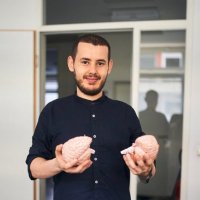
It's an exciting week at <a href="/IEEEembs/">IEEE Engineering Medicine and Biology Society</a> #EMBC2021 conference with presentations of our latest work on olfactory perception, brain's reward processing and novel approaches for reconstructing neurophysiological signals using reduced sensors setups. <a href="/Cognitive_Eng/">NUS Cognitive Engineering Lab</a>
<a href="/TheN1Institute/">The N.1 Institute for Health (N.1)</a>
Zied Tayeb (@zied_tayeb) 's Twitter Profile Photo

Very happy to announce that our paper "Distinct Spatio-temporal and spectral brain patterns...” has now been published in Scientific Reports with collaborative efforts between the TU München, NUS, and Johns Hopkins University. nature.com/articles/s4159…

Zied Tayeb (@zied_tayeb) 's Twitter Profile Photo

A demo video summarizing the main findings of our paper published in Scientific Reports - Nature. Link: nature.com/articles/s4159… #eeg #braincomputerinterface #pain #human_robot_interaction #Neuroprosthetics #PainSensation #TactileFeedback

NUS Cognitive Engineering Lab (@cognitive_eng) 's Twitter Profile Photo

New work by NUS Cognitive Engineering Lab RA Manuel Seet published in the Accident Analysis & Prevention Journal. Using baseline EEG metrics, we can predict drivers’ average takeover reaction time, as well as the likelihood of accident after takeover in vehicles with conditional automation.

Andrei Dragomir (@andrei_dragomir) 's Twitter Profile Photo

In our latest work published in Brain Sciences we show that olfactory hedonic evaluation modulates functional connectivity in several brain regions and is characterized by significant hemispheric laterality effects. mdpi.com/2076-3425/12/1… NUS Cognitive Engineering Lab The N.1 Institute for Health (N.1)

In our latest work published in Brain Sciences we show that olfactory hedonic evaluation modulates functional connectivity in several brain regions and is characterized by significant hemispheric laterality effects.  mdpi.com/2076-3425/12/1… <a href="/Cognitive_Eng/">NUS Cognitive Engineering Lab</a> <a href="/TheN1Institute/">The N.1 Institute for Health (N.1)</a>
NUS Cognitive Engineering Lab (@cognitive_eng) 's Twitter Profile Photo

⚡️Publication Alert⚡️In our latest work we show that olfactory hedonic evaluation modulates functional connectivity among several brain regions and is characterized by significant hemispheric laterality effects. bit.ly/Olfaction The N.1 Institute for Health (N.1) NUS

⚡️Publication Alert⚡️In our latest work we show that olfactory hedonic evaluation modulates functional connectivity among several brain regions and is characterized by significant hemispheric laterality effects. bit.ly/Olfaction <a href="/TheN1Institute/">The N.1 Institute for Health (N.1)</a> <a href="/NUSingapore/">NUS</a>
Andrei Dragomir (@andrei_dragomir) 's Twitter Profile Photo

New publication: we propose an alert-state EEG measure for profiling individuals’ susceptibility to vigilance decrements. Relevant for identifying high-risk drivers and designing interaction systems to enhance automation use NUS Cognitive Engineering Lab The N.1 Institute for Health (N.1) bit.ly/3C2PH7o

New publication: we propose an alert-state EEG measure for profiling individuals’ susceptibility to vigilance decrements. Relevant for identifying high-risk drivers and designing interaction systems to enhance automation use <a href="/Cognitive_Eng/">NUS Cognitive Engineering Lab</a> <a href="/TheN1Institute/">The N.1 Institute for Health (N.1)</a> bit.ly/3C2PH7o