Jan Albert (@jan_albert_) 's Twitter Profile
Jan Albert

@jan_albert_

Virus research

ID: 1058066229649379328

calendar_today01-11-2018 18:40:21

46 Tweet

348 Takipçi

17 Takip Edilen

Dr Emma Hodcroft (@firefoxx66) 's Twitter Profile Photo

@robert_dyrdak Thank you Robert! I wouldn't have written it up without your encouragement, & it's a better paper thanks to your proofreading! Will buy you a drink next time we meet!

Richard Neher (@richardneher) 's Twitter Profile Photo

The default scenario is for a medium-size city in Switzerland with a fairly slow-spreading outbreak and strong infection control measures. You can adjust all parameters (sometimes a little fiddly, we are working on it). The population parameters can be adjusted in this panel:

The default scenario is for a medium-size city in Switzerland with a fairly slow-spreading outbreak and strong infection control measures. You can adjust all parameters (sometimes a little fiddly, we are working on it). The population parameters can be adjusted in this panel:
Richard Neher (@richardneher) 's Twitter Profile Photo

The basic epidemiological parameters can be adjusted in this panel. You can set the annual average R0, the delay from infection to transmission, and the typical infectious period. These add up to a serial interval of 8 days in our defaults.

The basic epidemiological parameters can be adjusted in this panel. You can set the annual average R0, the delay from infection to transmission, and the typical infectious period. These add up to a serial interval of 8 days in our defaults.
Richard Neher (@richardneher) 's Twitter Profile Photo

In addition, to estimate hospital bed demand, you can select the average length of a hospital stay. This applies to both regular and ICU beds additively. Presumed seasonal variation can also be adjusted.

Richard Neher (@richardneher) 's Twitter Profile Photo

To explore the effect of infection control measures, you can modify the graph in this panel. The value modulates the baseline parameters set above. Moving dots down implies more control: 1 corresponds to no control, 0 to avoiding all infections.

To explore the effect of infection control measures, you can modify the graph in this panel. The value modulates the baseline parameters set above. Moving dots down implies more control: 1 corresponds to no control, 0 to avoiding all infections.
Richard Neher (@richardneher) 's Twitter Profile Photo

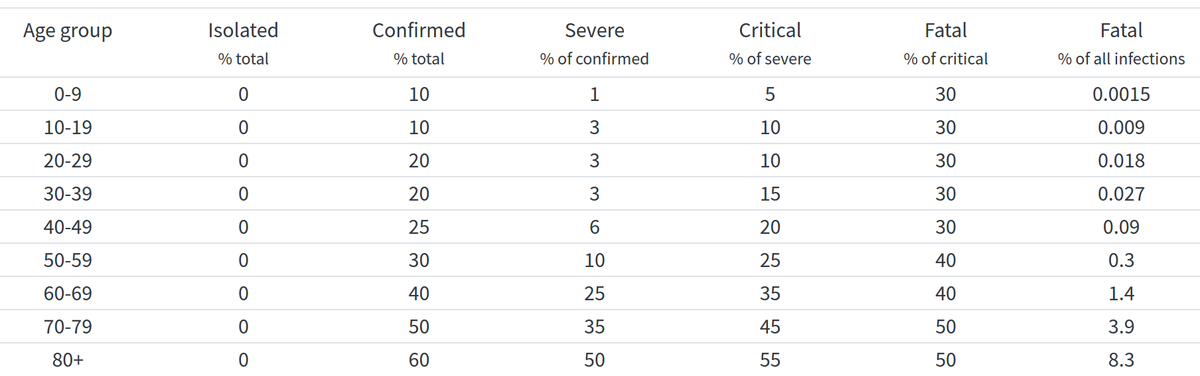
Our assumptions on severity are summarized in this table informed by data from China CDC. Most columns are editable and allow you to specify what fraction of cases show up in statistics, how many of those are severe, critical, and fatal (in a nested fashion).

Our assumptions on severity are summarized in this table informed by data from China CDC. Most columns are editable and allow you to specify what fraction of cases show up in statistics, how many of those are severe, critical, and fatal (in a nested fashion).
Richard Neher (@richardneher) 's Twitter Profile Photo

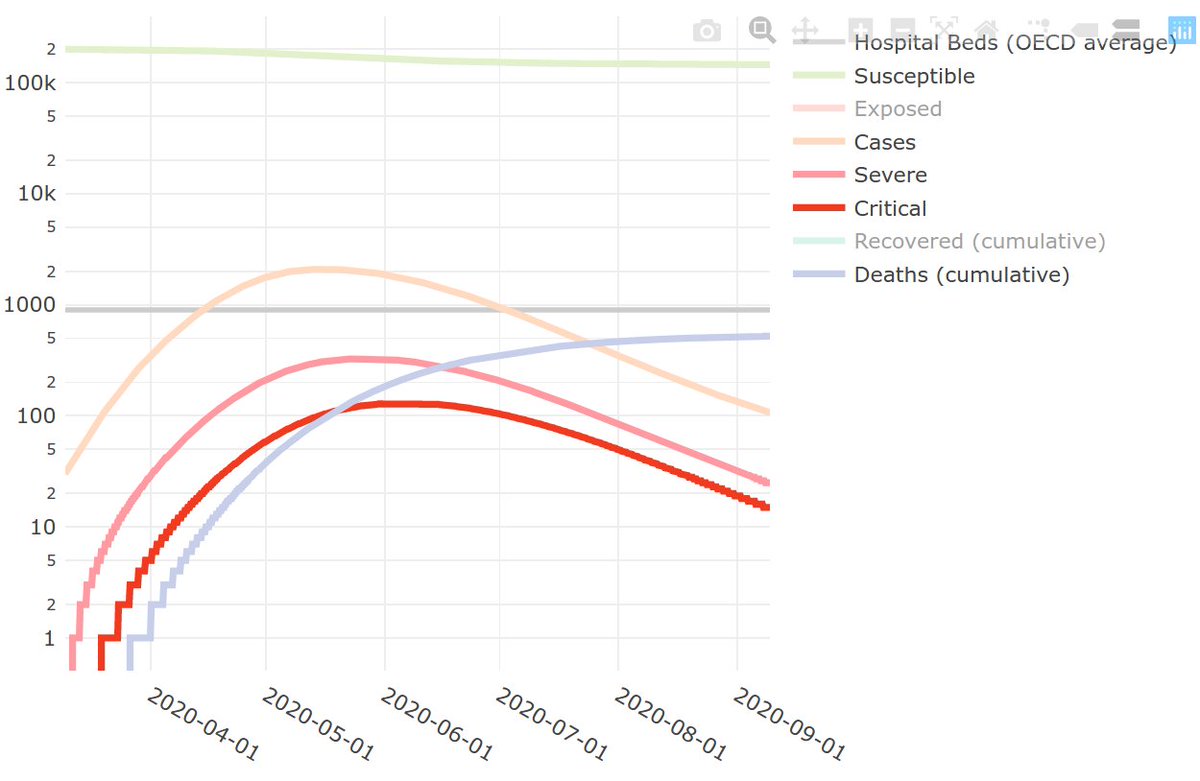
The main outputs are graphs of cases, severe cases, critical cases, and cumulative fatalities. (show/hide lines by clicking on the legend). OECD average *total* hospital capacity (scaled to population) is indicated as a horizontal line.

The main outputs are graphs of cases, severe cases, critical cases, and cumulative fatalities. (show/hide lines by clicking on the legend). OECD average *total* hospital capacity (scaled to population) is indicated as a horizontal line.
Richard Neher (@richardneher) 's Twitter Profile Photo

We hope this is useful, we welcome suggestions, and want to stress that these are scenarios of simplistic models. The actual outcome depends above all on what we do to prevent the spread of #COVID19.

Richard Neher (@richardneher) 's Twitter Profile Photo

After seeing a tweet on the many pages of obituaries in Bergamo's newspaper, I went and counted them in issues in Jan, Feb, and March. Death counts are at >7-fold above baseline corresponding to 7 weeks of excess deaths -- possibly attributable to #COVID19.

After seeing a tweet on the many pages of obituaries in Bergamo's newspaper, I went and counted them in issues in Jan, Feb, and March. Death counts are at >7-fold above baseline corresponding to 7 weeks of excess deaths -- possibly attributable to #COVID19.
Dr Emma Hodcroft (@firefoxx66) 's Twitter Profile Photo

So proud of Richard Neher, Ivan Aksamentov, & Nicholas Noll for working SO hard on this amazing model which helps people understand #COVID19 #SARSCoV2 model predictions & hospital bed demand. Developed also with @robert_dyrdak & Jan Albert These are amazing people!!

Alex Sigal (@sigallab) 's Twitter Profile Photo

We have completed our first experiments on neutralization of Omicron by Pfizer BNT162b2 vaccination elicited immunity Manuscript available at sigallab.net and should be available on medRxiv in the coming days

Alex Sigal (@sigallab) 's Twitter Profile Photo

This is our first set of data and is not corrected for values going below the lowest dilution used - we present the raw fold change, which is likely to be adjusted as we do more experiments.

Ben Murrell (@benjmurrell) 's Twitter Profile Photo

Omicron antibody neutralization thread, with preliminary results, and substantial caveats. Most credit to Daniel Sheward. We’ve been racing to generate neutralization data as fast as possible, and our first results were read this afternoon (1/n).

Ben Murrell (@benjmurrell) 's Twitter Profile Photo

Key to all of this was the early sharing of data from South Africa (driven by Tulio de Oliveira), and the identification of S-gene target failures as a means of screening for Omicron samples, which is now used globally (12/n)

Ben Murrell (@benjmurrell) 's Twitter Profile Photo

On our side, Daniel Sheward has been exceptional in all this, as have key collaborators Karlsson Hedestam Lab Alec Pankow, and especially Jan Albert and his team for rapidly identifying and sharing a set of anonymised samples from suspected Omicron cases (13/n)

Ben Murrell (@benjmurrell) 's Twitter Profile Photo

Another Omicron neutralization thread, this time about monoclonal antibodies. Once again, massive cred to Daniel Sheward, and everyone else from the previous data release. This time, we also need to especially thank LSSI Reddy (1/n)

Ben Murrell (@benjmurrell) 's Twitter Profile Photo

A brief draft with numbers and some technical details can be downloaded here: tinyurl.com/bdh3snmf - but please expect this to change. Once again, thanks to Daniel Sheward LSSI Reddy and everyone else involved (14/n)

Christophe Fraser Group (@christophraser) 's Twitter Profile Photo

Our paper on the discovery of a new variant of HIV with heightened transmissibility and virulence is out today in Science science.org/doi/10.1126/sc… Teamwork from two consortia, and analysis led by Chris Wymant @chriswymant.bsky.social 1/n