Ed Jee (@ed_jee) 's Twitter Profile
Ed Jee

@ed_jee

Econ grad student and human being.

ID: 3313638454

linkhttps://edjeeongithub.github.io/ calendar_today08-06-2015 17:36:54

101 Tweet

511 Takipçi

724 Takip Edilen

UChicago Economics (@uchi_economics) 's Twitter Profile Photo

Thomas Bourany Thomas Bourany works at the intersection of Macroeconomics, Environmental Economics, and International Trade. In his JMP, he shows how to design optimal climate agreements to implement carbon policy in the presence of free-riding and inequality. thomasbourany.github.io
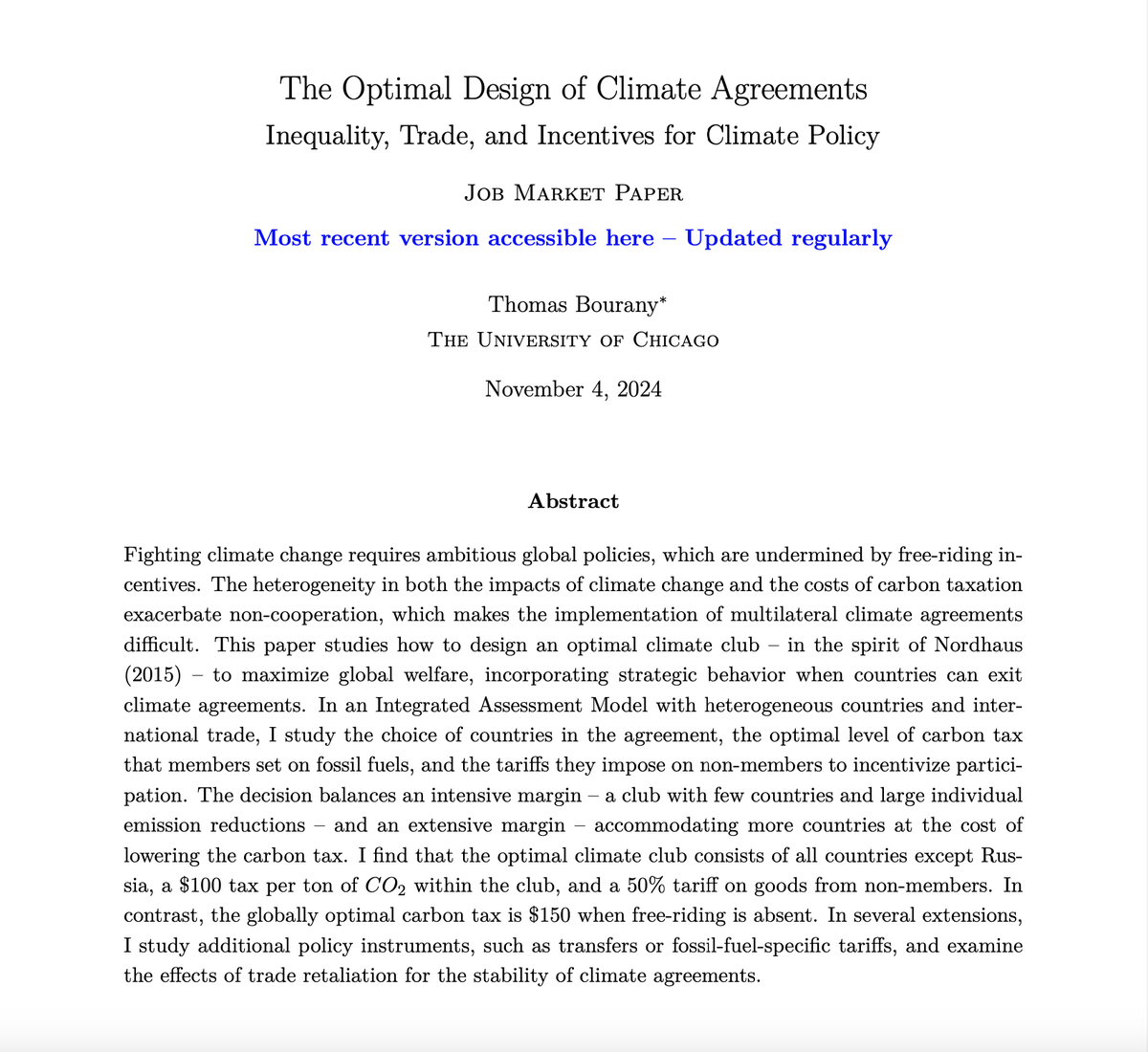
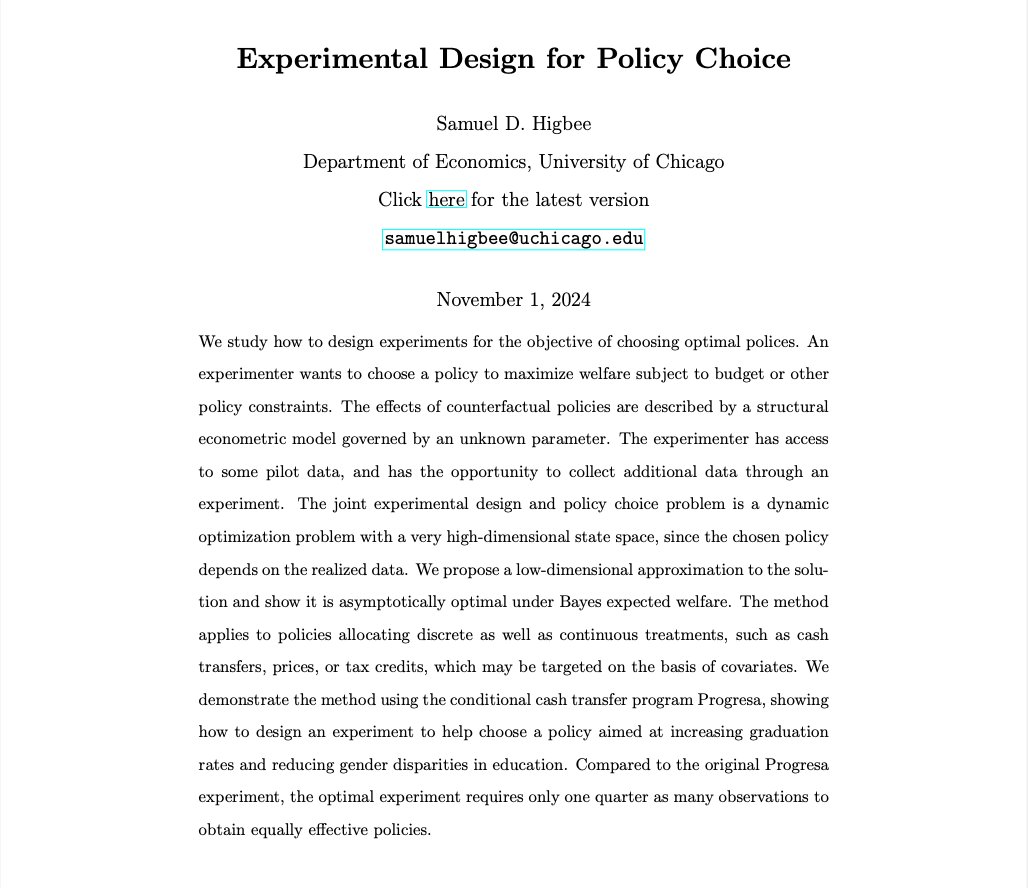
Thomas Bourany <a href="/TBourany/">Thomas Bourany</a> works at the intersection of Macroeconomics, Environmental Economics, and International Trade. In his JMP, he shows how to design optimal climate agreements to implement carbon policy in the presence of free-riding and inequality. thomasbourany.github.io
UChicago Economics (@uchi_economics) 's Twitter Profile Photo

How can we optimize experiments to inform policy decisions? @SamuelHigbee develops a two-wave adaptive experimental design which tailors the experiment to the objectives and constraints of policymakers. Read: samuelhigbee.github.io.

How can we optimize experiments to inform policy decisions? @SamuelHigbee develops a two-wave adaptive experimental design which tailors the experiment to the objectives and constraints of policymakers. Read: samuelhigbee.github.io.
UChicago Economics (@uchi_economics) 's Twitter Profile Photo

@SamuelHigbee How do social divisions shape the benefits of agglomeration? Shanon Hsuan-Ming Hsu's job market paper studies a 1950s ethnic-based resettlement in British Malaya, finding that while the clustering of Chinese created agglomeration economies, ethnic divisions limited gains for other groups.

@SamuelHigbee How do social divisions shape the benefits of agglomeration? <a href="/ShanonHMHsu/">Shanon Hsuan-Ming Hsu</a>'s job market paper studies a 1950s ethnic-based resettlement in British Malaya, finding that while the clustering of Chinese created agglomeration economies, ethnic divisions limited gains for other groups.
UChicago Economics (@uchi_economics) 's Twitter Profile Photo

@SamuelHigbee Shanon Hsuan-Ming Hsu Joshua Higbee Thomas Hierons (Tom Hierons) works in urban and spatial economics, international trade, and econometrics. In his job market paper, he studies the welfare gains from optimal congestion pricing with an application to New York City. Learn more at trhierons.github.io.
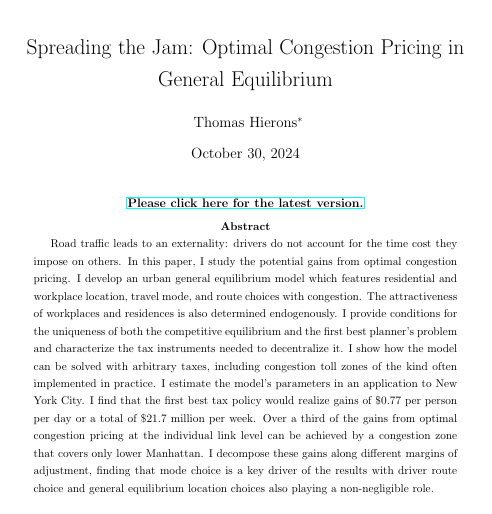
@SamuelHigbee <a href="/ShanonHMHsu/">Shanon Hsuan-Ming Hsu</a> <a href="/joshuadhigbee/">Joshua Higbee</a> Thomas Hierons (<a href="/tom_hierons/">Tom Hierons</a>) works in urban and spatial economics, international trade, and econometrics. In his job market paper, he studies the welfare gains from optimal congestion pricing with an application to New York City. Learn more at trhierons.github.io.
UChicago Economics (@uchi_economics) 's Twitter Profile Photo

Labor markets in LMICs have high turnover & unemployment, even with high demand. Through 3 field experiments, Varun K examines how limited commitment + liquidity constraints on both sides of the market cause mismatch in labor supply-demand, which partly explains this phenomenon.

Labor markets in LMICs have high turnover &amp; unemployment, even with high demand. Through 3 field experiments, Varun K examines how limited commitment + liquidity constraints on both sides of the market cause mismatch in labor supply-demand, which partly explains this phenomenon.
UChicago Economics (@uchi_economics) 's Twitter Profile Photo

.sasha petrov combines spatial GE modeling and computational methods to study economic effects of borders. His JMP develops tools to analyze both existing and optimal border configurations, evaluating welfare costs of post-colonial borders in Africa. sasha-petrov.com
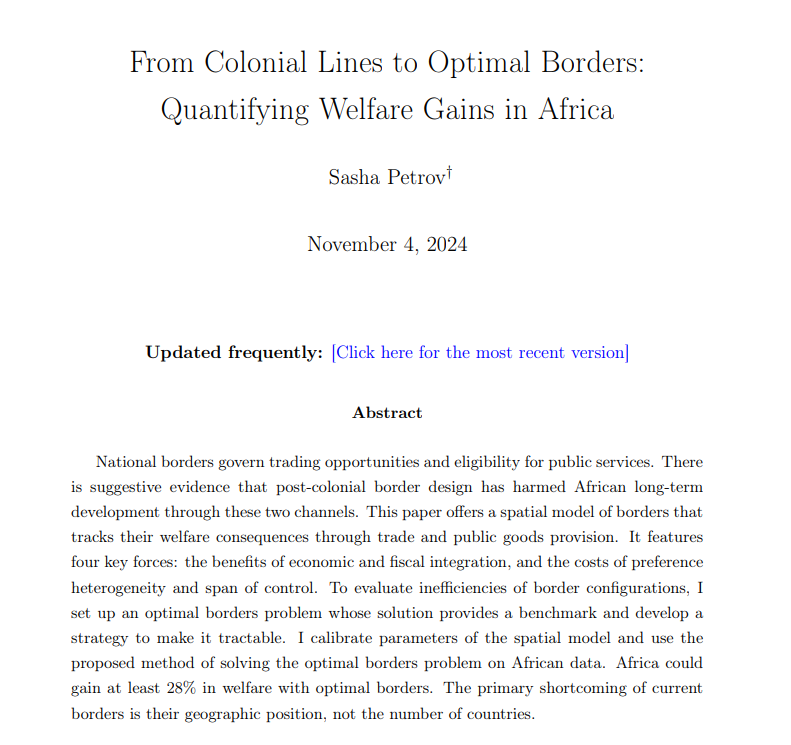
.<a href="/alexpetnet/">sasha petrov</a> combines spatial GE modeling and computational methods to study economic effects of borders. His JMP develops tools to analyze both existing and optimal border configurations, evaluating welfare costs of post-colonial borders in Africa. sasha-petrov.com
UChicago Economics (@uchi_economics) 's Twitter Profile Photo

sasha petrov How do workers sort between formal and informal sector jobs within the same industry? Tanya Rajan’s JMP collects data from Bangladeshi garment workers and quantifies the role of (1) search frictions and (2) preferences for nonwage amenities. Read more at: tanyarajan.com

<a href="/alexpetnet/">sasha petrov</a> How do workers sort between formal and informal sector jobs within the same industry? <a href="/tanyarajan/">Tanya Rajan</a>’s JMP collects data from Bangladeshi garment workers and quantifies the role of (1) search frictions and (2) preferences for nonwage amenities. Read more at: tanyarajan.com
UChicago Economics (@uchi_economics) 's Twitter Profile Photo

sasha petrov Tanya Rajan .Jordan Rosenthal-Kay studies spatial & trade economics. His JMP shows how barriers to urban expansion and high commuting costs inhibit development. Reducing urban costs would boost welfare by 66% in low-income nations and help nations adapt to climate change. jrosenthalkay.github.io

<a href="/alexpetnet/">sasha petrov</a> <a href="/tanyarajan/">Tanya Rajan</a> .<a href="/jordanr_k/">Jordan Rosenthal-Kay</a> studies spatial &amp; trade economics. His JMP shows how barriers to urban expansion and high commuting costs inhibit development. Reducing urban costs would boost welfare by 66% in low-income nations and help nations adapt to climate change. jrosenthalkay.github.io
UChicago Economics (@uchi_economics) 's Twitter Profile Photo

Camilla Schneier Jeanne Sorin (Jeanne Sorin) studies transportation and environmental challenges in developing cities. In her JMP, she examines how land acquisition costs prevent the implementation of high benefit road improvement projects in Kampala, Uganda. Read more at jeannesorin.github.io

<a href="/camillaschneier/">Camilla Schneier</a> Jeanne Sorin (<a href="/jenn_slg/">Jeanne Sorin</a>) studies transportation and environmental challenges in developing cities. In her JMP, she examines how land acquisition costs prevent the implementation of high benefit road improvement projects in Kampala, Uganda. Read more at jeannesorin.github.io
UChicago Economics (@uchi_economics) 's Twitter Profile Photo

When should governments target industries in specific places? Aditya Bhandari shows that optimal industrial policy is place-based when productivity is Hicks-neutral, but uniform when it is Harrod-neutral. Read more: economics.uchicago.edu/directory/adit… #UChicago #EconJobMarket

When should governments target industries in specific places? <a href="/ARBhandari97/">Aditya Bhandari</a> shows that optimal industrial policy is place-based when productivity is Hicks-neutral, but uniform when it is Harrod-neutral.

Read more: economics.uchicago.edu/directory/adit…

#UChicago #EconJobMarket
UChicago Economics (@uchi_economics) 's Twitter Profile Photo

Haruka Uchida studies labor & education. Her JMP runs 2 field experiments to measure & disentangle forms of discrimination. She finds that hiding applicant names changes representation without reducing quality. Read more: economics.uchicago.edu/directory/haru… #UChicago #EconJobMarket
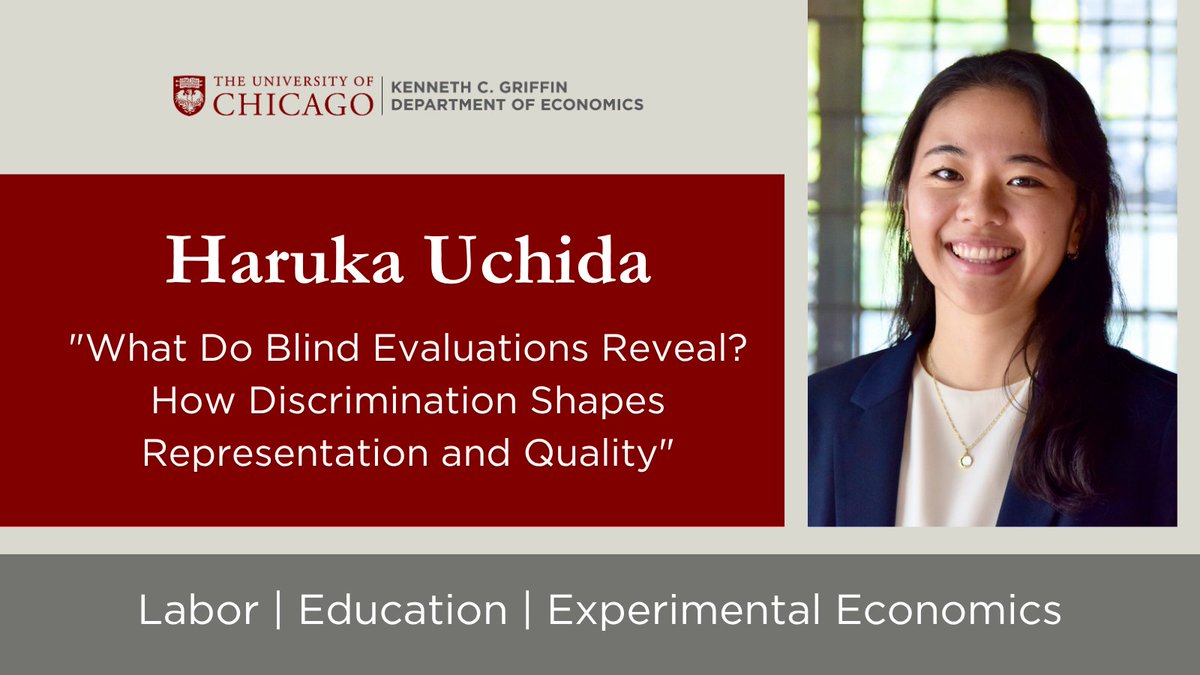

<a href="/haruka__uchida/">Haruka Uchida</a> studies labor &amp; education. Her JMP runs 2 field experiments to measure &amp; disentangle forms of discrimination. She finds that hiding applicant names changes representation without reducing quality.

Read more: economics.uchicago.edu/directory/haru…

#UChicago #EconJobMarket
Princeton Economics (@princetonecon) 's Twitter Profile Photo

Elena Aguilar’s (@tag_elena) job market paper studies location choices as a human capital investment. High-opportunity cities like New York offer superior learning environments but require paying high upfront housing costs. elena-aguilar.net

Elena Aguilar’s (@tag_elena) job market paper studies location choices as a human capital investment. High-opportunity cities like New York offer superior learning environments but require paying high upfront housing costs. elena-aguilar.net
UChicago Economics (@uchi_economics) 's Twitter Profile Photo

Michael Cuna’s JMP studies the hidden curriculum—unwritten rules for success. Combining data and field experiments, he finds first-gen students engage less in key actions, e.g. networking, due to low awareness. Read more: economics.uchicago.edu/directory/mich… #UChicago #EconJobMarket

<a href="/CunaMichae77590/">Michael Cuna</a>’s JMP studies the hidden curriculum—unwritten rules for success. Combining data and field experiments, he finds first-gen students engage less in key actions, e.g. networking, due to low awareness.

Read more: economics.uchicago.edu/directory/mich…

#UChicago #EconJobMarket
UChicago Economics (@uchi_economics) 's Twitter Profile Photo

Pharmacy exits cause temp. declines in medication use but long-run increases. Closure-induced reallocations to higher-dispensing pharmacies combined with meaningful impacts of pharmacies drive the increases. Read more about Joseph Battles: economics.uchicago.edu/directory/jose… #EconJobMarket
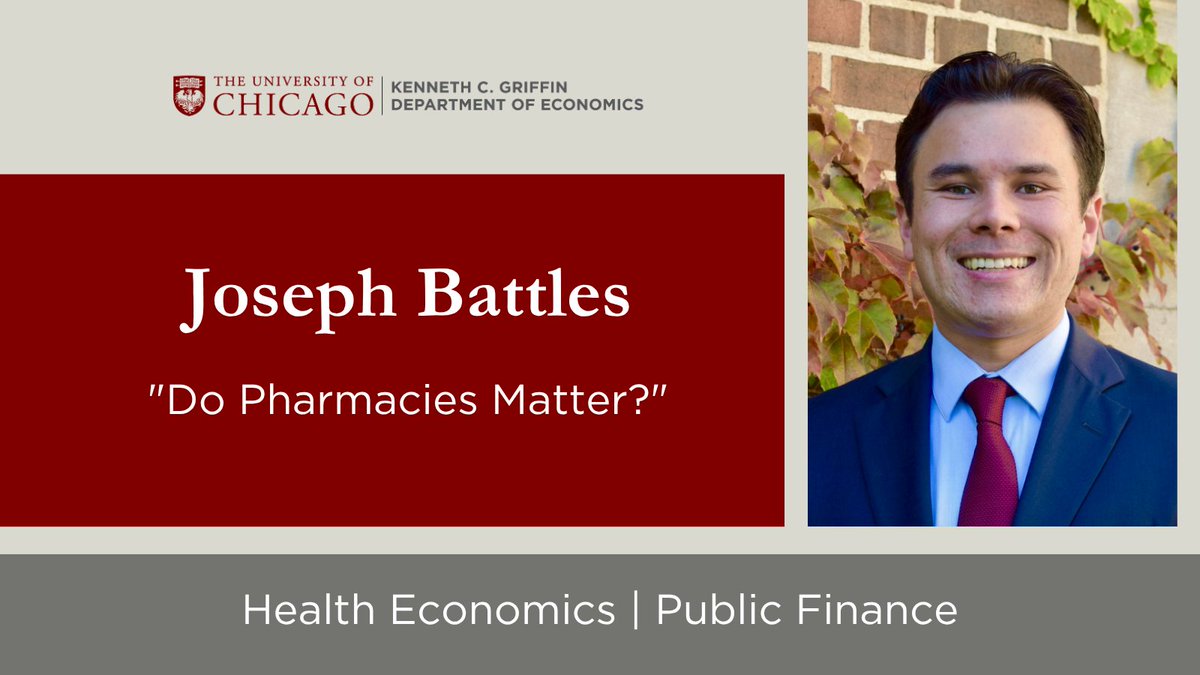
Pharmacy exits cause temp. declines in medication use but long-run increases. Closure-induced reallocations to higher-dispensing pharmacies combined with meaningful impacts of pharmacies drive the increases.

Read more about <a href="/econbattles/">Joseph Battles</a>: economics.uchicago.edu/directory/jose…

#EconJobMarket
UChicago Economics (@uchi_economics) 's Twitter Profile Photo

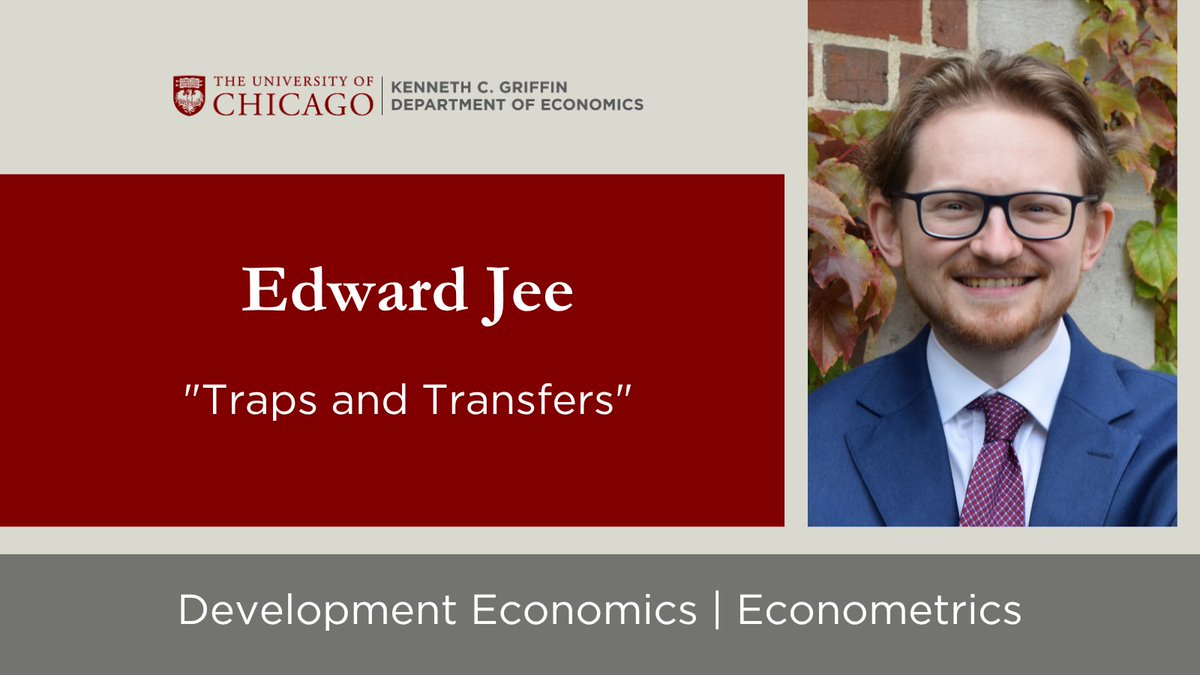
Do poverty traps exist? Ed Jee's study of 27 RCTs finds they're real but rare. Though fixed costs make traps common, forward-looking behavior & productivity differences mean they only affect 25% of households. Read more: economics.uchicago.edu/directory/edwa… #UChicago #EconJobMarket

Do poverty traps exist? <a href="/ed_jee/">Ed Jee</a>'s study of 27 RCTs finds they're real but rare. Though fixed costs make traps common, forward-looking behavior &amp; productivity differences mean they only affect 25% of households.

Read more: economics.uchicago.edu/directory/edwa…

#UChicago #EconJobMarket
Rachel Glennerster (@rglenner) 's Twitter Profile Photo

Balboni et al found poverty trap in Bangladesh due to fixed costs (eg to buy a cow) but is that unusual? Why cant ppl save up to buy the fixed asset? Ed Jee finds fixed costs of high return assets (diff by country) frequently cause traps but many ppl do save to overcome them.

UChicago Economics (@uchi_economics) 's Twitter Profile Photo

Conroy's JMP studies how to aggregate treatment effects across multiple outcomes. He evaluates several existing methods and proposes a new method for optimal aggregation that ensures weights with good properties. Read more: economics.uchicago.edu/directory/chun… #UChicago #EconJobMarket
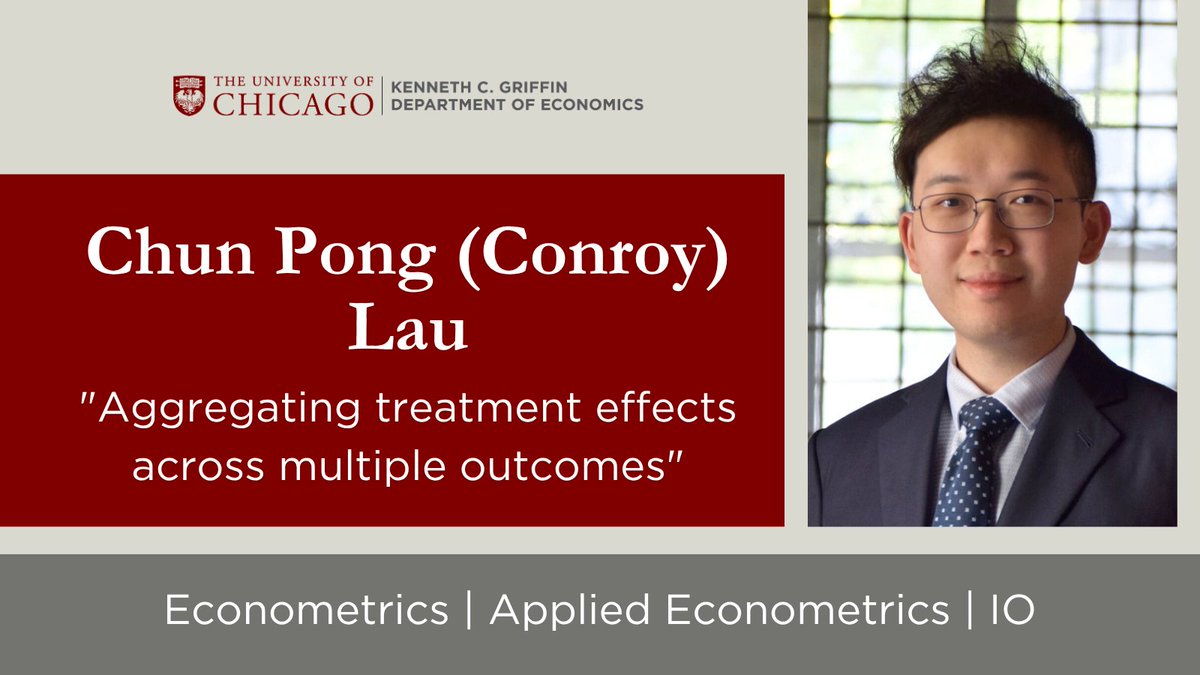
Conroy's JMP studies how to aggregate treatment effects across multiple outcomes. He evaluates several existing methods and proposes a new method for optimal aggregation that ensures weights with good properties.

Read more: economics.uchicago.edu/directory/chun…

#UChicago #EconJobMarket
Max Roser (@maxcroser) 's Twitter Profile Photo

My Our World in Data article this week looks at why, after two centuries of progress against the very worst poverty, the world is now facing a future in which progress comes to a halt. The end of progress against extreme poverty? ourworldindata.org/end-progress-e…

Anne Karing (@annekaring) 's Twitter Profile Photo

Ed's job market paper is a tour de force: 27 RCTs harmonized, fundamental identification challenges solved, and the clearest empirical evidence we have on poverty traps. Brilliant work from one of the most thoughtful, ambitious, and technically gifted young economists!